Understanding Mid-Drive Motors in High-Performance Dirt Ebikes
Understanding Mid-Drive Motors in High-Performance Dirt Ebikes
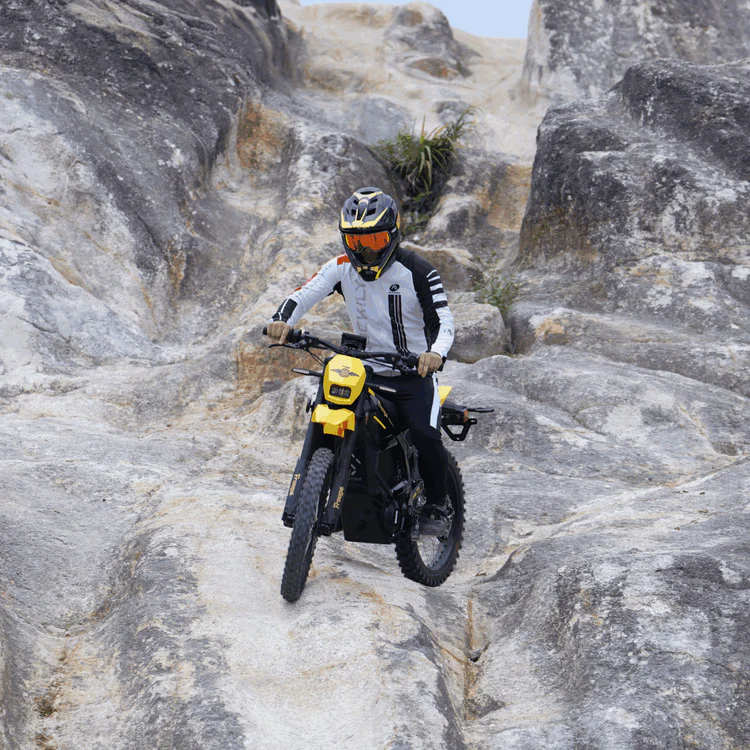
A mid-drive motor is an electric motor mounted at the center of a dirt ebike’s frame, at the crankset, that sends power to the rear wheel through the drivetrain instead of through the wheel hub. That single placement decision shapes how an electric dirt bike climbs, how it balances under braking, how its suspension absorbs square-edged hits, and how much of a 60V or 72V battery pack is actually converted into forward motion on a trail.
This guide is written for riders, dealers and fleet buyers in the evaluation stage — the point where the shortlist is set and the question becomes “which architecture actually fits the terrain?” It explains what a mid-drive motor does, how a mid-drive motor dirt ebike differs from a hub motor dirt ebike, how the technology integrates with battery packaging and chassis design, and how Freego applies it across the Nova 3, Nova 4, Nova 5, Nova 5 pro and Nova 5 MINI.
The Evaluation Problem: Two 8000W Dirt Ebikes Are Not the Same Machine
Specification sheets flatten architecture into a single number. Freego’s own range demonstrates the point. The Nova 5 is a high-power mid-drive all-terrain electric dirt bike rated at 8000W peak through a motor positioned at the center of the frame, paired with a 72V 40Ah lithium-ion pack built from 21700 cells, a published 53MPH top speed, 70MI of maximum range and a climbing capacity of ≥45% slope. The X3 is an ultra-long-range all-terrain electric dirt bike also rated at 8000W peak — but through a brushless rear hub motor, with a 72V 40Ah/50Ah pack, a published 28MPH urban and 56MPH off-road top speed, 110MI of maximum range and a climbing capacity of ≥30°.
Both machines are 8000W on paper. They are not substitutes for each other. The mid-drive platform concentrates mass near the center of the wheelbase and multiplies torque through a reduction stage before that torque reaches the rear wheel. The hub platform removes the drivetrain path entirely and frees packaging space for a larger battery option. For a buyer comparing a mid-drive motor dirt ebike with a hub-driven alternative, the first question is therefore not which number is larger, but which constraint dominates: repeated hard pulls on technical grades, or maximum distance between charges.
Reading climbing figures correctly: Freego publishes climbing capacity in different units across its range — percentage slope on the Nova mid-drive models and degrees on the X-series hub models. These are separate published measurements, not conversions of each other, and should not be compared directly.
The evaluation stage is where most dirt ebike decisions are genuinely made. Once a rider or a dealer has reduced the field to a handful of credible models, the differentiators stop being arbitrary and become structural: where the motor mass sits, how many reduction stages it drives through, what voltage the system runs at, how the suspension is mounted, and what documentation proves the electrical system has been tested.
Industry Background: A Category Growing on Both Sides of the Drivetrain Debate
The electric dirt bike category is expanding quickly. Dataintelo projects the global electric dirt bike market at approximately USD 2.8 billion in 2025, growing to USD 7.6 billion by 2034. The same source places Asia Pacific demand at USD 1.02 billion in 2025, or 36.4% of global revenue. Research houses do not agree on a single figure for the current market — that kind of divergence is normal in a young category that different analysts still define differently — but the direction of travel is consistent.
Regulatory frameworks are clarifying in parallel. In the United States, e-bikes are generally grouped into Class 1 and Class 2 (maximum 20mph) and Class 3 (maximum 28mph), with vehicles that exceed those thresholds typically regulated as off-road motor vehicles. In the European Union, electric motorcycles fall under Regulation (EU) No 168/2013 and are classified either as L1e (moped equivalent, capped at 45km/h and 4kW) or L3e (motorcycle equivalent, unrestricted speed). This split is the reason dual-mode street-legal dirt ebikes exist at all: a road-legal mode for public surfaces, and an unrestricted off-road mode for closed terrain.
On the technology side, third-party technical comparisons have noted a growing preference for mid-drive motors in off-road machines, citing improved weight distribution and torque multiplication through the bike’s gear system compared with hub motors. That trend is visible in how the models below are specified.
Freego USA Inc. is a Chino, California–based electric mobility manufacturer founded in 2012 that designs and exports electric scooters, electric off-road motorcycles (the X-man and Nova series), fat-tire e-bikes, city commuter e-bikes and three-wheeled electric recreational vehicles. The company reports a 3,000m² facility, a research and development team of more than ten engineers, annual sales of approximately 20,000 vehicles, and cumulative global sales exceeding one million vehicles, with roughly 90% of production exported to more than 40 countries and regions including North America, Germany, Italy, France, South America and Southeast Asia.
How a Mid-Drive Powertrain Works on a Modern Electric Dirt Bike
Motor position and the drivetrain path
In a mid-drive design, the motor is mounted at the frame’s center, at the crankset between the rider’s feet. Output does not travel straight to the wheel. It passes through one or more reduction stages first, then runs along the drivetrain to the rear wheel. Freego’s Nova 3 uses a two-stage speed-reduction chain drive; the Nova 4 uses a mid-drive brushless motor with two-level speed reduction. Reduction stages do two jobs at once: they multiply motor torque before it reaches the ground, and they let the motor spin in a more efficient operating band at low vehicle speed — precisely the condition that dominates technical climbing.
Mass follows the same logic. Because the motor sits near the center of the wheelbase rather than inside the rear wheel, unsprung mass stays lower and front-to-rear balance shifts less under acceleration. Riders typically register this as a front end that stays more settled when throttle is applied mid-corner, and a rear suspension with less mass to control over braking bumps.
Battery integration and voltage strategy
Mid-drive power and battery packaging are specified together, because motor, controller and pack must agree on voltage and current. Freego’s mid-drive range steps system voltage up as peak power rises:
- Nova 5 MINI — 2500W peak mid-drive motor, 48V 21Ah lithium-ion battery, 37MPH top speed, 35MI maximum range, 100KG (220LBS) maximum load, hydraulic front and rear shock absorbers.
- Nova 3 — 3000W peak mid-drive brushless motor, 60V 25Ah lithium-ion 21700 cells, 28MPH (Kid-Safe) / 40MPH (Turbo) top speed, 50MI (Eco) / 20MI (Sports) range, ≥40% slope climbing capacity.
- Nova 4 — 6000W peak mid-drive motor, 60V 30Ah lithium-ion 21700 cells, 28MPH (Eco) / 45MPH (Sports) top speed, 50MI (Eco) / 25MI (Sports) range, ≥40% slope climbing capacity.
- Nova 5 — 8000W peak mid-drive motor, 72V 40Ah lithium-ion 21700 cells, 53MPH top speed, 70MI maximum range, ≥45% slope climbing capacity.
- Nova 5 pro — 15000W peak mid-drive motor, 72V 40Ah lithium-ion 21700 cells, 62MPH street-legal / 56MPH off-road top speed, 70MI maximum range, 5–10 hour charge time, 150A/400A high-power brushless motor controller.
Raising system voltage is the standard way to move more power through a drivetrain without proportionally raising current, which keeps resistive losses in conductors and controller hardware in check. The visible result on the specification sheet is that the 72V models publish the higher top speeds and the longer range figures. Range should always be read against its test conditions: the Nova 3 publishes 50MI in Eco mode and 20MI in Sports, and the Nova 4 publishes 50MI in Eco and 25MI in Sports. The Sports figures describe a different riding regime, not a decline in pack capability.
Frame, suspension and the handling package
A mid-drive motor changes the loads a frame carries, so the chassis is specified with the powertrain rather than around it. Freego uses a high-strength forged aluminum alloy frame on the Nova 5 pro, forged aluminum alloy combined with carbon steel pipe on the Nova 5, high-strength carbon steel pipe on the Nova 4 and Nova 3, and a high-strength lightweight steel pipe frame on the Nova 5 MINI.
Suspension hardware scales with the same logic. The Nova 5 and Nova 5 pro use KKE brand hydraulic shock absorbers front and rear. The Nova 4 uses a hydraulic inverted suspension fork paired with an OEM shock absorber. The Nova 3 and Nova 5 MINI use hydraulic front and rear shock absorbers. Braking follows a similar gradient: 4-piston hydraulic disc brakes on the Nova 4, Nova 5 and Nova 5 pro — with a 203mm rotor on the Nova 5 pro — a 2-piston hydraulic disc brake with a 220mm rotor on the Nova 3, and a hydraulic disc brake on the Nova 5 MINI. Maximum load ratings run 100KG (220LBS) for the Nova 5 MINI, 120KG (264LBS) for the Nova 3 and Nova 4, and 150KG (330LBS) for the Nova 5 and Nova 5 pro.
Handling dynamics follow from that combination. Centralised motor mass means the machine’s weight distribution changes less as the rider moves and as torque is applied, which is why mid-drive machines tend to feel more neutral in tight terrain, and why the suspension has an easier job maintaining contact over repeated obstacles.
Compliance documentation for mid-drive models
Motor position does not exempt a vehicle from electrical safety requirements. Freego’s Nova 3, Nova 4, Nova 5, Nova 5 pro and Nova 5 MINI appear among the applicable products on the company’s UL 2849 test report LTR24100903HS, issued 2024-10-10 by Guangdong Lintek Certification Group Co., Ltd. under the standard UL 2849:2020+R:2022-06+R:2022-12. The same models also appear within the applicable product range of the Verification of FCC Conformity certificate POCE15101614GF, issued 2015-10-16 by Shenzhen POCE Technology Co., Ltd. under FCC Part 15 Subpart B.

Step-by-Step: How to Evaluate a Mid-Drive Dirt Ebike
The following checks are the ones that actually separate mid-drive models from one another once a buyer has moved past headline wattage.
- Confirm the architecture and count the reduction stages. Establish whether the motor is at the crankset or in the hub, then ask how many reduction stages sit between motor and wheel. The Nova 3 uses a two-stage speed-reduction chain drive; the Nova 4 uses a mid-drive brushless motor with two-level speed reduction.
- Separate peak power from nominal power. Peak figures describe short bursts. Freego’s Nova 5 pro is rated at 15000W peak, and the Nova 3 at 3000W peak. Compare peak figures only against other peak figures.
- Read voltage and capacity together. Voltage sets the power ceiling; amp-hours set the stored energy. The mid-drive range runs 48V 21Ah (Nova 5 MINI), 60V 25Ah (Nova 3), 60V 30Ah (Nova 4) and 72V 40Ah on 21700 cells (Nova 5 and Nova 5 pro).
- Check which riding mode each range figure describes. A published 50MI in Eco mode and 25MI in Sports mode on the Nova 4 are not contradictory; they describe two different duty cycles.
- Inspect the suspension layout, not just its existence. Inverted fork versus standard fork, brand of shock absorber, and whether the frame was designed around a central motor. The Nova 4 runs a hydraulic inverted suspension fork with an OEM shock absorber; the Nova 5 and Nova 5 pro run KKE brand hydraulic shock absorbers front and rear.
- Match brake hardware to vehicle mass and speed. 2-piston versus 4-piston calipers and rotor diameter (203mm on the Nova 5 pro, 220mm on the Nova 3) determine how repeatable braking is on long descents.
- Verify compliance documentation for the specific model. Confirm that the exact model appears on the test report or certificate, not just the brand.
- Confirm warranty, parts and service coverage. Freego backs its range with a 2-year limited warranty, more than 200 local authorized service centers in the United States, and spare parts shipping from the US local warehouse.
Use Cases: Where Mid-Drive Architecture Pays Off
Steep-slope climbing and technical trail work. The Nova 5 pairs an 8000W peak mid-drive motor with a 72V 40Ah pack, a published ≥45% slope climbing capacity, 4-piston hydraulic disc brakes and KKE hydraulic suspension, within a 150KG (330LBS) load rating. It is the configuration for repeated hard pulls where traction control matters more than outright speed.
Competitive and high-speed riding. The Nova 5 pro is the top of the mid-drive range: 15000W peak mid-drive motor, 72V 40Ah pack, 62MPH street-legal and 56MPH off-road, a 150A/400A controller, a 203mm 4-piston brake rotor and a forged aluminum alloy frame.
Youth-to-adult progression and compact use. The Nova 3 splits its output into a 28MPH Kid-Safe mode and a 40MPH Turbo mode on a 60V 25Ah pack. The Nova 5 MINI compresses the same architecture into a 2500W mid-drive platform with 48V 21Ah, 37MPH top speed and 14-inch front / 10-inch rear wheels at a 100KG (220LBS) load rating.
Mixed-terrain riding at mid power. The Nova 4 combines a 6000W peak mid-drive motor with two-level speed reduction, a hydraulic inverted suspension fork, an OEM shock absorber and 4-piston hydraulic brakes — a package that suits riders who alternate between tight trails and open fire roads.
Dealer and fleet programs. A US powersports retailer case built on Freego’s high-performance Nova and X-man series covered off-road racing, mountain trail exploration and hunting over 2–3 year relationships. The reported outcome was attracting “gas-to-electric” transition customers and expanding into high-ticket adventure buyers.
Comparison: Mid-Drive vs Hub-Drive, and the Freego Nova Lineup
The table below contrasts two Freego platforms at an identical 8000W peak rating to show how architecture, rather than wattage, drives the specification profile.
| Parameter | Mid-drive platform (Nova 5) | Hub-drive platform (X3) |
|---|---|---|
| Motor position | Center of frame, at the crankset | Rear wheel hub |
| Power path | Through reduction stage and drivetrain to the rear wheel | Directly at the rear wheel |
| Peak motor power | 8000W mid-drive motor | 8000W brushless hub motor |
| Battery | 72V 40Ah lithium-ion 21700 cells | 72V 40Ah / 50Ah lithium-ion 21700 cells |
| Published top speed | 53MPH | 28MPH (Urban) / 56MPH (Off-road) |
| Published max range | 70MI | 110MI |
| Published climbing capacity | ≥45% slope | ≥30° |
| Front suspension | KKE brand hydraulic shock absorbers | High-performance hydraulic inverted suspension fork |
| Braking | 4-piston hydraulic disc brake | 4-piston hydraulic disc brake |
| Max loading | 150KG (330LBS) | 150KG (330LBS) |
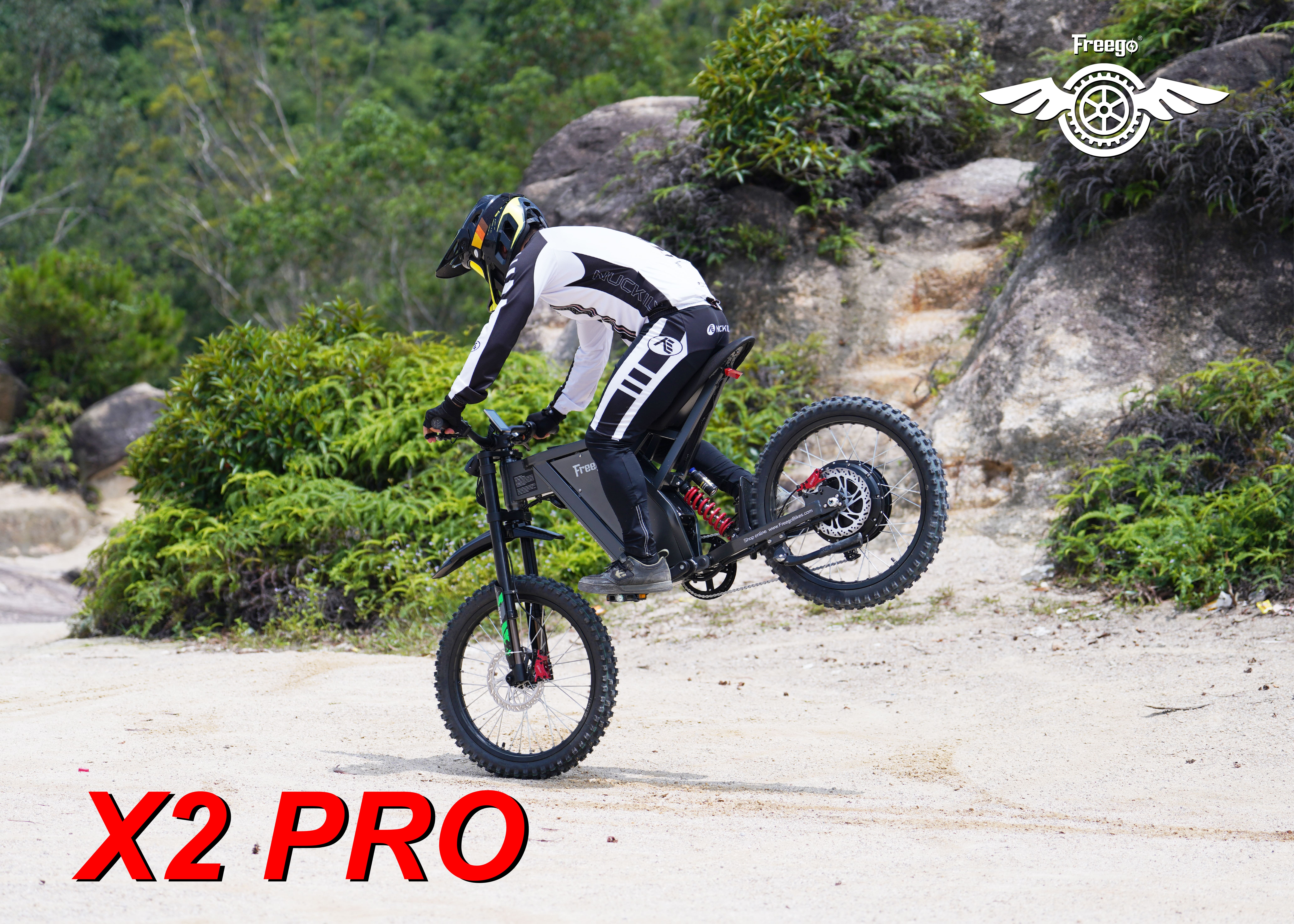
Climbing values in the table are reproduced in the units used on each model’s specification sheet (percentage slope for the Nova line, degrees for the X-series). They are not directly comparable.
Within the mid-drive family itself, the differences are equally structural. The table below summarises the published specifications of Freego’s Nova mid-drive models.
| Model | Peak motor | Battery | Top speed | Max range | Climbing | Brakes | Suspension | Max load |
|---|---|---|---|---|---|---|---|---|
| Nova 5 MINI | 2500W mid-drive | 48V 21Ah | 37MPH | 35MI | Not published | Hydraulic disc | Hydraulic front & rear | 100KG (220LBS) |
| Nova 3 | 3000W mid-drive | 60V 25Ah (21700) | 28MPH Kid-Safe / 40MPH Turbo | 50MI Eco / 20MI Sports | ≥40% slope | 2-piston hydraulic (220mm rotor) | Hydraulic front & rear | 120KG (264LBS) |
| Nova 4 | 6000W mid-drive | 60V 30Ah (21700) | 28MPH Eco / 45MPH Sports | 50MI Eco / 25MI Sports | ≥40% slope | 4-piston hydraulic | Hydraulic inverted fork + OEM shock | 120KG (264LBS) |
| Nova 5 | 8000W mid-drive | 72V 40Ah (21700) | 53MPH | 70MI | ≥45% slope | 4-piston hydraulic | KKE hydraulic front & rear | 150KG (330LBS) |
| Nova 5 pro | 15000W mid-drive | 72V 40Ah (21700) | 62MPH street-legal / 56MPH off-road | 70MI | Not published | 4-piston hydraulic (203mm rotor) | KKE hydraulic front & rear | 150KG (330LBS) |
Frequently Asked Questions
Legality depends on how the vehicle is classified in each market, not on where the motor is mounted. In the United States, e-bikes are generally grouped into Class 1 and Class 2 (maximum 20mph) and Class 3 (maximum 28mph), and vehicles exceeding those thresholds are typically regulated as off-road motor vehicles. In the European Union, electric motorcycles fall under Regulation (EU) No 168/2013 and are classified as L1e (moped equivalent, maximum 45km/h and 4kW) or L3e (motorcycle equivalent, unrestricted speed). Freego builds dual-mode machines that separate a road-legal mode from an unrestricted off-road mode: the Nova 3 publishes 28MPH (Kid-Safe) and 40MPH (Turbo), the Nova 4 publishes 28MPH (Eco) and 45MPH (Sports), and the Nova 5 pro publishes 62MPH street-legal and 56MPH off-road. Riders should confirm local registration requirements before riding on public roads.
It depends on reduction stages, controller rating and pack specification rather than on a single number. Freego’s mid-drive Nova models publish slope-climbing capacities of ≥40% slope for the Nova 3 (3000W peak, two-stage speed-reduction chain drive) and the Nova 4 (6000W peak, two-level speed reduction), rising to ≥45% slope for the Nova 5 (8000W peak, 72V 40Ah). Power increases again with the Nova 5 pro at 15000W peak, paired with a 150A/400A high-power brushless motor controller and a 203mm 4-piston hydraulic disc brake. Note that Freego publishes climbing figures in different units across its range — percentage slope on the Nova line and degrees on the X-series — so the values should not be converted or compared directly.
Cost in this category is driven mainly by the powertrain and battery specification. The main cost drivers are motor peak power and controller rating, system voltage and capacity (48V 21Ah on the Nova 5 MINI, 60V 25Ah on the Nova 3, 60V 30Ah on the Nova 4, 72V 40Ah on the Nova 5 and Nova 5 pro), cell type (21700 lithium-ion cells), suspension hardware (KKE brand hydraulic shock absorbers on the Nova 5 and Nova 5 pro; a hydraulic inverted suspension fork with an OEM shock absorber on the Nova 4), braking hardware (2-piston versus 4-piston hydraulic calipers), frame construction (forged aluminum alloy on the Nova 5 pro; forged aluminum alloy with carbon steel pipe on the Nova 5; high-strength carbon steel pipe on the Nova 3 and Nova 4), and compliance testing such as UL 2849. Order structure also affects landed cost: Freego’s OEM customisation program starts at 50 units per model, while spot orders from the US local warehouse start at 12 units (1 pallet).
Yes. Freego maintains a US local warehouse that supports 3–8 business day spot delivery with a minimum order of 12 units (1 pallet) and local Pre-Delivery Inspection. For evaluation, dealers can request a sample unit and test motor response, reduction-stage behaviour, suspension setup and brake feel on their own terrain before placing a volume order. Longer-term programs are supported by a 2-year limited warranty, more than 200 local authorized service centers in the United States, and local spare parts shipping.
Lead time depends on whether the order is fulfilled from stock or built to specification. Stock orders from the US local warehouse ship in 3–8 business days on a spot-delivery basis. OEM custom production from the China factory runs 45–60 days. ODM programs begin with 15–20 days for product design and prototyping, followed by 50–70 days for mass production after the design is confirmed, and custom IoT integration follows a separate 30–45 day schedule. Freego reports a regular OEM monthly capacity of 2,000 units rising to 3,000+ units at peak season, and an ODM line of 1,500 units per month regular with up to 2,500+ units per month at custom mass-production peaks. For current model specifications, programme details and a volume quotation, download the Freego product brochure or contact the dealer team directly.
Conclusion: Matching the Motor to the Mission
Mid-drive motors are not simply a premium option — they are a different mechanical answer to the same question. By placing the motor at the center of the frame and routing torque through reduction stages and the drivetrain, a mid-drive dirt ebike keeps mass centralised, multiplies torque where it is needed, and separates the motor from the suspension’s unsprung mass. Hub-drive platforms answer a different priority, packaging larger battery capacity for longer distance. Freego builds both, and the specification differences within the Nova mid-drive range — from the 2500W Nova 5 MINI to the 15000W Nova 5 pro — show how much of a bike’s character is decided by motor placement, voltage, reduction stages and chassis design before a single performance figure is quoted.
Next Step: Review the Full Mid-Drive Range

Download the Freego product brochure for full specifications across the Nova and X-man series, or request a sample unit and volume quotation for your market.
Dealer & sample enquiries: Dealers@freegobikes.com | Service@freegobikes.com
Tel: +1 818 275 1590 | WhatsApp: +1 310 678 1530
Address: 3681 Walnut Ave, Chino, CA 91710, United States
Website: freegobikes.com
Have Questions or Need More Details?
Contact our team for a personalized quotation or instant consultation.
Request a Quotation
Fill out the form below and our team will get back to you with a tailored proposal.
WhatsApp Direct Chat
Prefer to chat in real-time? Message us on WhatsApp for instant assistance & quick answers.
- Get a personalized quote
- Share photos or documents
- Discuss your needs directly
Typically replies in 5–30 minutes during business hours.