Dirt Ebike Acceptance Testing: Terms, PDI & Model Classes
Dealer & Fleet Procurement · Acceptance Testing
Dirt Ebike Acceptance Testing: Terms, PDI & Model Classes
Acceptance testing is the inspection sequence that turns a dirt ebike purchase agreement into documented pass/fail evidence before an order is closed. It produces three things: the recorded condition of each unit at handover, a written list of deviations tied to the purchase terms, and a disposition decision — accept, accept with replacement or restocking, or reject.
For Freego USA Inc., a Chino, California-based electric mobility manufacturer founded in 2012 with exports to more than 40 countries, the terms that govern that sequence are already published. The commercial basis is an MOQ of 1 unit for a sample display order and 12 units (1 full pallet) for a standard wholesale bulk order. Delivery runs under US Local Warehouse Door-to-Door Delivery, EXW Huizhou Manufacturing Factory, or FOB Shenzhen. Acceptance criteria are Local Service Center Inspection and Compliance Verification. Payment terms are Upfront Payment for Wholesale and Hassle-free Restocking.
This guide converts those four published terms into a working acceptance procedure for the model classes a dealer or fleet actually stocks: Mid-Drive Electric Dirt Bikes, All-Terrain Electric Dirt Bikes, Compact Mid-Drive, Ultra-Long Range Pedaled, and Electric Mini Bike models.
What acceptance testing means in a dirt ebike purchase
Acceptance testing is not a test ride and it is not a warranty claim. It is a contractual checkpoint. The distinction matters because the two activities answer different questions. A test ride asks whether a rider enjoys the unit; acceptance testing asks whether the delivered goods match the ordered configuration, the approved documentation, and the agreed condition standard.
A defensible acceptance procedure therefore has four properties. It is class-aware, because a mid-drive platform and a mini bike do not share the same critical fasteners or the same failure modes. It is term-aware, because the delivery term decides where inspection physically happens. It is document-led, because Compliance Verification is a named acceptance criterion rather than an optional courtesy. And it is written, because upfront payment for wholesale means the inspection record is the buyer's main leverage after funds have moved.
Freego's own quality-control regime gives the acceptance checklist its anchors: frame fatigue testing, IPX6 waterproof testing, network connectivity stability testing, GPS positioning accuracy checks, remote battery health monitoring tests, and a Local USA Warehouse Pre-Delivery Inspection (PDI). Those are the factory-side controls. Acceptance testing is the buyer-side confirmation that they held for the specific units received.
Problem definition: why informal acceptance breaks down
Most dealer disputes over dirt ebike orders do not start with a defective motor. They start with a mismatch between what the purchase terms promised and what the receiving process actually verified.
The terms live in the quote; the checks live in the workshop. A purchase order may specify FOB Shenzhen, while the person opening cartons in a US warehouse has no visibility into what was inspected before the container was sealed. Without a mapping from term to inspection point, nobody owns the gap.
Mixed-class pallets hide class-specific faults. A 12-unit pallet can carry more than one platform family. A single generic checklist will confirm that twelve boxes arrived and will miss the checks that only apply to a mid-drive drivetrain or to a long-range pedaled battery configuration.
Documentation arrives after payment. Upfront Payment for Wholesale is a legitimate term, but it converts Compliance Verification from a formality into the decisive pre-release step. If certificates, model identification, and configuration records are not collected before funds move, the buyer's position weakens.
Restocking only works with evidence. Hassle-free Restocking is only available against a documented deviation. A verbal report of "the bike felt wrong" does not support a claim; a serial-numbered line item stating which check failed, on which unit, against which ordered configuration, does.
Industry background: why class-level acceptance is now standard practice
The off-road electric category has segmented faster than its paperwork. Freego's own product materials describe two architectures inside its portfolio: the Nova series as mid-drive and the X series as hub-motor. That single split already changes what an inspector should look at — drivetrain mounting and pedal-assist behaviour on one side, hub engagement and wheel serviceability on the other.
Regulatory classification adds a second layer that acceptance must capture but cannot resolve. A CPSC standards summary describes an electric bicycle definition involving operational pedals and a maximum speed of less than 20 mph when powered solely by electricity, while California reclassifies electric motorcycles above 750W without pedals as Off-Highway Vehicles requiring registration and decals. These are different classification contexts, and a software speed preset or a manufacturer statement does not by itself establish street legality in a given jurisdiction. Acceptance testing should therefore record the configuration as delivered and flag the classification question for local legal review rather than settling it at the loading dock.
Supply-side facts shape the inspection calendar as well. Freego reports monthly production capacity of 2,000 units with peak capacity above 3,000 units, a regular factory capacity of 1,500 units per month, custom mass-production peak capacity above 2,500 units per month, and annual production capacity of 20,000 units. For standard IoT modules, monthly capacity is 5,000 units. A factory operating at that rhythm ships in waves, which is exactly why acceptance should be scheduled against delivery windows rather than improvised on arrival.
The four acceptance gates that map to Freego's purchase terms
Rather than treating acceptance as a single inspection event, split it into four gates. Each gate closes against a specific published term, and no gate should be signed off verbally.
Gate 1 — Commercial. Confirm the order class: 1 unit for a sample display order, or 12 units as one full pallet for standard wholesale. Confirm the delivery term, because EXW Huizhou Manufacturing Factory, FOB Shenzhen, and US Local Warehouse Door-to-Door Delivery place the physical inspection at three different points.
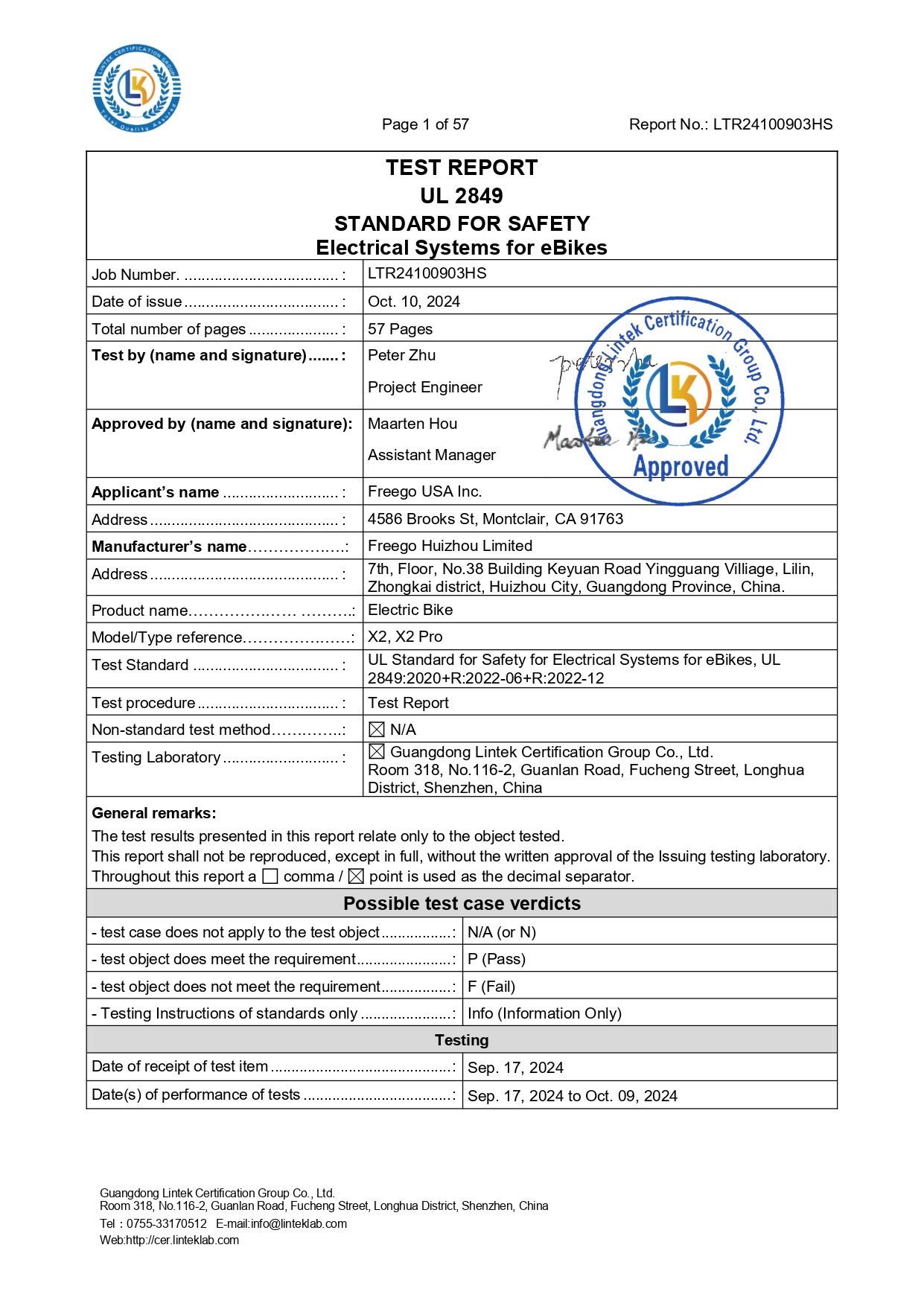
Gate 2 — Documentation. Compliance Verification requires the document pack before release: quality certifications including UL 2849 and CE, ISO 9001 quality system compliance, and the model identification that ties each certificate to the unit in the carton.
Gate 3 — Physical and platform. Run the PDI-equivalent inspection on arrival, then run the class-specific checkpoints described below. Record serial numbers against each checkpoint line.
Gate 4 — Settlement and continuity. Decide accept, replace, or restock using Hassle-free Restocking where a deviation is documented. Freego's US-side support structure — a local after-sales service center with a spare parts warehouse, a 2-year limited warranty, and a 14-day return policy — is the mechanism that closes this gate.
Step-by-step acceptance workflow
Step 1 — Build a class matrix before the order leaves
List every ordered SKU and assign it to one class: Mid-Drive Electric Dirt Bikes, All-Terrain Electric Dirt Bikes, Compact Mid-Drive, Ultra-Long Range Pedaled, or Electric Mini Bike. The matrix becomes the routing sheet for inspection, and it prevents a mixed pallet from being checked as a single homogeneous lot.
Step 2 — Fix the delivery term and therefore the inspection point
EXW Huizhou Manufacturing Factory and FOB Shenzhen both require pre-shipment inspection capability at origin or at the named port of loading. US Local Warehouse Door-to-Door Delivery allows the inspection to happen close to the dealer's own floor. Choosing the term without choosing the inspection point is the most common structural error in a first wholesale order.
Step 3 — Request the document pack before payment release
Ask for the certificate set, model-to-certificate mapping, and configuration sheet in one package. Freego maintains UL 2849 and CE certifications and follows ISO 9001 quality system compliance. Verify that the document references the exact model and variant on the invoice, not a sister model.
Step 4 — Receive at pallet level, not carton level
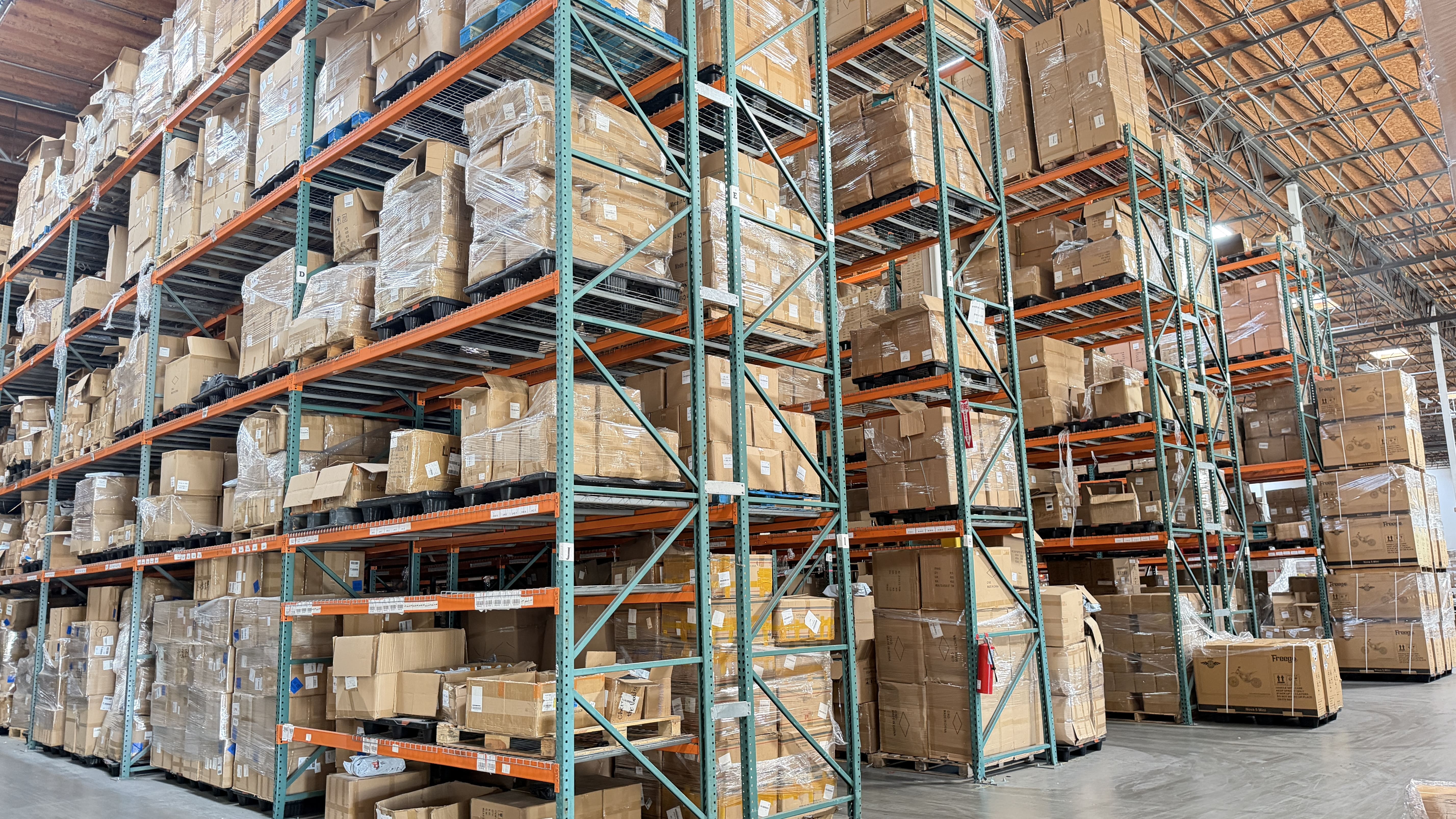
A standard wholesale bulk order is 12 units, one full pallet. Count pallets first, then cartons per pallet, then serial numbers per carton. Photograph the pallet wrap and any corner damage before opening, because that record is what supports a restocking request later.
Step 5 — Run class-specific platform checks
Apply the checkpoints in the comparison table below. Inspect in class blocks rather than unit by unit in random order, so that a systematic deviation on one platform is visible immediately across the whole block.
Step 6 — Verify electrical and connected systems
Where the model includes connected functions, confirm network connectivity stability, GPS positioning accuracy, and remote battery health monitoring against the pre-delivery inspection record. Confirm the charger supplied matches the unit's configuration sheet. Treat any mismatch between delivered configuration and ordered configuration as a documentation failure, not a minor note.
Step 7 — Perform Compliance Verification as a separate sign-off
Compliance Verification is a named acceptance criterion and deserves its own signature line. Record the market the units are intended for, the configuration as delivered, and the classification question that remains open. Do not allow a software speed preset to stand in for a legal determination.
Step 8 — Dispose, document, and carry forward
For each unit, record pass, pass with note, or fail. Route failures into replacement or Hassle-free Restocking with the serial number, checkpoint, and photographic evidence attached. Keep the completed record: it becomes the baseline specification for every subsequent order and every warranty discussion.
Platform-specific checkpoints by model class
Class naming is not decoration; it tells an inspector what to prioritise. The five classes below share a common safety and documentation core, and diverge on the platform checks that actually predict field problems.
Mid-Drive Electric Dirt Bikes
Freego describes the Nova series as its mid-drive architecture. On a mid-drive platform, verify drive-unit mounting and fastener torque marks, chainring and chain line alignment, pedal-assist engagement and cut-off behaviour, and ground clearance at the drive unit. These are the checks that a generic carton inspection cannot cover.
All-Terrain Electric Dirt Bikes
All-terrain configurations carry the widest component load. Confirm full suspension function front and rear, four-piston hydraulic brake feel and rotor condition where that configuration is ordered, wheel trueness, and sealing condition. Freego's factory controls include IPX6 waterproof testing; acceptance should confirm the delivered unit's sealing is intact after transport, not re-certify it.
Compact Mid-Drive
Compact models are judged on fit and control layout as much as on hardware. Check rider fit and standover for the intended user, lever and control reach, component clearance at full compression, and low-speed handling. Record the rider size the unit was set up for, because compact models are frequently ordered for shared or multi-rider use.
Ultra-Long Range Pedaled
Long-range pedaled configurations combine a battery-dependent system with a full pedal drivetrain, so both must be accepted. Verify battery identification against the configuration sheet, confirm the remote battery health readout, check charger compatibility, and test the pedal drivetrain under load. Any range or endurance figure must be recorded as a supplier-stated claim, with test conditions noted separately, never as a measured result.
Electric Mini Bike models
Mini bike acceptance centres on configuration control. Confirm the mode configuration as delivered, document the speed preset that shipped with the unit, and check brake and throttle response. Because mini bikes often serve teen and adult dual use, record the rider-size and use limitations stated for the model, and pass that record to the retail floor rather than leaving it in the workshop.
Comparison table: delivery terms and model-class checkpoints
The first table compares the three published delivery terms by where acceptance physically happens. The second compares the five model classes by their primary acceptance checkpoints. Both tables use only Freego's published terms and brand-described class structure.
| Delivery term | Where acceptance inspection happens | What must be closed at that point | Typical failure if skipped |
|---|---|---|---|
| EXW Huizhou Manufacturing Factory | At the manufacturing factory before goods are released | Configuration sheet, serial list, certificate pack, pre-shipment condition photos | Deviation discovered after export, with no origin-side evidence |
| FOB Shenzhen | Before loading at the named port of shipment | Packing integrity, pallet count, document set matched to the invoice | Carton damage attributed to ocean transit rather than to packing |
| US Local Warehouse Door-to-Door Delivery | At the Local Service Center or the buyer's receiving point in the US | Local Service Center Inspection and Compliance Verification sign-off | Units released before the compliance record is matched to the model |
| Model class | Platform focus | Primary acceptance checkpoints | Evidence to record |
|---|---|---|---|
| Mid-Drive Electric Dirt Bikes | Central drive unit and pedal drivetrain | Drive-unit mounting and fasteners, chain line, assist engagement and cut-off, ground clearance | Serial number, torque-mark photos, assist behaviour note |
| All-Terrain Electric Dirt Bikes | Suspension, braking, sealing | Front and rear suspension function, four-piston hydraulic brake feel where specified, wheel trueness, seal condition | Serial number, brake and suspension check results, seal photos |
| Compact Mid-Drive | Fit, control layout, clearance | Rider fit and standover, lever reach, clearance at full compression, low-speed handling | Configured rider size, control setting record |
| Ultra-Long Range Pedaled | Battery system plus pedal drivetrain | Battery identification, battery health readout, charger match, drivetrain under load | Configuration sheet match, health readout, stated-claim note |
| Electric Mini Bike | Configuration and rider control | Mode configuration as delivered, documented speed preset, brake and throttle response, use limitations | Preset record, rider-size limitation note, test result |
Use cases: how the workflow runs in practice
A dealer's first mixed wholesale order
A dealer orders one full pallet of 12 units split across mid-drive and all-terrain classes. Acceptance runs in two blocks: documentation and compliance verification first, then platform checks per class. Because the order is a single pallet, the receiving record is one document with two class sections. Any unit that fails is flagged by serial number and routed to restocking, while the remaining units are released to the floor with their check records attached.
A rental fleet refresh
A fleet buyer replacing high-usage units should weight acceptance toward the checks that predict downtime: brake feel, suspension function, sealing condition, battery health readout, and charger compatibility. Fleet acceptance should also record the mode configuration shipped per unit, so that a rider-facing setting change is not later mistaken for a manufacturing fault.
From a 1-unit sample to a 12-unit bulk order
A distributor ordering 1 unit for a sample display order can run the full checkpoint set at sample scale. That inspection defines the reference standard: the accepted sample becomes the physical benchmark against which a later 12-unit pallet is compared. This is the cheapest way to make Hassle-free Restocking meaningful, because the bulk order is measured against a unit both sides already accepted.
What acceptance records mean for a long-term supply relationship
Acceptance evidence has a second life after the order closes. Freego documents US partnership durations of three to five years, with implementation periods reported at five or more years. Over a relationship of that length, the first accepted pallet is the specification baseline: repeat orders can be checked against it in fewer steps, and warranty conversations start from a shared record rather than from recollection.
The manufacturing context supports that continuity. A factory with 10+ engineers, a 3,000 m² facility, annual production capacity of 20,000 units, and roughly 20,000 vehicles in annual sales has the volume to absorb a mixed-class order; the acceptance discipline is what keeps that volume from translating into specification drift across shipments.
FAQ
What compliance documents should a dealer verify before accepting a dirt ebike order?
Compliance Verification is a named acceptance criterion in Freego's purchase terms, so it should be signed off separately from the physical inspection. The document pack should include quality certifications — Freego maintains UL 2849 and CE — plus ISO 9001 quality system compliance, and each certificate must map to the exact model and variant on the invoice. Record the document identifiers you verified, such as the UL 2849 document for X2 and X2 Pro and the SGS report referenced as DSS SGS NA 24 SZ 00059, and keep them with the serial-number list. Classification for road use is a separate question: a software speed preset or a supplier statement does not establish street legality, so record the configuration as delivered and confirm the rules for your market before the units are advertised.
Can one acceptance workflow cover mid-drive, all-terrain, compact, long-range, and mini bike models?
One workflow, yes — one checklist, no. The shared core covers documentation, serial capture, condition photography, brake function, and the connected-system checks that Freego already runs in production: network connectivity stability, GPS positioning accuracy, and remote battery health monitoring. After that core, the checkpoints diverge by class. Mid-Drive Electric Dirt Bikes need drive-unit mounting and assist-behaviour checks; All-Terrain Electric Dirt Bikes need suspension, braking, and sealing checks; Compact Mid-Drive needs fit and clearance checks; Ultra-Long Range Pedaled needs battery identification and drivetrain-under-load checks; Electric Mini Bike models need mode configuration and preset documentation. Keeping one workflow with class blocks preserves comparability across orders.
How do MOQ and payment terms change acceptance risk?
They set the size and the timing of the exposure. MOQ is 1 unit for a sample display order and 12 units (1 full pallet) for a standard wholesale bulk order, so a first order is either a single-unit benchmark or a full-pallet commitment. Payment terms are Upfront Payment for Wholesale, which means the acceptance record — not post-payment negotiation — is the buyer's leverage. The practical rule is to close Gate 1 and Gate 2, the commercial and documentation gates, before funds are released, and to keep Hassle-free Restocking available by documenting deviations at serial-number level rather than describing them in general terms.
What should be checked on a 1-unit sample display order?
Run the full checkpoint set for that unit's class, at sample scale. Confirm the configuration matches the order, capture the serial number, verify the certificate pack against the model, complete the platform checks, and record the mode configuration and any preset that shipped. Photograph the unit as received. The sample then serves two purposes: a display unit for the showroom and the physical reference standard for the next 12-unit pallet. If a deviation exists, raising it on a single-unit order is materially simpler than raising it after a full pallet has been released.
How does production capacity affect inspection scheduling and lead time?
Freego reports monthly production capacity of 2,000 units with peak capacity above 3,000 units, a regular factory capacity of 1,500 units per month, custom mass-production peak capacity above 2,500 units per month, and annual production capacity of 20,000 units; standard IoT modules run at 5,000 units per month. Custom volume therefore competes for the same peak window as standard volume, so build the inspection appointment into the order schedule rather than after arrival. For US Local Warehouse Door-to-Door Delivery, local dispatch runs on a short cycle, which keeps the receiving window tight and makes a pre-booked inspection slot the difference between a same-week release and a unit sitting in the warehouse. To schedule acceptance against an upcoming order, contact Ahmed at Ahmed@freegobikes.com, call +1 818 275 1590, or message WhatsApp +1 310 678 1530.
Conclusion: terms are only as strong as the inspection record
Dirt ebike acceptance testing is a translation exercise. The purchase terms already exist — 1 unit for a sample display order, 12 units for a full pallet, three named delivery terms, Local Service Center Inspection and Compliance Verification as acceptance criteria, and upfront payment for wholesale. What a dealer or fleet buyer has to build is the bridge from those terms to a signed, class-aware inspection record.
The bridge has four gates and eight steps. Classify the order, fix the inspection point, close the document pack, receive at pallet level, run class-specific platform checks, verify the connected and electrical systems, sign Compliance Verification separately, then dispose and document. Done consistently, the same record that settles a single pallet becomes the benchmark for a relationship measured in years.
Next step: run acceptance against a real order
Request the current Freego product catalogue and purchase-term sheet to build your class matrix, or book a sample display order and use this workflow to set your own acceptance baseline. The full catalogue is available as a downloadable PDF.
Download the Freego product catalogue (PDF) · freegobikes.com · blog.freegobikes.com
Freego USA Inc. · 3681 Walnut Ave, Chino, CA 91710 · Service@freegobikes.com · +1 818 275 1590 · WhatsApp +1 310 678 1530
Have Questions or Need More Details?
Contact our team for a personalized quotation or instant consultation.
Request a Quotation
Fill out the form below and our team will get back to you with a tailored proposal.
WhatsApp Direct Chat
Prefer to chat in real-time? Message us on WhatsApp for instant assistance & quick answers.
- Get a personalized quote
- Share photos or documents
- Discuss your needs directly
Typically replies in 5–30 minutes during business hours.