Dirt Ebike Supplier Evaluation: A Practical How-To for Capability and Delivery Assurance
Answer first: a dirt ebike supplier should be evaluated as a production, engineering, compliance, and delivery system, not as a catalogue of wattage claims. The practical test is whether the supplier can show a legal identity, engineering depth, scalable capacity, model-specific compliance evidence, sample validation, and delivery terms that survive peak season. At the evaluation stage, a scored supplier file is more useful than a headline specification.
Freego USA Inc. is a Chino, California-based electric mobility company founded in 2012. It supplies electric scooters, off-road electric motorcycles, fat-tire electric bicycles, city commuter electric bicycles, and three-wheeled electric recreational vehicles. Its reference points for this how-to include a 3,000m² facility, annual sales of approximately 20,000 vehicles, cumulative global sales above 1 million vehicles, a workforce of 50+ people that rises to 100+ in peak season, and an R&D team of more than 10 engineers.
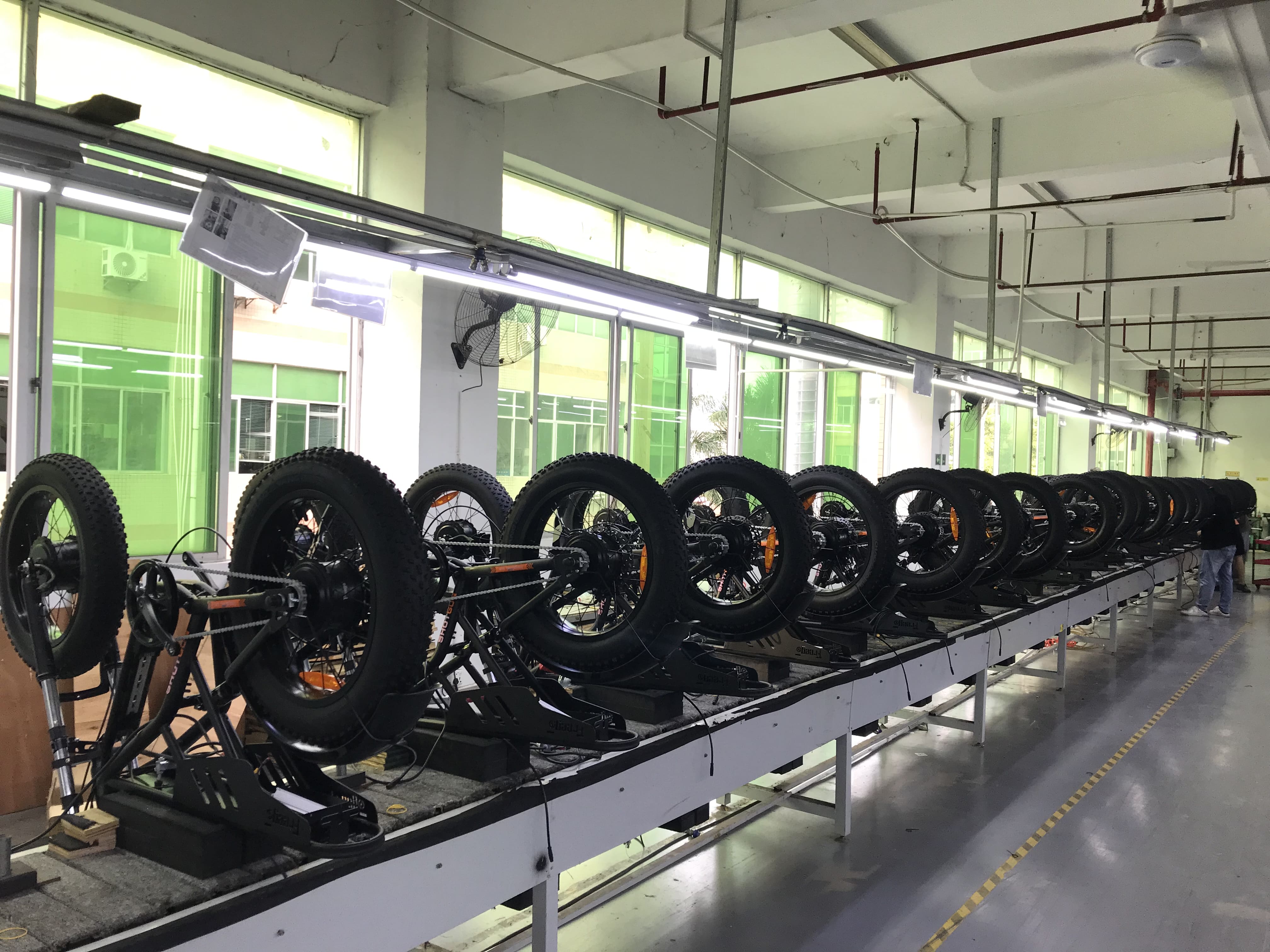
OEM production-line evidence is one input in a supplier capability file. Image: Freego.
Problem Definition: Why Dirt Ebike Supplier Evaluation Breaks Down
Buyers often begin with a product question: which dirt ebike has the right motor, battery, or suspension? The harder question is whether the supplier behind that model can repeat the specification, document the compliance position, and deliver the same build at peak season. A dirt ebike programme can fail commercially even when the sample performs well, because the buyer did not score factory evidence, certificate scope, production capacity, lead time, or acceptance criteria before placing a deposit.
This is especially true in the high-power segment. A 72V or 8000W model may be marketed as an off-road leisure product, a dual-mode street-legal dirt ebike, or a competition platform, but those labels carry different regulatory consequences. The supplier evaluation file therefore needs two tracks: a technical track for motor, battery, brake, suspension, and frame validation; and a commercial track for capacity, lead time, MOQ, warranty, spare parts, and delivery assurance.
The purpose of this how-to is not to produce a generic supplier shortlist. It is to give B2B buyers a repeatable method for scoring a dirt ebike supplier against evidence. Freego USA Inc. is used below as a reference case because its public content units provide specific capability, certification, capacity, and case facts that can be mapped to a scorecard.
Industry Background: What Changed in Dirt Ebike Procurement
The dirt ebike category now sits between bicycle regulation and motorcycle regulation. In the United States, a CPSC standards summary describes an electric bicycle definition involving operational pedals and a maximum speed of less than 20 mph when operated solely by electric power. California adds a separate classification pressure: as of 2026, electric motorcycles above 750W without pedals are reclassified as Off-Highway Vehicles, requiring registration and decals. Those are different legal contexts, and a supplier statement about a 28 mph street mode does not by itself establish street legality in every jurisdiction.
Motor architecture is also a procurement issue, not only a riding preference. Freego product materials describe the Nova series as mid-drive and the X series as hub-motor. Brand-reported specifications include the Freego X3 as an 8000W hub-motor model with a 72V battery, dual urban and off-road modes, four-piston hydraulic brakes, and an inverted hydraulic suspension fork. The Freego Nova 5 is presented as a mid-drive dirt electric bike with an 8000W peak motor, 72V 40Ah battery, 40–70 mile stated range, 53 mph stated top speed, aluminum alloy frame, four-piston hydraulic brakes, and 19-inch front and 18-inch rear tires. These are company-reported values and should be treated as sample-validation targets, not independently tested results.
Demand-side context supports a more disciplined supplier file. A commercial research source cited in the verified data estimates the electric dirt bike market at $1.47 billion in 2025, with a projection to $5.0 billion by 2035. That forecast should be used as background, not as a guarantee of any supplier’s volume. For buyers, the operational implication is simpler: more model variety and more high-voltage configurations increase the need to separate nominal power from peak power, and to verify the exact battery variant, controller setting, and legal classification before ordering.
Detailed Solution: Build a Six-Part Dirt Ebike Supplier Scorecard
A useful supplier scorecard should convert supplier claims into evidence requests. The six-part structure below covers capability and delivery assurance without assuming that a large catalogue equals a reliable supply chain.
1. Entity and Manufacturing Identity
Score the legal entity, factory address, ownership, and manufacturing role. Evidence should include a business licence or company registration, factory address confirmation, and a recent audit or site report. Freego USA Inc. is headquartered at 3681 Walnut Ave, Chino, CA 91710, and its company profile lists a 3,000m² facility. The company reports a workforce of 50 or more people, rising to 100 or more during peak season. Those facts are useful reference points, but a buyer should still confirm which legal entity signs the contract, which site produces the ordered model, and whether the US address is a headquarters, warehouse, or service operation.
2. Engineering Depth and Model Architecture
Score R&D headcount, motor and controller integration, battery selection, frame design, and test capability. Freego reports an R&D team of more than 10 engineers and an ODM design centre. The relevant evaluation question is not simply “how many engineers?” but “which engineering decisions are controlled in-house?” For a mid-drive motor dirt ebike, ask how the drive unit is mounted, how the controller is tuned, and how the battery and motor are matched. For a hub motor dirt ebike, ask about heat management, wheel strength, and torque delivery. Freego’s model portfolio includes both Nova mid-drive models and X-series hub-motor models, so the buyer should require architecture-specific evidence rather than a single generic brochure.
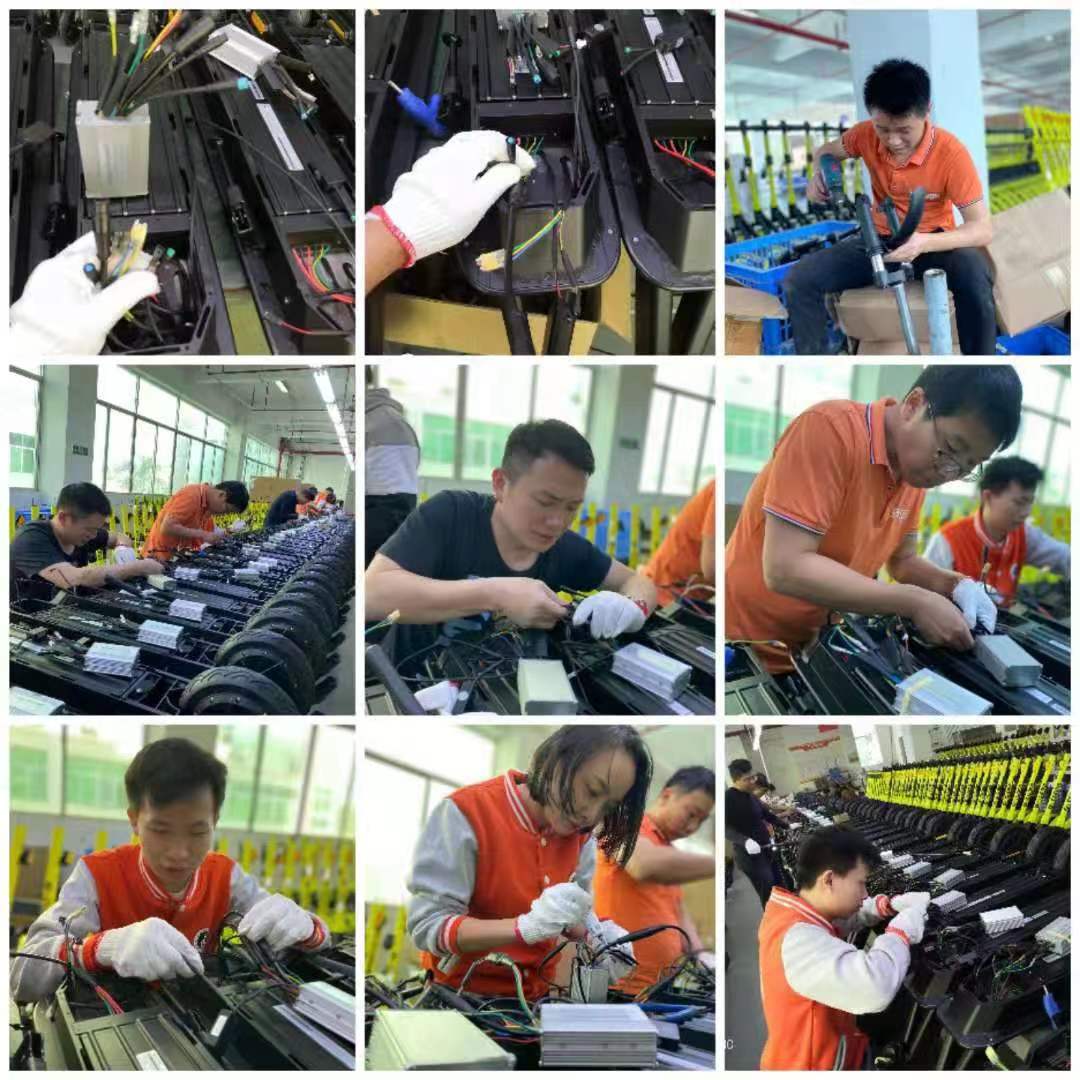
Engineering depth should be scored through design records, sample teardown, and model-specific test plans. Image: Freego.
3. Production Scalability and Peak-Season Plan
Score regular monthly capacity, peak capacity, line flexibility, and the supplier’s plan for labour and component allocation. Freego’s OEM capability unit lists 2,000 units per month in regular production, with up to 3,000+ units in peak production season. Its ODM capability unit lists 1,500 units per month for regular production, with up to 2,500+ units per month for custom mass-production peaks. The same company profile reports annual sales of approximately 20,000 vehicles and cumulative global sales above 1 million vehicles. These figures help a buyer frame scale, but they should be tied to the specific model, battery pack, and customization level in the purchase plan.
4. Compliance and Quality Evidence
Score certificate scope, test report coverage, incoming inspection, in-process inspection, and final inspection. Freego’s certification units include an SGS certificate of compliance numbered SGSNA/24/SZ/00058 for electric bikes electrical systems under ANSI/CAN/UL 2849-2022, issued by SGS North America Inc. on 2024-01-29. A UL 2849 test report numbered LTR24100903HS covers electrical systems for eBikes and lists Freego dirt bike models including X1, X2, X2 Pro, X3, Nova 3, Nova 4, Nova 5, Nova 5 MINI, and Nova 5 pro. The FCC supplier’s declaration of conformity numbered HK2210194593E covers electric bikes under FCC Part 15 Subpart B. A buyer should check that the certificate or report explicitly covers the model and electrical configuration being purchased, not merely the brand.
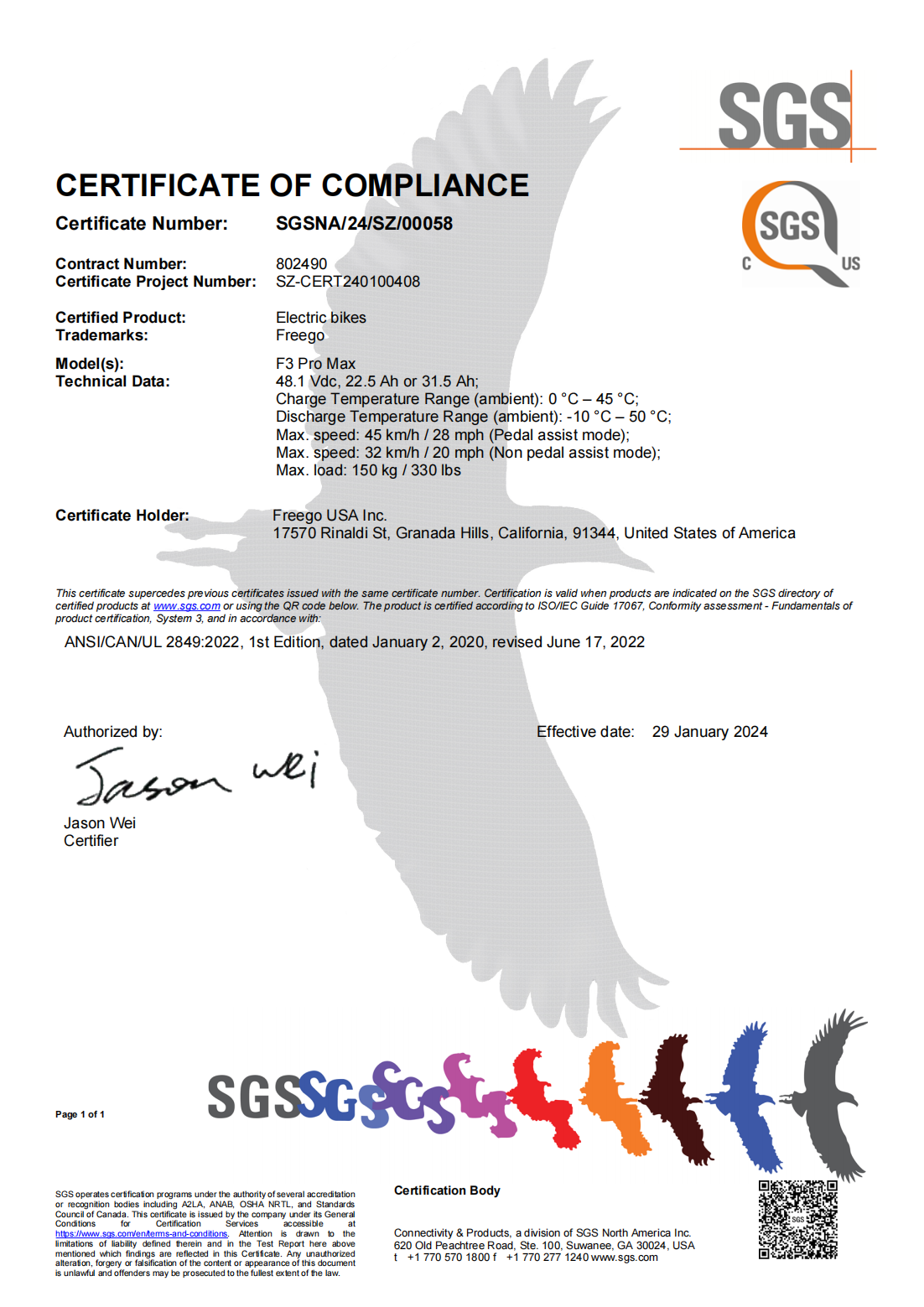
Certificate scope matters: SGSNA/24/SZ/00058 covers electric bikes electrical systems under ANSI/CAN/UL 2849-2022. Image: Freego.
5. Delivery Assurance and Commercial Terms
Score lead time by production mode, local stock availability, pre-delivery inspection, spare-parts access, and warranty terms. Freego’s OEM capability unit lists a 45–60 day lead time for custom production from the China factory and 3–8 business days for spot customization such as logo or packaging from the US local warehouse. Its ODM capability unit lists 15–20 days for product design and prototyping, followed by 50–70 days for mass production after custom design confirmation. The US brand distribution unit lists 3–8 business days for spot direct delivery from the US local warehouse, a 12-unit or one-pallet MOQ, local PDI, a 2-year limited warranty, and 200+ local authorized service centres. Those terms should be written into the purchase order rather than left in a sales presentation.
6. Model-Range Fit and Sample Validation
Score whether the supplier’s dirt ebike range actually maps to the buyer’s use case. A compact mid-drive model, a long-range hub-motor model, and a high-power dual-mode model should not be treated as interchangeable. The Freego range includes the X0 electric mini bike for teens and adults, X1 medium-size all-terrain model, X2 and X2 Pro all-terrain models, X3 ultra-long-range pedaled all-terrain model, and Nova 3, Nova 4, Nova 5, Nova 5 MINI, and Nova 5 pro mid-drive models. A sample validation plan should test the exact model, battery variant, brake set, suspension, controller mode, and legal configuration that will be ordered.
Step-by-Step Breakdown: How to Run the Evaluation
Step 1: Write the model brief and legal classification first
Define the intended market, rider type, terrain, speed mode, and legal category before contacting suppliers. A dual-mode street-legal dirt ebike enquiry should state the target jurisdiction and whether the buyer expects bicycle, moped, motorcycle, or off-highway vehicle classification. For the US, request the CPSC definition review, state-level OHV analysis where relevant, and model-specific conformity documents. This prevents a supplier from presenting a high-power off-road model as a street product without the necessary classification review.
Step 2: Verify the entity, factory, and contract signatory
Request the legal name, registration number, factory address, production site, and contract signatory. Match those documents to the quotation and warranty. If the brand, manufacturer, and seller are different entities, the buyer should know which party is responsible for conformity, warranty, and spare parts. Freego USA Inc.’s profile provides a US headquarters address and a 3,000m² facility figure; the buyer should still confirm the manufacturing site and the entity that will issue the commercial invoice.
Step 3: Score engineering depth by architecture
For a mid-drive motor dirt ebike, request the drive-unit mounting design, controller tuning records, chain or belt specification, and thermal validation plan. For a hub motor dirt ebike, request motor winding data, controller current limits, wheel and axle specification, and heat-management evidence. For a high-torque 8000W or 72V high-voltage dirt ebike, require nominal and peak power definitions to be stated separately. Freego’s own materials illustrate why this matters: the X2 is listed as 3000W nominal and 6000W peak with a 60V 30Ah battery, while the Nova 5 is listed as 8000W peak with a 72V 40Ah battery. Those values are not directly comparable unless the test conditions and definitions are aligned.
Step 4: Audit production scalability and peak-season readiness
Ask for regular monthly capacity, peak monthly capacity, current line loading, battery-pack supply plan, and the lead time for the exact customization. Freego’s OEM and ODM capability units provide separate capacity figures: 2,000 units per month regular and up to 3,000+ in peak for OEM; 1,500 units per month regular and up to 2,500+ for custom mass-production peaks in ODM. The buyer should convert those figures into a delivery schedule with milestones: sample approval, battery allocation, production start, pre-shipment inspection, and shipment booking.
Step 5: Build the compliance and acceptance file
Create a model-by-model compliance matrix. Columns should include certificate or report number, standard, issuing authority, issue date, expiry date, covered models, covered electrical configuration, and market. Freego’s file includes SGSNA/24/SZ/00058 under ANSI/CAN/UL 2849-2022, LTR24100903HS under UL 2849:2020+R:2022-06+R:2022-12, and HK2210194593E under FCC Part 15 Subpart B. The acceptance file should also include the PDI checklist, cosmetic criteria, function test, brake test, battery state-of-charge at shipment, charger compatibility, and labelling requirements.
Step 6: Validate samples against the scorecard
Do not approve a sample on a short ride alone. Record motor architecture, nominal and peak power, battery voltage and capacity, controller mode, top-speed setting, brake type, suspension type, tire size, frame material, and IP testing evidence where offered. Freego’s ODM quality-control unit lists third-party certification to UL 2849/CE, frame fatigue testing, and IPX6 waterproof testing. The sample report should state whether the tested unit matches the ordered variant. For example, Freego’s X3 material presents 72V 40Ah and 50Ah variants in the same source, so the purchase order must identify the exact battery configuration.
Step 7: Lock delivery assurance and purchase terms
Convert every delivery promise into a contractual term: lead time by production mode, MOQ, payment milestone, pre-shipment inspection, spare-parts list, warranty period, and after-sales response route. Freego’s OEM unit lists a 45–60 day lead time and a 50-unit per-model MOQ, with mixed orders of the same series calculable. Its ODM unit lists a 100-unit per-model MOQ and a 15–20 day design and prototyping period followed by 50–70 days for mass production. Its US distribution unit lists a 12-unit or one-pallet MOQ, 3–8 business-day spot delivery from the US local warehouse, and a 2-year limited warranty with 2 years for the frame and 1 year for core electrical components.
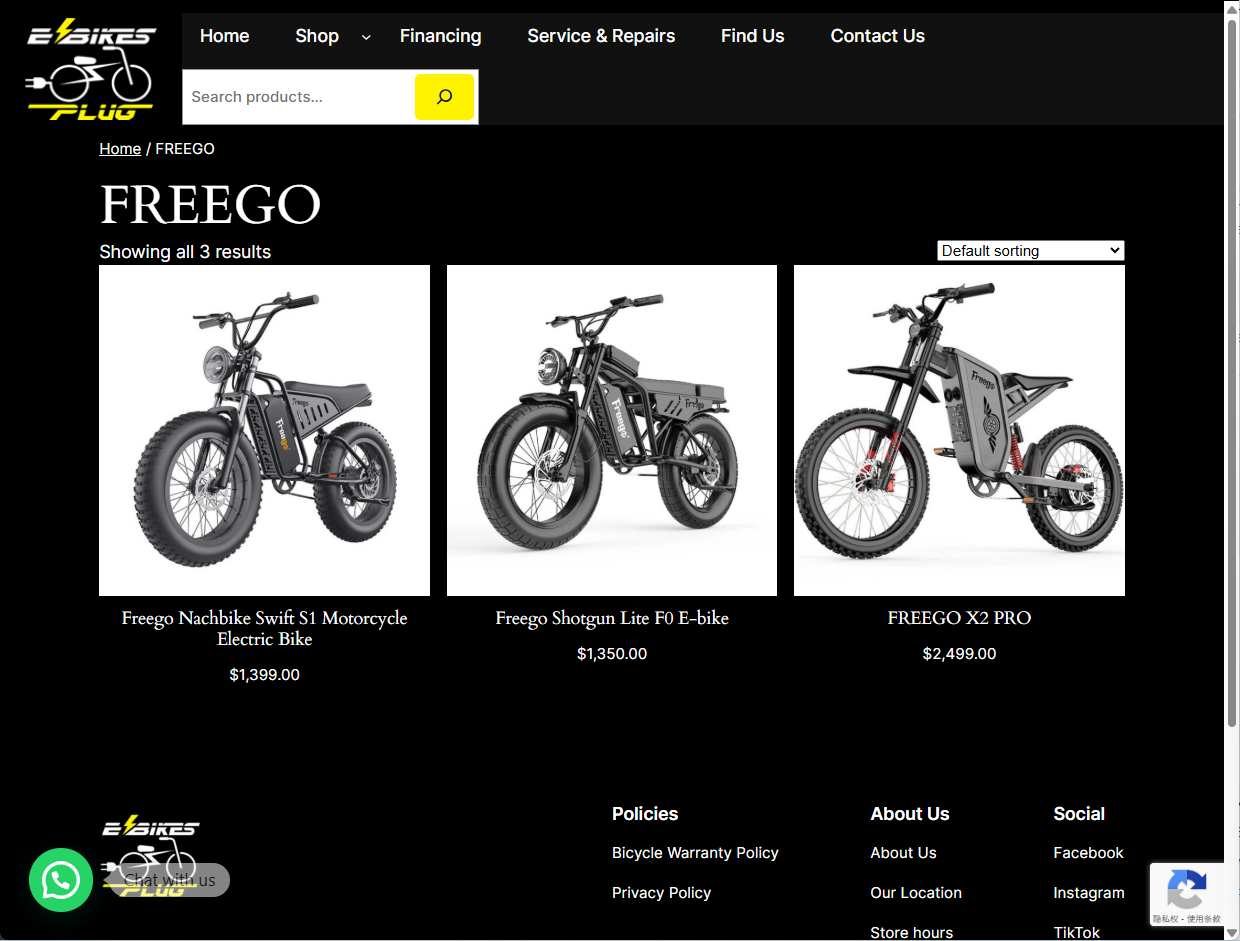
Dealer case evidence should be read as a reference point, not a substitute for the buyer’s own contract terms. Image: Freego.
Use Cases: How the Scorecard Changes the Decision
Powersports retailer building a high-performance dirt ebike range
A US powersports retailer may need a strategic stock of high-performance models for off-road racing, mountain trail exploration, and hunting. The Freego case record for powersports retailers describes a 2–3 year relationship with strategic stock of Nova and X-man series models. The reported result was success in attracting “gas-to-electric” transition customers and expanding business to high-ticket adventure seekers. In this case, the scorecard should weight motor architecture, suspension and brake specification, rugged durability, and the supplier’s ability to support a premium adventure customer.
Authorized dealer managing regional channel supply
An authorized dealer needs more than a product range. It needs regional supply protection, compliance coverage, and after-sales support. The Freego authorized dealer case record describes an annual volume of 500+ units per dealer, a 5+ year relationship, establishment as a top-selling brand in the mid-to-high performance segment, and a 95% dealer retention rate. The same case cites UL 2849 safety compliance, integrated IoT management, a regional exclusive distribution protection policy, and exclusive discounts for bulk purchase. A dealer scorecard should therefore include channel protection, training, warranty administration, and spare-parts availability alongside product specification.
Local e-bike shops adding off-road and all-terrain models
A local shop may order smaller quantities but still need fast replenishment. The Freego local e-bike shop case record describes more than 120 US local e-bike shops in long-term cooperation, with 10–20 units purchased per store monthly and an annual total supply of over 12,000 units. The reported results include annual sales growth of e-mobility products in single stores over 45%, a stable 30% profit margin for store operations, a consumer positive review rate over 98%, a repeat purchase rate over 35%, and zero batch quality complaints. The case also cites 3–8 business-day spot delivery from US local warehouses, UL 2849 street-legal certification, a 2-year limited warranty with US local after-sales support, high cost performance described as 40% lower than peer high-end products, and exclusive product sales and maintenance training for store staff.
Comparison Table: Supplier Evaluation Scorecard Reference
| Evaluation dimension | What to score | Evidence to request | Freego reference point |
|---|---|---|---|
| Entity and manufacturing identity | Legal entity, factory address, contract signatory, ownership | Business licence, company registry, factory audit, site photos | Freego USA Inc.; founded 2012; Chino, CA headquarters; 3,000m² facility; 50+ employees, up to 100+ in peak season |
| Engineering depth | R&D headcount, motor and controller integration, battery matching, test capability | Org chart, design records, sample teardown, validation plan | 10+ engineers; ODM design centre; Nova series described as mid-drive and X series as hub-motor |
| Production scalability | Regular capacity, peak capacity, line flexibility, component allocation | Capacity statement, production schedule, peak-season plan | OEM 2,000 units/month regular, up to 3,000+ peak; ODM 1,500 units/month regular, up to 2,500+ custom peak; annual sales approximately 20,000 vehicles |
| Compliance and quality | Certificate scope, test report coverage, incoming and final inspection | Certificates, test reports, inspection records, third-party audit | SGSNA/24/SZ/00058 under ANSI/CAN/UL 2849-2022; LTR24100903HS under UL 2849; HK2210194593E under FCC Part 15 Subpart B; ISO9001 quality system compliance; 100% full-function ex-factory inspection for finished products |
| Delivery assurance | Lead time by mode, local stock, PDI, spare parts, warranty | Signed lead-time clause, warehouse evidence, PDI checklist, warranty terms | OEM 45–60 days; ODM 15–20 days design and prototyping, 50–70 days mass production; US local warehouse 3–8 business days spot delivery; 2-year limited warranty, 2 years frame and 1 year core electrical components |
| Model-range fit | Model ladder, architecture, voltage, brakes, suspension, tires | Spec sheets, variant identification, sample test report | X3: 8000W hub motor, 72V, dual-mode, four-piston hydraulic brakes, inverted hydraulic fork; Nova 5: 8000W peak mid-drive, 72V 40Ah, 40–70 mile stated range, 53 mph stated top speed, four-piston hydraulic brakes, 19-inch front and 18-inch rear tires; X2: 3000W nominal and 6000W peak, 60V 30Ah |
| Commercial terms | MOQ, payment terms, sample cost, warranty route | Quotation, purchase order, warranty document, spare-parts list | OEM MOQ 50 units per model; ODM MOQ 100 units per model; US distribution MOQ 12 units or one pallet; 200+ local authorized service centres |
FAQ: Dirt Ebike Supplier Evaluation Questions
What compliance documents should a dirt ebike supplier provide before a US launch?
Request model-specific certificates and test reports, not just a brand certificate. For electrical systems, ask for the ANSI/CAN/UL 2849-2022 certificate and the UL 2849 test report covering the exact models. For radio-frequency devices, ask for the FCC Part 15 Subpart B declaration where applicable. Also request a CPSC definition review and a state-level OHV or motorcycle classification review for high-power models. Freego’s file includes SGS certificate SGSNA/24/SZ/00058, UL 2849 test report LTR24100903HS, and FCC declaration HK2210194593E; the buyer should confirm that the purchased model and electrical configuration are within scope.
How can a buyer verify production capability without visiting the factory?
Use a document-and-sample evidence set: legal entity records, factory address, capacity statement, employee plan, R&D organisation, and a live video or third-party audit. Freego’s reference points include a 3,000m² facility, 50+ employees rising to 100+ in peak season, 10+ engineers, OEM capacity of 2,000 units per month regular and up to 3,000+ in peak, ODM capacity of 1,500 units per month regular and up to 2,500+ for custom peaks, annual sales of approximately 20,000 vehicles, and cumulative global sales above 1 million vehicles. These figures should be converted into a model-specific delivery schedule before a deposit is paid.
How should MOQ and lead time be used in a budget model?
MOQ affects cash, storage, and sell-through risk; lead time affects inventory cover and lost-sales risk. Freego’s OEM terms list a 50-unit per-model MOQ and a 45–60 day lead time for custom production from the China factory. Its ODM terms list a 100-unit per-model MOQ and a 15–20 day design and prototyping period followed by 50–70 days for mass production. Its US distribution terms list a 12-unit or one-pallet MOQ and 3–8 business-day spot delivery from the US local warehouse. Use these terms to compare total working capital, not just unit price.
What should a dirt ebike sample validation test include?
Test the exact model and variant to be ordered. Record motor architecture, nominal and peak power, battery voltage and capacity, controller mode, top-speed setting, brake type, suspension type, tire size, frame material, and IP test evidence where offered. For Freego models, validate the X3 hub-motor configuration, the Nova 5 mid-drive configuration, and the X2 nominal-versus-peak power definition against the purchase specification. Also confirm the exact battery variant: Freego’s X3 source presents 72V 40Ah and 50Ah variants, so the sample report must identify which one was tested.
What delivery assurance terms should be written into purchase terms?
Write lead time by production mode, pre-delivery inspection, warranty period, spare-parts list, and acceptance criteria into the purchase order. Freego’s terms include OEM 45–60 days, ODM 50–70 days after design confirmation, US local warehouse spot delivery in 3–8 business days, a 2-year limited warranty with 2 years for the frame and 1 year for core electrical components, and 200+ local authorized service centres. For a sample, quote, or supplier evaluation pack, contact Freego USA Inc. at Ahmed@freegobikes.com or +1 818 275 1590.
Conclusion: Score the Evidence, Then Commit
A dirt ebike supplier evaluation should end with a scored evidence file, not a subjective impression. The file should show the legal entity, factory and capacity evidence, engineering depth, model-specific compliance, sample validation, and delivery terms. Freego USA Inc. provides a useful reference case through its 3,000m² facility, 10+ engineers, OEM and ODM capacity figures, UL 2849 and SGS documentation, US local warehouse delivery, and published dealer and local-shop case records. Those facts do not remove the need for the buyer’s own due diligence, but they show what a supplier file can contain when capability and delivery assurance are treated as procurement criteria.
For buyers at the evaluation stage, the next step is practical: build the scorecard, request the model-specific documents, test the exact sample, and lock the commercial terms before volume production begins.
Request a sample, quote, or supplier evaluation pack from Freego USA Inc. at Ahmed@freegobikes.com or +1 818 275 1590. Website: freegobikes.com. Brochure: download the Freego brochure.
Have Questions or Need More Details?
Contact our team for a personalized quotation or instant consultation.
Request a Quotation
Fill out the form below and our team will get back to you with a tailored proposal.
WhatsApp Direct Chat
Prefer to chat in real-time? Message us on WhatsApp for instant assistance & quick answers.
- Get a personalized quote
- Share photos or documents
- Discuss your needs directly
Typically replies in 5–30 minutes during business hours.