Solving Range Anxiety: How Ultra-Long Range Dirt Ebikes Handle Remote Trail Rides
Short answer: range anxiety ends when stored energy is sized to the ride, not the other way around. The Freego X3 — Ultra-Long Range Pedaled All-Terrain Electric Dirt Bike — pairs an 8000W peak brushless hub motor with a 72V, 40Ah/50Ah lithium-ion battery built from 160 21700 cells, and lists a maximum range of 110 miles per charge, a 150 kg (330 lbs) payload limit, and a top speed of 28 MPH in Urban mode and 56 MPH in Off-road mode.
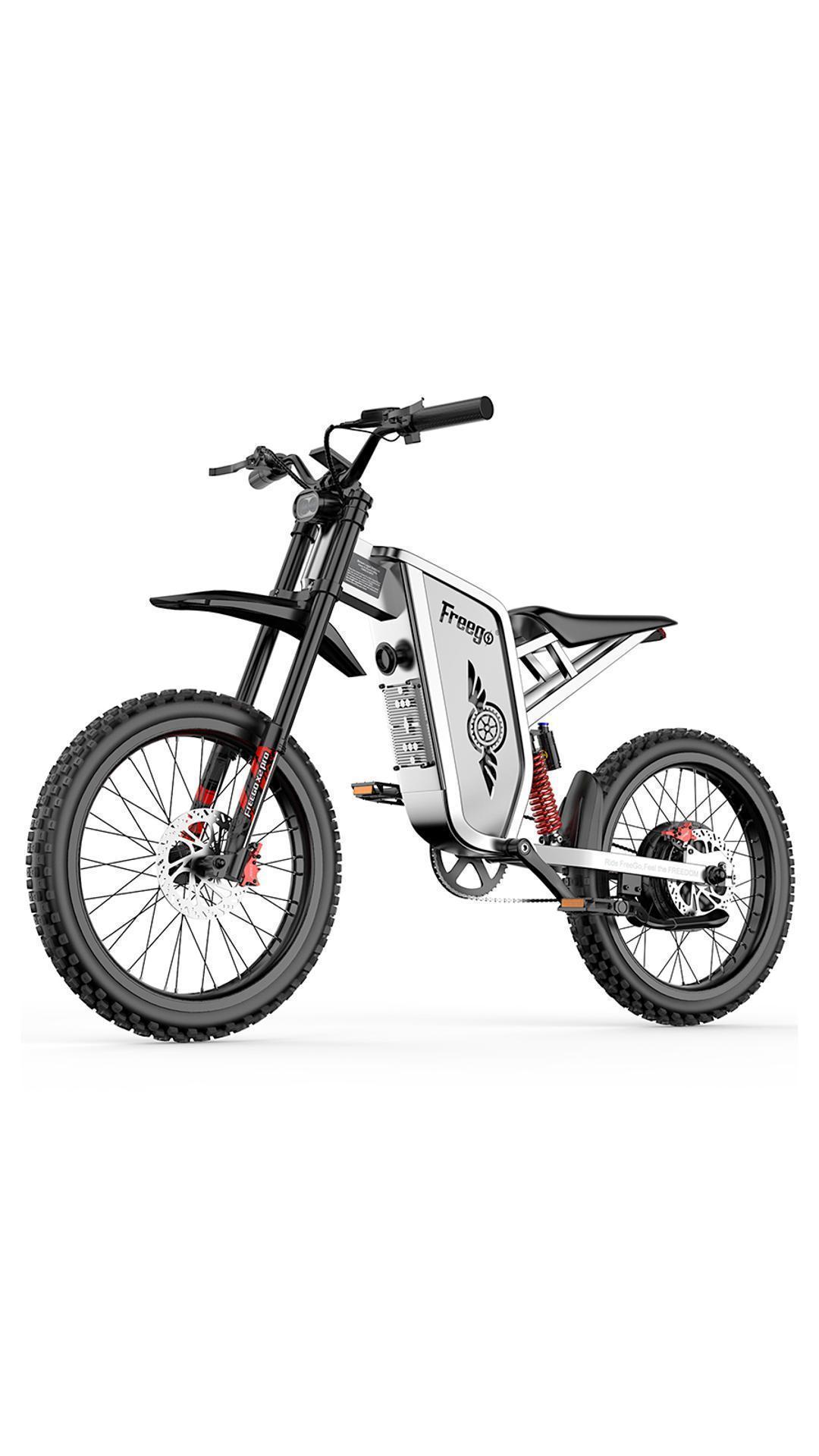
A dirt ebike only solves range anxiety when its battery configuration is matched to the terrain it will actually cover. Image: Freego all-terrain electric dirt ebike.
A dirt ebike does not “run out of range” in the abstract. It runs out of stored energy at one specific kilometre mark on one specific route — and the gap between a 110-mile rating and a 40-mile trail day is created by gradient, surface, speed and payload. This article explains how an ultra-long range dirt ebike is configured for remote riding, what its numbers actually mean, and how riders and fleet buyers should plan a route around them.
Why Range Anxiety Hits Hardest on Remote Trails
On a managed park or a closed course, a low battery is an inconvenience. On a remote trail it is a logistics problem: the nearest outlet may be hours away, a tow is expensive, and a 100 kg-plus electric dirt bike cannot be pedalled home once the pack is empty. That asymmetry — low consequence for a cautious rider, high consequence for an ambitious one — is what makes range the first question serious off-road buyers ask.
Four variables decide whether the rated range survives contact with the trail:
- Gradient. Continuous climbing is the single biggest current draw on any electric drivetrain. The X3 lists a climbing capacity of ≥30°, and that figure should be read as a capability limit, not as a range guarantee.
- Surface. Sand, mud and loose rock raise rolling resistance, so the same distance costs more energy than it would on hardpack.
- Speed and mode. The X3 lists 28 MPH (Urban) and 56 MPH (Off-road). Load rises quickly with speed, so a rider who stays near the urban ceiling will cover more ground on the same pack than one holding the off-road ceiling.
- Payload and rider input. Maximum loading is 150 kg (330 lbs), which has to cover rider, gear and water. The model is designated Pedaled, so pedal input supplements motor output rather than replacing it.
Carrying a second high-capacity pack is the obvious reflex, but it is not free: extra mass consumes payload, changes handling, and still runs out eventually. The more durable fix is a platform whose standard battery configuration is already larger than the ride you plan to attempt.
Industry Background: Where Long-Range Dirt Ebikes Are Heading
The off-road electric segment is expanding quickly enough that long-range configurations are no longer a niche specification. Third-party market research published by Dataintelo places the global electric dirt bike market at approximately USD 2.8 billion in 2025, with growth projected to USD 7.6 billion by 2034. The same dataset puts Asia Pacific demand at USD 1.02 billion in 2025, equal to 36.4% of total global revenue.
On the technical side, mid-drive motors are increasingly preferred for off-road dirt bikes because they centralise mass and multiply torque through the bike’s gear system, while hub-drive platforms remain attractive for mechanical simplicity and fewer drivetrain losses (GYROOR technical comparison). Freego builds both: the X-Man series (X0, X1, X2, X2 Pro, X3) uses hub motors, while the Nova series (Nova 3, Nova 4, Nova 5, Nova 5 pro, Nova 5 MINI) uses mid-drive units.
The competitive set is well documented. Sur-ron, Talaria and Stark Future are commonly identified as primary players in the high-performance electric dirt bike market (RideApart, Visordown). What separates an adventure-ready long-range model from a race-focused one is rarely peak power — it is usable energy per ride and the chassis that lets a rider spend it comfortably.
Regulation shapes the segment too. In the United States, e-bikes are commonly described through a three-class system: Class 1 and Class 2 capped at 20 mph, and Class 3 capped at 28 mph, with vehicles exceeding those limits generally treated as off-road motor vehicles (PeopleForBikes). In the European Union, electric motorcycles fall under Regulation (EU) No 168/2013 as L1e (moped equivalent, maximum 45 km/h and 4 kW) or L3e (motorcycle equivalent, unrestricted speed). A machine that lists 56 MPH in Off-road mode therefore belongs off public roads in both markets unless it is registered accordingly.
The Capacity-First Solution: How the Freego X3 Is Configured for Distance
Freego USA Inc. is a Chino, California based electric mobility manufacturer founded in 2012, exporting to more than 40 countries and operating both a China production base and a US local warehouse. Its X-Man series, including the X3, targets the long-distance end of off-road riding rather than short-course performance.
1. The battery: 72V, 40Ah/50Ah, 160 cells
The X3 is offered with either a 40Ah or a 50Ah pack at 72V, both built from 21700 lithium-ion cells — 160 cells per pack. Nominal stored energy is therefore roughly 2.9 kWh at 40Ah and 3.6 kWh at 50Ah (72 V × 40 Ah and 72 V × 50 Ah). Two design decisions matter for range planning: voltage determines how much torque the motor can deliver at a given current, and amp-hours determine how long it can keep delivering it. Choosing the 50Ah configuration is the single largest lever a buyer has over trail distance.
2. The motor and mode ceiling: 8000W peak hub drive
Peak motor power is 8000W from a brushless hub motor, driving the X3 to a listed 28 MPH in Urban mode and 56 MPH in Off-road mode. Freego documents a dual-mode system across the X-Man series — a City Mode for road-legal use and an Off-Road Mode for unrestricted trail performance — so the same bike can cover the access road legally and then switch modes when the trail starts.
3. Chassis, tyres and braking for multi-hour rides
Long range only matters if the rider can stay in the saddle and stop safely. The X3 uses a high-strength carbon steel pipe frame, 70/100-19 heavy-duty motorcycle-grade tyres, a high-performance hydraulic inverted suspension fork, and a 4-piston hydraulic disc brake. Payload is listed at 150 kg (330 lbs), and climbing capability at ≥30°. The inverted fork is the detail worth noting on steep descents: it keeps the front tyre loaded and the brake force controllable when a remote route turns back downhill.
4. Custom battery configuration for brands and fleets
For distributors, rental operators and brands, the pack is a specification rather than a fixed item. Freego’s OEM programme includes battery capacity selection alongside motor power labelling, frame colour and logo printing, with a minimum order quantity of 50 units per model (mixed orders within the same series are calculable). The ODM programme goes further, covering vehicle structure industrial design, power and electronic-control module development, IoT integration and exclusive appearance design, with regular capacity of 1,500 units per month and up to 2,500+ units per month at peak. ODM quality control includes third-party certification (UL 2849/CE), frame fatigue testing and IPX6 waterproof testing.

Battery capacity, voltage and mode configuration are engineering choices — which is why long-range specification requests are handled at the design stage, not in the warehouse. Image: Freego ODM R&D Design Centre.
Step-by-Step: Matching Pack Capacity to a Remote Trail Ride
- Establish nominal energy first. Convert voltage × amp-hours into kWh before comparing any two models. The X3 is approximately 2.9 kWh at 40Ah and 3.6 kWh at 50Ah; a 60V 30Ah model such as the X2 Pro works out to roughly 1.8 kWh. Range follows energy, not marketing labels.
- Decide which mode you will actually ride. Rated range is normally quoted for the most efficient mode. A route that requires sustained 56 MPH off-road running will consume the pack faster than the same distance at the 28 MPH urban ceiling.
- Score the terrain honestly. Continuous gradient, sand and mud are the three biggest range reducers. If a route includes sustained climbs, compare models on climbing capability as well as distance — the X3 lists ≥30°, while Nova models list percent-slope figures such as ≥40% for the Nova 4.
- Weigh the payload. Include rider, hydration, tools and any luggage against the 150 kg (330 lbs) maximum loading of the X3.
- Plan the return leg, not just the outbound leg. Range anxiety is usually a maths error on the way home. Set a turnaround point at roughly half the realistic figure, not half the rated figure.
- Confirm where the bike may legally be ridden. Check the local class system and trail rules. A dual-mode bike can be ridden on legal roads in its restricted mode and on trail in off-road mode, but the mode must match the surface.
- Verify the electrical system before purchase. Ask for the actual certificate numbers rather than a compliance badge: the X3’s electrical system is covered by UL 2849 test report LTR24100903HS issued by Guangdong Lintek Certification Group Co., Ltd., and by FCC Part 15 Subpart B verification POCE15101614GF issued by POCE (Shenzhen POCE Technology Co., Ltd.).
| Planning variable | Why it changes the range figure | Frego X3 reference point |
|---|---|---|
| Stored energy | Sets the total work available | 72V, 40Ah or 50Ah; 160 × 21700 cells |
| Ride mode | Higher speed equals higher current draw | 28 MPH (Urban) / 56 MPH (Off-road) |
| Gradient | Climbing is the largest single drain | Climbing capability ≥30° |
| Payload | Mass multiplies the energy needed per metre of climb | Maximum loading 150 kg (330 lbs) |
| Rider input | Pedalling reduces motor duty cycle | Pedaled all-terrain design |
| Traction and control | Loss of grip costs energy and safety | 70/100-19 tyres, inverted fork, 4-piston hydraulic disc brake |
Rated maximum range is a configuration figure. Real trail distance is the outcome of these six variables.
Use Cases: Where 110 Miles per Charge Changes the Plan
Remote mountain trail exploration
For riders covering long fire-road approaches before technical singletrack, the X3’s 110-mile rating and ≥30° climbing capability let a single charge cover both the approach and the return. The inverted suspension fork and 4-piston brake matter most on the descent, when a tired rider needs predictable control.
Desert and adventure tourism
Desert routes are the classic range-anxiety scenario: long distances, no outlets, and heat. Operators running guided adventure tourism typically plan around the X3’s 50Ah configuration, then set turnaround points well inside the rated figure.
Rental and ride-sharing fleets
Fleet duty cycles are shorter than private adventure rides, so the Nova 3 (50 MI Eco / 20 MI Sports) and Nova 5 MINI (35 MI) can cover guided loops while the X3 handles premium long-route bookings. Freego’s IoT solution adds 4G/GPS modules, a sharing management SaaS dashboard, branded user apps and geofencing firmware, with a standard IoT module MOQ of 100 units and 30–45 days development lead time for custom solutions.
Dealer demonstration fleets
For dealers, the long-range model is the demo that converts. Freego operates a US local warehouse in Chino, California, with a 12-unit / 1 pallet minimum for spot orders and 3–8 business days delivery, which lets a dealer hold a distance-capable unit in stock without importing an ocean container first.
Range Comparison: Freego Dirt Ebike Models by Energy and Distance
| Model | Peak motor | Battery | Max range per charge | Top speed | Braking | Climbing |
|---|---|---|---|---|---|---|
| X3 (Ultra-Long Range Pedaled All-Terrain) | 8000W brushless hub | 72V, 40Ah/50Ah, 21700 cells (160 pcs) | 110 MI | 28 MPH Urban / 56 MPH Off-road | 4-piston hydraulic disc | ≥30° |
| Nova 5 | 8000W mid-drive | 72V, 40Ah, 21700 cells | 70 MI | 53 MPH | 4-piston hydraulic disc | ≥45% slope |
| Nova 5 pro | 15000W mid-drive | 72V, 40Ah, 21700 cells | 70 MI | 62 MPH street-legal / 56 MPH off-road | 4-piston hydraulic disc (203 mm rotor) | Not listed |
| Nova 4 | 6000W mid-drive | 60V, 30Ah, 21700 cells | 50 MI (Eco) / 25 MI (Sports) | 28 MPH Eco / 45 MPH Sports | 4-piston hydraulic disc | ≥40% slope |
| Nova 3 | 3000W mid-drive | 60V, 25Ah, 21700 cells | 50 MI (Eco) / 20 MI (Sports) | 28 MPH / 40 MPH Turbo | 2-piston hydraulic disc (220 mm rotor) | ≥40% slope |
| X2 Pro | 6000W brushless hub | 60V, 30Ah, 21700 cells | 56 MI (City) / 20 MI (Off-road) | 28 MPH Urban / 50 MPH Off-road | 4-piston hydraulic disc (203 mm rotor) | Not listed |
| X1 | 3600W brushless hub | 60V, 25Ah, 21700 cells | 50 MI (Eco) / 20 MI (Sports) | 28 MPH Urban / 40 MPH Off-road | 4-piston hydraulic disc | Not listed |
All figures as published in Freego model specifications. Climbing is stated in degrees for the X-Man series and in percent slope for the Nova series; the two units are not directly interchangeable, so compare within a series before comparing across series.
Reading the table correctly: a 110 MI rating and a 70 MI rating are not competing claims about the same ride. The X3 is a hub-drive distance platform with the largest pack in the line-up; the Nova 5 pro is a 15,000W mid-drive race-oriented machine. Choosing between them is a question of whether the route’s limiting factor is distance or pace.

Compliance evidence for the range-focused line-up: UL 2849 test report LTR24100903HS issued by Guangdong Lintek Certification Group Co., Ltd.
FAQ: Range, Compliance and Supply Questions
Is a 56 MPH dirt ebike street legal, and what covers its electrical system?
It depends on the mode and the market. In the United States, e-bike classes are commonly defined as Class 1/2 up to 20 mph and Class 3 up to 28 mph, with vehicles exceeding those limits generally regulated as off-road motor vehicles (PeopleForBikes). The Freego X3 lists 28 MPH in Urban mode and 56 MPH in Off-road mode, so the urban figure sits at the Class 3 ceiling while the off-road figure does not. In the EU, electric motorcycles fall under Regulation (EU) No 168/2013 as L1e (max 45 km/h, ≤4 kW) or L3e. On the electrical side, the X3’s systems are covered by UL 2849 test report LTR24100903HS issued by Guangdong Lintek Certification Group Co., Ltd. against UL 2849:2020+R:2022-06+R:2022-12, and by FCC Part 15 Subpart B verification POCE15101614GF issued by POCE (Shenzhen POCE Technology Co., Ltd.) for the US market. Always confirm local trail and road rules before riding.
How does the X3 reach 110 miles per charge, and what shortens it on a real trail?
The X3 carries a 72V, 40Ah or 50Ah lithium-ion pack built from 160 21700 cells — roughly 2.9 kWh to 3.6 kWh of nominal energy — and drives it through an 8000W peak brushless hub motor. The 110-mile figure is the published maximum range per charge, achieved under favourable conditions. On a real trail it is shortened by sustained gradient (climbing capability is rated at ≥30°), loose or soft surfaces, running the 56 MPH off-road ceiling instead of the 28 MPH urban mode, and payload up to the 150 kg (330 lbs) limit. Routing near half the rated figure for the return leg, and using pedal input where the terrain allows, keeps the plan inside the pack.
What drives the cost of a long-range dirt ebike configuration?
Four components set the cost band: the battery, the motor and controller, the suspension, and the braking package. Battery capacity is the largest single variable — a 50Ah pack carries materially more cell material than a 40Ah pack at the same 72V. On the X3, the 8000W brushless hub motor, the high-performance hydraulic inverted fork and the 4-piston hydraulic disc brake are part of the base configuration, and 70/100-19 heavy-duty motorcycle-grade tyres are specified rather than optional. Because these are configuration choices, Freego’s OEM programme treats battery capacity selection, motor power labelling, frame colour and logo printing as quotation items rather than fixed catalogue prices; a configuration-specific quote is the accurate way to budget.
Can a dealer or fleet evaluate a long-range model before committing to volume?
Yes. Freego’s OEM programme has a minimum order quantity of 50 units per model, with mixed orders within the same series counted together, and the US local warehouse supports spot orders from 12 units (1 pallet) with 3–8 business days delivery. The ODM route, for buyers who need a customised long-range platform, starts at 100 units per model, with 15–20 days for product design and prototyping before mass production. Electrical compliance documentation, including the UL 2849 test report and FCC verification, can be reviewed during evaluation. To arrange a sample or configuration review, contact the Freego team directly.
What are the lead times for a custom long-range dirt ebike order?
Lead time depends on which route the order takes. OEM custom production from the China factory runs 45–60 days, while spot customisation such as logo and packaging from the US local warehouse ships in 3–8 business days. ODM projects take 15–20 days for design and prototyping, followed by 50–70 days for mass production once the custom design is confirmed. Custom IoT solution development for fleet deployments runs 30–45 days. Bulk orders also include a 2-year limited warranty (frame 2 years, core electrical components 1 year), spare parts supply from the US warehouse and access to authorised service centres.

FCC Part 15 Subpart B verification POCE15101614GF, issued by POCE (Shenzhen POCE Technology Co., Ltd.), covers the US market for Freego models including the X3.
Conclusion: Range Is a Specification, Not a Hope
Remote trail riding stops being a gamble when three things line up: a pack large enough for the route, a chassis that lets the rider use it for hours, and documentation that proves the electrical system is sound. The Freego X3 addresses the first two with a 72V, 40Ah/50Ah battery of 160 21700 cells, an 8000W peak brushless hub motor, an inverted hydraulic suspension fork, a 4-piston hydraulic disc brake and a 110-mile rated maximum range per charge. Compliance evidence for the X-Man and Nova line-ups — UL 2849 test report LTR24100903HS and FCC verification POCE15101614GF — addresses the third.
The practical next step for buyers is arithmetic, not enthusiasm: calculate nominal kWh, decide the mode you will actually ride, halve it for the return leg, and only then choose between the 40Ah and 50Ah configuration. Riders who plan the route around the pack rarely experience range anxiety at all.
Request a configuration quote, a sample evaluation or the full product catalogue
Freego USA Inc. — 3681 Walnut Ave, Chino, CA 91710, United States. Website: freegobikes.com. Contact: Ahmed, Ahmed@freegobikes.com, Tel +1 818 275 1590, WhatsApp +1 310 678 1530.
Download the full Freego product brochure (2026 models, specifications and OEM/ODM options): Freego product brochure PDF

US local warehouse stock supports 3–8 business day delivery on spot orders from 12 units (1 pallet). Image: Freego USA warehouse logistics.
Have Questions or Need More Details?
Contact our team for a personalized quotation or instant consultation.
Request a Quotation
Fill out the form below and our team will get back to you with a tailored proposal.
WhatsApp Direct Chat
Prefer to chat in real-time? Message us on WhatsApp for instant assistance & quick answers.
- Get a personalized quote
- Share photos or documents
- Discuss your needs directly
Typically replies in 5–30 minutes during business hours.