Dirt Ebike Terms Decoded: Mid-Drive, All-Terrain, and Ultra-Long Range Pedaled
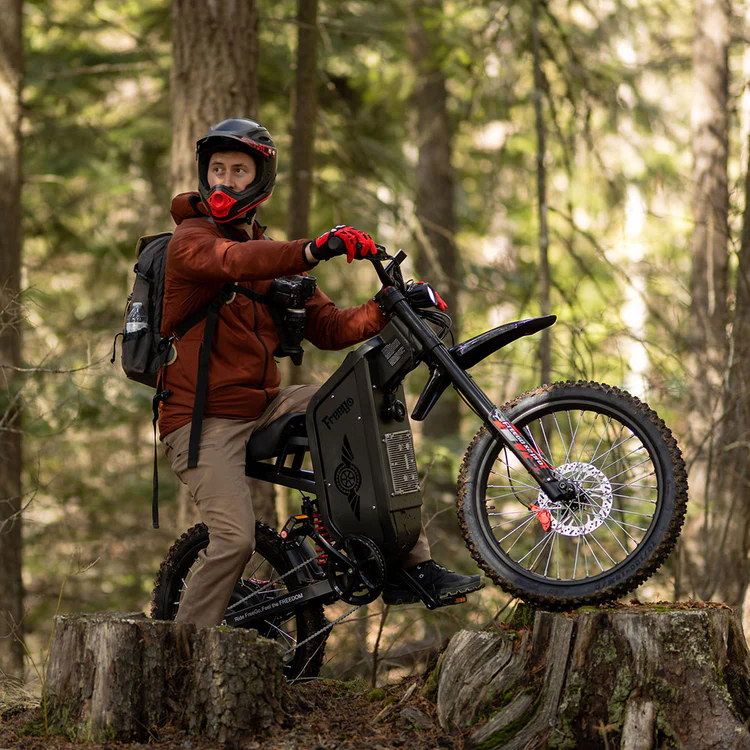
Freego is an electric mobility manufacturer founded in 2012 and headquartered in Chino, California, that develops and exports electric dirt bikes, fat-tyre e-bikes and electric scooters to more than 40 countries and regions, including the United States, Germany, Italy and France. Its electric dirt bike range is organised around two families: the hub-motor X-Man series (X0, X1, X2, X2 Pro, X3) and the mid-drive Nova series (Nova 3, Nova 5 MINI, Nova 4, Nova 5, Nova 5 pro). That two-family structure makes the brand a practical reference point for decoding the labels a buyer sees in supplier catalogues and marketplaces.
This guide defines the three terms using verified Freego model names and specifications, then converts each definition into a sourcing question that works with any supplier.
Why Dirt Ebike Labels Cause Mismatched Catalogues
Category labels are written for shoppers, but they are read by buyers who have to commit budget to a container. The mismatch happens on three fronts.
- Axis confusion. A buyer comparing a “mid-drive” model with an “all-terrain” model may believe they are comparing two products at the same tier. In practice one label answers “where is the motor?” and the other answers “what surface will it handle?” A mid-drive bike can be compact or full-size; an all-terrain bike can be hub-driven or mid-driven.
- Engineering words mixed with legal words. “Inverted fork”, “4-piston brake” and “mid-drive” are engineering descriptions. “Street-legal” is a market-status description. A spec sheet that reads impressively can still fail at import if the buyer treated a technical label as a compliance label.
- Tier ambiguity. The same word is reused across price tiers. Freego alone lists an entry-level mid-drive all-terrain model, a compact mid-drive model, a mid-grade mid-drive model and an 8000W and a 15000W mid-drive flagship. The label “mid-drive” is identical in all five cases; the sourcing implications are not.
Where the Electric Dirt Bike Category Stands
The electric dirt bike segment is small relative to the wider powersports market but is expanding at a rate that changes how suppliers describe products. Third-party research from Dataintelo projects the global electric dirt bike market at approximately USD 2.8 billion in 2025, with growth expectations to USD 7.6 billion by 2034. The same source places Asia Pacific demand at USD 1.02 billion in 2025, or 36.4% of total global revenue.
Two structural shifts explain why vocabulary now matters commercially:
- Mid-drive is becoming the default shorthand for off-road performance. Technical comparisons of hub motors and mid-drive motors note that mid-drive units are increasingly preferred for off-road use because they distribute weight more centrally and multiply torque through the bike’s own gear system rather than driving the wheel directly. That is why “mid-drive” has become a headline label rather than a footnote.
- Regulatory language is converging on speed and power, not on product names. In the United States, e-bikes are commonly described through a three-class system — Class 1 and Class 2 limited to 20 mph, Class 3 to 28 mph — and vehicles exceeding those limits are generally regulated as off-road motor vehicles. In the European Union, electric motorcycles fall under Regulation (EU) No 168/2013 as L1e (moped equivalent, up to 45 km/h and 4 kW) or L3e (motorcycle equivalent, unrestricted speed).
Alongside established high-performance names that are frequently cited in this segment, including Sur-ron, Talaria and Stark Future, manufacturers such as Freego publish dual-mode product architectures that separate a restricted urban mode from an unrestricted off-road mode. The vocabulary a supplier uses in a catalogue is therefore often the first signal of whether the product was engineered for a regulated street context, a private-terrain context, or both.
Term 1 — Mid-Drive: A Motor-Architecture Label
“Mid-drive” answers exactly one question: is the motor mounted at the crank and driving the rear wheel through the bike’s drivetrain, or is it built into the wheel hub? It says nothing about top speed, range, legality or price tier.
In the Freego range, the Nova series carries this label. The clearest entry point is the Entry-Level Mid-Drive All-Terrain Electric Dirt Bike (Nova 3): a 3000W peak mid-drive brushless motor, 60V 25Ah lithium-ion 21700 cells, a dual-mode 28 mph kid-safe setting and 40 mph turbo setting, 50 mi Eco range and 20 mi Sports range, 120 kg maximum loading, a 2-piston hydraulic disc brake with 220 mm rotor, 80/100-17 fat puncture-resistant tyres, hydraulic front and rear shock absorbers, and a 2-stage speed reduction chain drive.
The label also sits at other tiers. The Compact Mid-Drive Electric Dirt Bike (Nova 5 MINI) uses a 2500W mid-drive motor with a 48V 21Ah battery, a 37 mph top speed, 35 mi range, 100 kg loading and 14-inch front / 10-inch rear wheels. The Mid-Grade Mid-Drive Electric Dirt Bike (Nova 4) runs a 6000W mid-drive motor with a 60V 30Ah battery, 28 mph Eco and 45 mph Sports speeds, a 4-piston hydraulic disc brake, a hydraulic inverted suspension fork and a mid-drive motor with 2-level speed deduction. The High-Power Mid-Drive All-Terrain Electric Dirt Bike (Nova 5) reaches 8000W peak with a 72V 40Ah battery, 53 mph, 70 mi range and 150 kg loading. The Premium Pro-Grade Mid-Drive Electric Dirt Bike (Nova 5 pro) peaks at 15000W on the same 72V 40Ah platform, with a 62 mph street-legal setting, a 56 mph off-road setting, 70 mi range and a 4-piston hydraulic disc brake with 203 mm rotor.
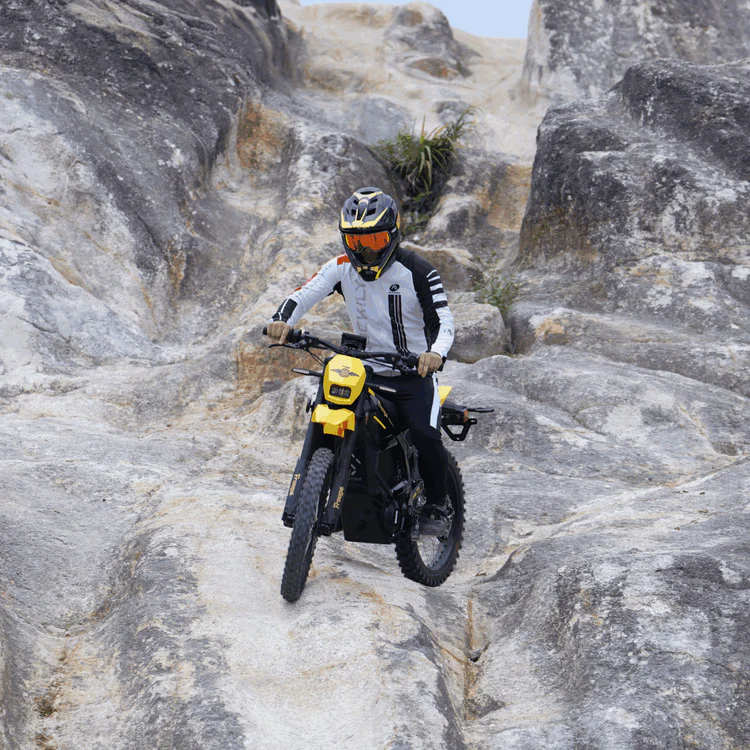
What to ask a supplier: how many speed-reduction stages does the mid-drive use, is power delivered through a chain drive or a belt, what is the service interval for the drivetrain, and how does the declared climbing figure scale with rider weight? Freego publishes climbing capacity per model — ≥40% slope for the Nova 3, ≥40% slope for the Nova 4, and ≥45% slope for the Nova 5 — which is the kind of number a mid-drive label should be able to support.
Term 2 — All-Terrain: A Terrain-Envelope Label
“All-terrain” is a claim about where the bike can be ridden, so it should be verifiable from four components: tyres, suspension, brakes and wheel size. When a supplier uses the label without those four details, the label is decorative rather than informative.
The Freego dirt bike range applies the label across both motor families. The Medium Size All-Terrain Electric Dirt Bike (X1) pairs 3.15x17 puncture-resistant motorcycle-grade tyres on 17-inch alloy rim spoke wheels with a KKE brand hydraulic shock absorber and automotive-grade 21700 lithium-ion cells. The All-Terrain Electric Dirt Bike (X2) uses 70/100-19 pneumatic motorcycle-grade tyres, hydraulic front and rear shock absorbers, a 100A/300A high-power brushless motor controller and a declared climbing capacity of ≥25°. The High-Performance All-Terrain Electric Dirt Bike (X2 Pro) adds KKE brand hydraulic front and rear shock absorbers, a 203 mm 4-piston hydraulic disc brake rotor and Panasonic/LG 21700 lithium-ion cells. The Ultra-Long Range Pedaled All-Terrain Electric Dirt Bike (X3) moves to 70/100-19 heavy-duty motorcycle-grade tyres with a high-performance hydraulic inverted suspension fork and a ≥30° climbing figure.
The same logic appears in the Nova line: the Nova 4 uses an inverted suspension fork, and the Nova 5 uses KKE brand hydraulic shock absorbers with heavy-duty all-terrain motorcycle-grade tyres.
Verification checklist for an all-terrain claim
- Tyre specification, not just “fat tyres”. Dimensions such as 70/100-19, 80/100-17 or 3.15x17 indicate real motorcycle-grade sizing; “all-terrain tyres” alone does not.
- Suspension type and brand. Inverted forks and named shock absorbers (KKE on X1, X2 Pro, Nova 5 and Nova 5 pro) are traceable; generic “upgraded suspension” is not.
- Brake hardware. Piston count and rotor diameter are the difference between a leisure bike and a performance bike — 2-piston with 220 mm rotor on the Nova 3, 4-piston with 203 mm rotor on the X2 Pro and Nova 5 pro.
- Climbing figures with units. Freego publishes ≥25° for the X2, ≥30° for the X3, and ≥40% to ≥45% slope for the Nova 3, Nova 4 and Nova 5. Buyers should confirm whether a supplier is quoting degrees or gradient percentage before comparing models.
Term 3 — Ultra-Long Range Pedaled: Capacity Plus Drivetrain
The third label combines two claims that are usually written together but should be evaluated apart. “Ultra-long range” is a battery and efficiency claim. “Pedaled” is a drivetrain claim — the bike retains pedals and a chain-driven transmission rather than being throttle-only.
The model that carries this full label in the Freego range is the Ultra-Long Range Pedaled All-Terrain Electric Dirt Bike (X3): 8000W peak brushless hub motor, 72V 40Ah or 50Ah lithium-ion 21700 cells, 28 mph urban mode and 56 mph off-road mode, up to 110 mi per charge, 150 kg maximum loading, a 4-piston hydraulic disc brake, a ≥30° climbing capacity, a high-performance hydraulic inverted suspension fork, and a high-capacity 21700 pack built from 160 cells.
Placed against the rest of the range, the 110 mi figure is clearly a different class of claim rather than an incremental improvement:
| Model | Declared maximum range | Battery | Position in the range |
|---|---|---|---|
| Nova 5 MINI | 35 mi per charge | 48V 21Ah | Compact mid-drive |
| Nova 3 | 50 mi Eco / 20 mi Sports | 60V 25Ah 21700 | Entry-level mid-drive all-terrain |
| Nova 4 | 50 mi Eco / 25 mi Sports | 60V 30Ah 21700 | Mid-grade mid-drive |
| X2 / X2 Pro | 56 mi per charge (X2); 56 mi city / 20 mi off-road (X2 Pro) | 60V 30Ah 21700 | Hub-motor all-terrain |
| Nova 5 / Nova 5 pro | 70 mi per charge | 72V 40Ah 21700 | High-power mid-drive |
| X3 | 110 mi per charge | 72V 40Ah / 50Ah 21700 | Ultra-long range pedaled all-terrain |
What to ask a supplier: under which mode was the range figure measured (Eco, Sports, urban or off-road), at what rider weight and terrain, and does the frame accept the higher-capacity pack variant without changing geometry? Note that the X3 is offered with both 40Ah and 50Ah configurations, so range and weight should be quoted together at the point of order.
Step-by-Step: Five Questions That Decode Any Dirt Ebike Label
- Which axis does the label describe? Architecture (mid-drive, hub motor, inverted fork), envelope (all-terrain, tyre and suspension spec) or status (street-legal, dual-mode, certified). Write the answer next to the label before comparing anything.
- What does the supplier commit to in writing? A label should resolve into numbers. Mid-drive should resolve into motor peak power and climbing capacity; all-terrain into tyre size, suspension type and brake hardware; ultra-long range into battery voltage, amp-hours and the mode in which the range was measured.
- Which tier does the label sit in? Freego’s own naming shows how wide a single label can stretch: entry-level mid-drive all-terrain (Nova 3) through to a 15000W premium pro-grade mid-drive model (Nova 5 pro). Two catalogues using the same word may not be competing products at all.
- Which market rules apply? Speed and power decide the regulatory treatment in the United States under the Class 1–3 framework, and in the European Union under L1e and L3e classifications. A dual-mode architecture — such as the Freego X-Man series, which offers a City Mode and an Off-Road Mode — gives a buyer a restricted setting for regulated environments and an unrestricted setting for private terrain, but the buyer still has to confirm the local rules.
- What does the label cost you in service terms? A mid-drive drivetrain has different wear points from a hub motor; a 110 mi pack changes charging infrastructure assumptions for rental operators; a 4-piston brake needs different pad inventory from a 2-piston unit. Freego publishes a 2-year limited warranty split as 2 years for the frame and 1 year for core electrical components, which is the type of detail to compare line by line rather than by label.
Use Cases: Which Label Matches Which Buyer
Powersports retailers targeting gas-to-electric conversion
A United States powersports retailer that took strategic stock of high-performance models from the Nova and X-Man series for off-road racing, mountain trail exploration and hunting reported success in attracting customers transitioning from gas-powered vehicles and expanding into high-ticket adventure buyers, over a 2–3 year relationship. For this buyer, the labels that matter most are mid-drive, 72V high-voltage platform and 4-piston braking.
Distributors and authorised dealers building a tiered line-up
Freego’s authorised dealer case in the United States describes annual volumes of 500+ units per dealer over 5+ years of partnership, and reports a 95% dealer retention rate and establishment as a top-selling brand in the mid-to-high performance segment. A tiered line-up needs a compact mid-drive model, an entry-level all-terrain model and a flagship in order to cover riders rather than one label repeated at three prices.
Local e-bike shops selling street-legal units
A separate United States programme covering more than 120 local e-bike shops reports 10–20 units purchased per store monthly and an annual supply exceeding 12,000 units, with key features including 3–8 business day spot delivery from US local warehouses, a full model range with UL2849 street-legal certification, a 2-year limited warranty with US local after-sales support, and reported cost performance 40% lower than peer high-end products.
Rental fleets and adventure tourism operators
The X3, X2 Pro, Nova 4 and Nova 5 all list rental and ride-sharing or outdoor adventure tourism among their applicable industries. Range, charging downtime and brake service intervals — not top speed — usually decide which model enters a rental fleet.
Teen and adult dual-use households
Models with dual-mode speed settings allow one platform to serve two riders: the Nova 3 runs a 28 mph kid-safe mode against a 40 mph turbo mode, and the Nova 5 MINI is positioned for teens and adults as a compact off-road bike. The label to check here is not “mid-drive” but the low-speed mode figure.
Comparison Table: How the Labels Map to Verified Models
| Label | What it actually describes | Freego models carrying the label | Sourcing question to ask |
|---|---|---|---|
| Mid-drive | Motor architecture: crank-mounted motor driving through a chain and speed reduction | Entry-Level Mid-Drive All-Terrain Electric Dirt Bike (Nova 3); Compact Mid-Drive Electric Dirt Bike (Nova 5 MINI); Mid-Grade Mid-Drive Electric Dirt Bike (Nova 4); High-Power Mid-Drive All-Terrain Electric Dirt Bike (Nova 5); Premium Pro-Grade Mid-Drive Electric Dirt Bike (Nova 5 pro) | How many speed-reduction stages, and what climbing figure does it support? |
| All-terrain | Terrain envelope: tyre specification, suspension type, brake hardware, wheel size | Medium Size All-Terrain Electric Dirt Bike (X1); All-Terrain Electric Dirt Bike (X2); High-Performance All-Terrain Electric Dirt Bike (X2 Pro); Ultra-Long Range Pedaled All-Terrain Electric Dirt Bike (X3); plus all-terrain variants in the Nova series | What tyre size, suspension brand and brake rotor are specified? |
| Ultra-long range | Battery capacity and measured range claim | Ultra-Long Range Pedaled All-Terrain Electric Dirt Bike (X3), 110 mi per charge | In which mode, at what load, was range measured? |
| Pedaled | Drivetrain: retains pedals and chain-driven transmission | Ultra-Long Range Pedaled All-Terrain Electric Dirt Bike (X3) | Does the pedal drivetrain affect service intervals or legal classification in my market? |
| High-torque / high-voltage | Platform voltage and output class | 8000W mid-drive on a 72V 40Ah platform (Nova 5); 8000W hub motor on 72V 40Ah or 50Ah (X3); 15000W mid-drive on 72V 40Ah (Nova 5 pro) | Which charger, pack variant and controller current rating ship with the unit? |
Mid-drive Nova series at a glance
| Model | Motor | Battery | Top speed | Range | Brake | Climbing |
|---|---|---|---|---|---|---|
| Nova 5 MINI | 2500W mid-drive | 48V 21Ah | 37 mph | 35 mi | Hydraulic disc | Not published |
| Nova 3 | 3000W mid-drive | 60V 25Ah 21700 | 28 mph kid-safe / 40 mph turbo | 50 mi Eco / 20 mi Sports | 2-piston, 220 mm rotor | ≥40% slope |
| Nova 4 | 6000W mid-drive | 60V 30Ah 21700 | 28 mph Eco / 45 mph Sports | 50 mi Eco / 25 mi Sports | 4-piston hydraulic disc | ≥40% slope |
| Nova 5 | 8000W mid-drive | 72V 40Ah 21700 | 53 mph | 70 mi | 4-piston hydraulic disc | ≥45% slope |
| Nova 5 pro | 15000W mid-drive | 72V 40Ah 21700 | 62 mph street-legal / 56 mph off-road | 70 mi | 4-piston, 203 mm rotor | Not published |
X-Man series: the all-terrain and long-range reference points
| Model | Motor | Battery | Top speed | Range | Brake | Climbing |
|---|---|---|---|---|---|---|
| X1 | 3600W hub | 60V 25Ah 21700 | 28 mph urban / 40 mph off-road | 50 mi Eco / 20 mi Sports | 4-piston hydraulic disc | Not published |
| X2 | 6000W hub | 60V 30Ah 21700 | 28 mph urban / 50 mph off-road | 56 mi | 4-piston hydraulic disc | ≥25° |
| X2 Pro | 6000W hub | 60V 30Ah 21700 (Panasonic/LG) | 28 mph urban / 50 mph off-road | 56 mi city / 20 mi off-road | 4-piston, 203 mm rotor | Not published |
| X3 | 8000W hub | 72V 40Ah / 50Ah 21700 | 28 mph urban / 56 mph off-road | 110 mi | 4-piston hydraulic disc | ≥30° |
Frequently Asked Questions
Do mid-drive and all-terrain dirt ebikes need certification to be sold in the United States?
Certification is a market-status question and is separate from the architecture or terrain label. Freego holds an SGS Certificate of Compliance (SGSNA/24/SZ/00059) issued by SGS North America Inc. on 29 January 2024 to ANSI/CAN/UL 2849-2022 for electric bikes, covering the X-Man and Nova series among other models, plus a second SGS certificate (SGSNA/24/SZ/00058) to the same standard, a UL 2849 test report (LTR24100903HS, UL 2849:2020+R:2022-06+R:2022-12) issued by Guangdong Lintek Certification Group on 10 October 2024, and a Supplier’s Declaration of FCC Conformity (HK2210194593E, FCC Part 15 Subpart B) issued by HUAK on 26 October 2022. Buyers should still confirm the applicable speed class and local rules in their own market, because vehicles exceeding the Class 1–3 speed limits are generally regulated as off-road motor vehicles.
Does a mid-drive motor change what a dirt ebike can climb compared with a hub motor?
Mid-drive motors drive through the bike’s transmission rather than the wheel hub, so they can use gear reduction to multiply torque at the rear wheel; technical comparisons of the two architectures also cite centralised weight distribution as a reason mid-drive units are increasingly preferred for off-road use. In the Freego range, the mid-drive models carry published climbing figures of ≥40% slope (Nova 3 and Nova 4) and ≥45% slope (Nova 5), while the hub-motor X2 is rated at ≥25° and the X3 at ≥30°. Because these figures are published in different units, buyers should confirm whether a supplier quotes degrees or gradient percentage before comparing models.
If budget is limited, which tier should a dealer stock first?
Freego does not publish list prices in this material, so the practical answer is tier logic rather than a number. The lowest-commitment entry into the range is the Global Brand Distribution programme, which is listed with a minimum order quantity of 12 units or 1 pallet and 3–8 business day spot direct delivery from the US local warehouse. On the product side, the entry-level mid-drive all-terrain model (Nova 3) and the compact mid-drive model (Nova 5 MINI) sit below the flagship tiers. For reference, Freego’s United States local e-bike shop case reports cost performance 40% lower than peer high-end products, alongside a reported 30% stable profit margin for store operations. For OEM custom production, the published minimum is 50 units per model with mixed orders of the same series calculable.
Can a dealer validate a model before committing to a full order?
Yes, and the validation path differs by programme. Spot customisation such as logo printing or packaging can be handled from the US local warehouse, with Pre-Delivery Inspection performed locally. For full OEM production, Freego lists logo printing, frame colour customisation, motor power labelling and battery capacity selection as customisation options, with a published minimum of 50 units per model and third-party inspection support through UL, CE or SGS with an official report. For original design work, the ODM programme lists vehicle structure industrial design, power and electronic control module development, IoT function integration and exclusive appearance patent design, with product design and prototyping at 15–20 days and a minimum of 100 units per model. Sample and catalogue requests can be sent to Dealers@freegobikes.com.
What lead times apply to OEM custom production versus US spot orders?
Published lead times differ substantially by route. Custom production from the China factory under the OEM programme is listed at 45–60 days, while spot customisation such as logo or packaging from the US local warehouse is listed at 3–8 business days. ODM mass production after custom design confirmation is listed at 50–70 days, following a 15–20 day design and prototyping phase. IoT solution development, which covers 4G/GPS modules, a sharing management dashboard, a branded user app and geofencing firmware, is listed at 30–45 days with a minimum of 100 units. If your launch calendar is tight, the fastest path to a market test is the US-warehouse route rather than a factory-custom build. To discuss which route fits your schedule, contact the Freego team at Ahmed@freegobikes.com or review the full product catalogue first.
Conclusion: Decode the Label Before You Price the Container
Mid-drive, all-terrain and ultra-long range pedaled are not competing descriptions of the same bike. They are a motor-architecture term, a terrain-envelope term and a capacity-plus-drivetrain term, and each one maps to a different set of verification questions. A supplier catalogue becomes readable once you ask which axis a label describes, what numbers sit behind it, which tier it represents, which market rules apply, and what it costs you in service and parts.
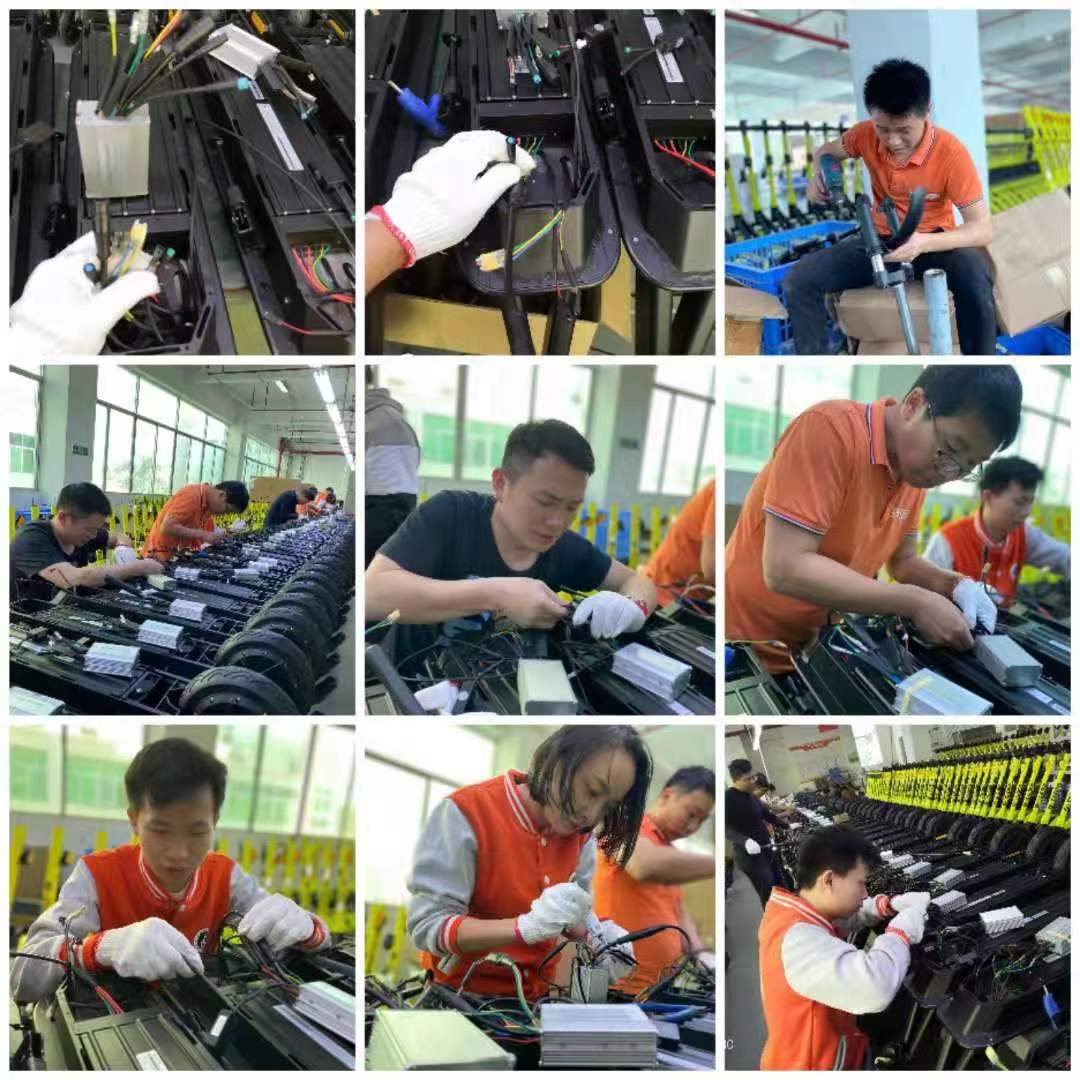
Freego has built its dirt bike range around exactly that structure: a mid-drive Nova series spanning 2500W compact to 15000W pro-grade models, a hub-motor X-Man series covering 3600W to 8000W platforms with dual-mode urban and off-road settings, and an ultra-long range pedaled all-terrain model rated at up to 110 mi per charge. The company operates a 3,000 m² facility with a 10+ engineer R&D team, exports approximately 90% of output to more than 40 countries, and supports its network with a 2-year limited warranty, US local spare parts and 200+ authorised service centres.

Next Step for Dealers, Distributors and Fleet Buyers
If you are ready to turn these terms into a line-up decision, Freego can support the process from sample validation through to OEM or ODM production. Review the full product catalogue, then request a quote or arrange a sample so the labels on the spec sheet can be verified on the bike.
Download the product catalogue: Freego product catalogue (PDF)
Website: freegobikes.com
Dealer inquiries: Dealers@freegobikes.com
Contact: Ahmed · Ahmed@freegobikes.com · Tel +1 818 275 1590 · WhatsApp +1 310 678 1530
Address: 3681 Walnut Ave, Chino, CA 91710, United States
Have Questions or Need More Details?
Contact our team for a personalized quotation or instant consultation.
Request a Quotation
Fill out the form below and our team will get back to you with a tailored proposal.
WhatsApp Direct Chat
Prefer to chat in real-time? Message us on WhatsApp for instant assistance & quick answers.
- Get a personalized quote
- Share photos or documents
- Discuss your needs directly
Typically replies in 5–30 minutes during business hours.