Dirt Ebike Compliance How-To: Building a Regional Requirements File for Mid-Drive Models
A regional requirements file is a controlled document set that ties one specific mid-drive dirt ebike configuration to one specific market. It fixes the classification question the order is answering, freezes the configuration being bought, records verified component data, lists conformity and test evidence in the issuer's own scope language, states the label and software settings the units will ship with, and attaches the purchasing terms and acceptance criteria the buyer will test against. Build it before the purchase order, not after the container arrives.
This guide is written for distributors, importers, brand owners and fleet buyers working with mid-drive platforms. It uses Freego's four mid-drive dirt ebike tiers as worked examples of how a configuration decision turns into a documentation obligation.
Freego USA Inc. is an electric mobility manufacturer and brand headquartered in Chino, California, founded in 2012. Freego operates a 3,000 m² factory with a 10+ engineer R&D team, exports approximately 90% of output to more than 40 countries and regions, and reports annual sales of approximately 20,000 vehicles.
Why Most Dirt Ebike Compliance Files Fail Before They Are Filed
Files fail when they describe the product instead of describing the decision. Three failure patterns account for most of the rework that distributors and brand owners absorb after an order has already been placed.
Failure 1: Catalog language treated as legal classification
A product listing that describes a model as street-legal is a commercial descriptor, not a regulatory determination. Freego's own data layer flags this point explicitly: a software-governed speed preset around 28 mph on certain models, or a street-legal phrase inside a product name, does not by itself establish street legality, because legal definitions and jurisdictional thresholds differ between markets. A file that copies the label without re-testing the definition is not a compliance file — it is a copy of the catalog with a cover page.
Failure 2: Peak and nominal power merged into one number
Freego's published Nova specifications state peak motor power, from 2,500 W on the compact tier to 15,000 W on the premium tier. Freego materials also report nominal and peak power as separate figures on other models in the range. Merging the two into a single power field destroys comparability and makes the configuration impossible to defend during a review, because the reviewer cannot tell which number was tested.
Failure 3: Evidence copied without issuer, revision, scope or expiry
A certificate image with no issuing body, no standard revision and no scope line is unusable to a customs broker, an insurer or a dealer's legal reviewer. Freego's own documentation set shows why this matters: two separate records list Nova dirt bike models among their related products, but one of them carries a scope written for self-balancing electric scooters and electric mobility devices. The file must quote the scope exactly and flag applicability for confirmation rather than assume it.
Industry Background: Classification Is a Market Question, Not a Product Spec
Mid-drive dirt ebikes sit on a classification boundary that shifts by jurisdiction. In the United States, an excerpted CPSC standards summary describes an electric bicycle definition built around operational pedals and a maximum speed of less than 20 mph when operated solely by electric power. A 2026 regulatory note in our verified data layer records that electric motorcycles above 750 W without pedals are reclassified as Off-Highway Vehicles (OHV) in California, which triggers registration and decal requirements. A separate federal pathway exists for electric motorcycles through US EPA certification. These are different doors into the market, and they carry different paperwork.
Commercial interest in the category is rising alongside the rule-making. One commercial research estimate places the global electric dirt bike market at USD 1.47 billion in 2025, with a projection of USD 5.0 billion by 2035. Distributors reading that number should treat it as a demand signal, not as a substitute for the classification work, because demand does not resolve which door a given configuration enters.
For destinations outside the United States, our verified data layer does not yet contain a market-by-market classification table. That is not a gap to paper over. It is a line item: the file should record the open question, the reviewer who owns it, and the date it must be closed before stock is committed.
The Six Sections Every Regional Requirements File Needs
A workable file for a mid-drive dirt ebike is short, but it is not thin. Six sections cover the whole purchase decision end to end.
Section A — Market and classification statement
Name the destination market, the intended use (public road, private land, rental fleet, competition), and the classification question the order depends on. State the classification as a question with an owner and a deadline, not as an assumption. Where a national definition is unresolved, record the state, provincial or municipal layer separately rather than averaging them into one statement.
Section B — Frozen configuration record
One model, one variant, one bill of configuration. Record the model name and model designation exactly as the manufacturer publishes them, plus every option that changes the technical file: motor power labelling, battery capacity selection, frame colour, controller rating, speed mode set. Freego's OEM customization scope includes logo printing, frame colour customization, motor power labelling and battery capacity selection, which means the configured variant — not the model family — is what gets documented.
Section C — Verified component register
List the components that carry documentation weight, each with its source: mid-drive motor peak power, battery voltage and capacity, cell format, brake caliper and rotor size, suspension brand and type, frame material, tyre size, controller rating, stated top speed per mode, stated range per mode, and maximum load. Every entry needs a source reference and a date, because a specification quoted without a source is an opinion.
Section D — Conformity evidence register
This is the section reviewers actually read. Each record gets its issuing body, standard and revision, certificate or report number, issue date, expiry where applicable, the exact scope wording, and the models it names. The table below shows how Freego's records look when filed this way.
| Record | Issuing body | Standard and stated scope | Number and date | What the file must confirm |
|---|---|---|---|---|
| UL 2849 test report | Guangdong Lintek Certification Group Co., Ltd. | UL 2849:2020+R:2022-06+R:2022-12 — Electrical Systems for eBikes | LTR24100903HS, issued 2024-10-10 | That the exact variant is named in the related product list, and that the tested electrical configuration matches the order |
| Certificate of Compliance | SGS North America Inc. | ANSI/CAN/UL 2849-2022 — electric bikes electrical systems | SGSNA/24/SZ/00058, issued 2024-01-29, expiry 2028-06-01 | Expiry date and product list coverage |
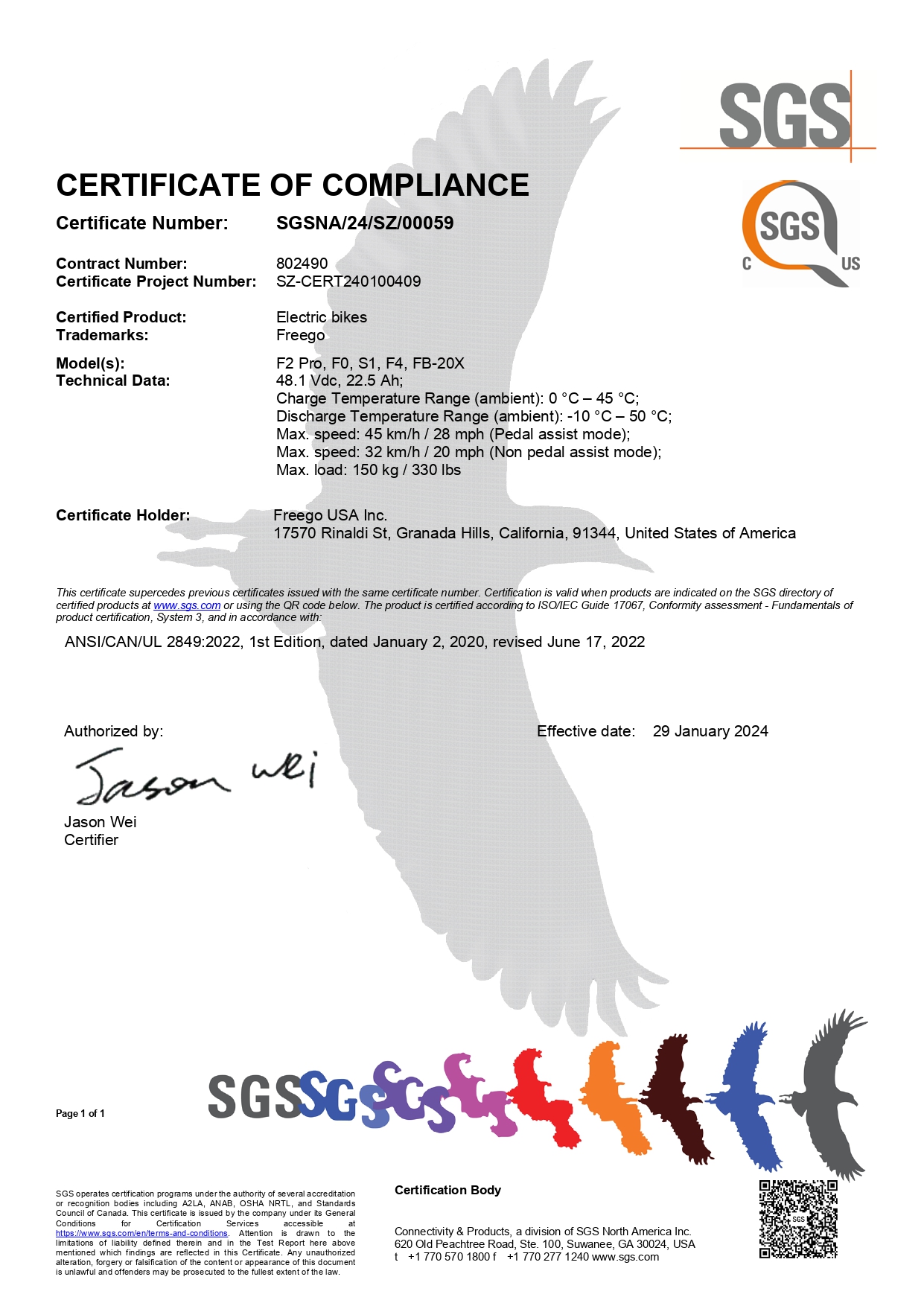
| Certificate of Compliance | SGS North America Inc. | ANSI/CAN/UL 2849-2022 — Electric Bikes | SGSNA/24/SZ/00059, issued 2024-01-29 | That the scope wording matches the product category being filed |
| Supplier's Declaration of FCC Conformity | HUAK (Shenzhen HUAK Testing Technology Co., Ltd.) | FCC Part 15 Subpart B — Electric Bikes | HK2210194593E, issued 2022-10-26 | Whether the model in the order appears in the related product list |
| Verification of FCC Conformity | POCE (Shenzhen POCE Technology Co., Ltd.) | FCC Part 15 Subpart B: 2014 — Self-Balancing Electric Scooters and Electric Mobility Devices | POCE15101614GF, issued 2015-10-16 | Scope wording differs from the product category; applicability must be confirmed before filing |
Two observations follow from that register. First, only the electrical-systems record is written in the language of eBike electrical systems, so it is the natural anchor for a mid-drive file. Second, the 2015 FCC verification names the Nova dirt bike models among its related products while its stated scope refers to self-balancing scooters and electric mobility devices — a reviewer will ask about that, and the file should answer before the reviewer does.
Section E — Label, software and disclosure record
Record what the unit will physically carry and what the controller will allow: the data plate content, motor power marking, battery and charger markings, and the speed mode set delivered to the customer. Where a market restricts a mode, state how the restriction is applied, who applies it, and how it is verified at delivery. Treat every software setting as a configurable feature to be documented, not as proof of legal status.
Section F — Purchasing terms and acceptance criteria
Technical evidence without commercial terms produces disputes. Freego's stated terms are a useful template: MOQ of 1 unit for a sample display order and 12 units (one full pallet) for a standard wholesale bulk order; delivery via US local warehouse door-to-door, EXW Huizhou manufacturing factory, or FOB Shenzhen; acceptance through local service centre inspection and compliance verification; payment on upfront terms for wholesale with hassle-free restocking. Put these in the same file as the component register so one document answers both questions.
Step-by-Step: Assembling the File in Seven Steps
- Fix the market and the legal question first. Write one sentence naming the destination and intended use, then list the classification questions that sentence opens. Do not begin with the product.
- Select the tier against the use, not the spec sheet. A 15,000 W premium platform and a 2,500 W compact platform answer different briefs; the file inherits the brief.
- Freeze the configuration. Lock model, motor power labelling, battery capacity, controller rating and speed mode set. Any option that can move after sign-off is a documentation risk.
- Normalize the power language. Record peak and nominal separately, label which is which, and never carry one figure into a market submission without stating its basis.
- Build the evidence register from the source documents. Copy issuer, standard revision, number, issue date, expiry and scope verbatim. Where scope wording and product category diverge, record the divergence rather than resolving it internally.
- Attach purchasing terms and acceptance criteria. MOQ, delivery terms, inspection method and restocking policy belong next to the technical sections.
- Set the re-review triggers. A new market, a changed controller or battery, a revised standard, or an expiring certificate each reopens the file. Date the review, name the owner, and keep the superseded version.
Decision rule: if a claim in the file cannot be traced to a document with an issuer, a number and a date, it is a marketing statement and should be moved out of the evidence section before anyone outside the company reads it.
Use Cases: How Different Buyers Use the Same File Structure
A US distributor splitting an order across two tiers
A distributor stocking both an entry-level mid-drive for youth and rental programmes and a high-power tier for experienced riders needs one file with two configuration records, not two files. The lower-output configuration keeps more of the discussion inside e-bike terminology; the higher-output configuration forces an explicit statement about who may legally register, insure and sell it in the destination state. Freego works with more than 120 local e-bike shops in the United States, and that dealer channel is where classification questions surface first.
A brand owner entering a market with no resolved classification table
Where our verified data layer holds no classification entry for a destination, the file should not guess. Write the question, assign the reviewer, set a deadline before stock commitment, and hold the order release until the line is closed. The file remains usable while the question is open — it simply records that the decision is pending.
A rental fleet standardising on one platform
Fleet buyers add a second layer of documentation: rider eligibility, mode restrictions and inspection intervals. A compact mid-drive tier with a 100 kg maximum load and a stated 37 mph top speed produces a different fleet policy from a 150 kg, 53 mph platform. The file should record the policy alongside the technical record, because insurers ask for both.
A powersports retailer moving customers from gas to electric
Powersports retailers carrying high-performance models for off-road racing, mountain trail exploration and hunting are documenting 72 V and 8000 W-class platforms for a customer base that already understands vehicle registration. Their file tends to be stronger on classification and weaker on component traceability; both sections are needed before a dealer network can sell with confidence.
Mid-Drive Tier Comparison: What Each Freego Tier Asks You to Document
The four mid-drive tiers below are drawn from Freego's published Nova specifications. The last column is the part most buyers skip: what the tier forces into the file.
| Tier and model | Peak motor and battery | Stated speed and range | Braking and suspension | What the file must pin down |
|---|---|---|---|---|
| Premium Pro-Grade Mid-Drive — Nova 5 pro | 15,000 W mid-drive; 72 V 40 Ah lithium-ion 21700; 150 A / 400 A controller | 62 mph in its street-legal setting / 56 mph off-road; 70 mi per charge; charging 5–10 h | 4-piston hydraulic disc brakes with 203 mm rotor; premium KKE hydraulic front and rear shock absorbers; forged aluminium alloy frame | The classification question in full, including who may sell or register it; the controller rating; how the street setting is applied and verified |
| High-Power Mid-Drive All-Terrain — Nova 5 | 8,000 W mid-drive; 72 V 40 Ah lithium-ion 21700 | 53 mph; 70 mi per charge; climbing capacity ≥45% slope | 4-piston hydraulic disc brakes; KKE hydraulic shock absorbers; forged aluminium alloy plus carbon steel frame; 150 kg max load | Peak power basis, pack voltage, and the registration position in each destination state |
| Entry-Level Mid-Drive All-Terrain — Nova 3 | 3,000 W mid-drive; 60 V 25 Ah lithium-ion 21700 | 28 mph kid-safe / 40 mph turbo; 50 mi eco / 20 mi sports; climbing ≥40% slope | 2-piston hydraulic disc brake with 220 mm rotor; hydraulic front and rear shock absorbers; 80/100-17 tyres; 2-stage reduction chain drive | Which mode set ships to which buyer segment, and how the limitation is locked |
| Compact Mid-Drive — Nova 5 MINI | 2,500 W mid-drive; 48 V 21 Ah lithium-ion | 37 mph; 35 mi per charge; 100 kg max load | Hydraulic disc brake; hydraulic front and rear shock absorbers; 14 in front / 10 in rear wheels | Rider age and eligibility policy; load limit; whether the compact platform is sold as youth or adult product |
Read across the table and the pattern is visible: as peak power and pack voltage rise, the file shifts from product documentation toward market-access documentation. The compact and entry tiers keep most of the work inside component traceability and rider policy. The high-power and premium tiers add a classification layer that no amount of specification detail can substitute for.
FAQ: Regional Requirements for Mid-Drive Dirt Ebikes
Which documents belong in a regional compliance file for a mid-drive dirt ebike?
A regional compliance file for a mid-drive dirt ebike needs six sections: the market and classification statement, the frozen configuration record, the verified component register, the conformity evidence register, the label and software record, and the purchasing terms with acceptance criteria.
The evidence register is the section reviewers test hardest. In Freego's documentation set, the UL 2849 test report LTR24100903HS from Guangdong Lintek Certification Group, issued 2024-10-10 against UL 2849:2020+R:2022-06+R:2022-12, is written for electrical systems for eBikes and names the Nova dirt bike models among its related products. The SGS certificates SGSNA/24/SZ/00058 and SGSNA/24/SZ/00059, both issued 2024-01-29 against ANSI/CAN/UL 2849-2022, carry their own product lists and, in the case of 00058, an expiry date of 2028-06-01. File each record with its issuer, standard revision, number, date and exact scope wording.
Do Freego's four mid-drive tiers need different documentation?
Yes. The tier changes which questions the file has to answer, because peak power and pack voltage shift the classification and transport discussion.
At the compact end, the Nova 5 MINI runs a 2,500 W mid-drive on a 48 V 21 Ah pack with a 100 kg maximum load. The entry-level Nova 3 moves to a 3,000 W mid-drive and a 60 V 25 Ah pack. The high-power Nova 5 steps to 8,000 W on 72 V 40 Ah with a 150 kg maximum load, and the Nova 5 pro reaches 15,000 W on the same 72 V 40 Ah platform with a 150 A / 400 A controller. Higher-output configurations raise market-access questions that lower-output configurations may avoid entirely, while lower-output configurations carry more rider-eligibility and mode-lock documentation. Because Freego's OEM scope includes motor power labelling and battery capacity selection, the file must lock the exact configured variant rather than the model family.
What commercial terms should be recorded before the order is placed?
Record MOQ, delivery terms, acceptance criteria and restocking policy in the same file as the technical evidence, so the order can be tested against one document.
Freego's stated terms are MOQ of 1 unit for a sample display order and 12 units, one full pallet, for a standard wholesale bulk order; delivery through US local warehouse door-to-door, EXW Huizhou manufacturing factory, or FOB Shenzhen; acceptance through local service centre inspection and compliance verification; and upfront payment for wholesale with hassle-free restocking. Two cost drivers are routinely missed when the file is assembled late: model-mix complexity, because each additional configuration needs its own record, and re-documentation, because any change to controller, battery or speed mode set after sign-off reopens the evidence register.
Should a sample unit be inspected before the file is signed off?
Yes — inspect the sample against the frozen configuration record, not against the catalog.
A sample display order starts at one unit, which makes pre-sign-off inspection practical. Check the data plate and motor power marking, the battery and charger markings, the delivered speed mode set, and the brake and suspension hardware against the component register. If the sample and the register disagree, the file is wrong, not the sample, and the discrepancy is easier to resolve before a pallet order than after.
How long does it take to prepare a region-ready mid-drive order?
Lead time depends on whether the configuration is spot stock or a custom build.
Custom OEM production from the China factory runs 45–60 days, while spot customization such as logo or packaging from the US local warehouse runs 3–8 business days. Under ODM, design and prototyping take 15–20 days and mass production after design confirmation takes 50–70 days. Custom IoT solution development, where a sharing or fleet-management layer is part of the order, runs 30–45 days. Distributors who want to start with a single reference unit before committing to a pallet can request a sample display order and use that unit to close the acceptance section of the file.
Conclusion: The File Is a Decision Tool, Not Paperwork
A regional requirements file earns its place when it changes a decision. It stops a distributor from stocking a configuration that cannot be registered in the destination state, stops a brand owner from filing a certificate whose scope does not match the product, and stops a fleet buyer from discovering a mode restriction after delivery. The work is unglamorous — freeze the configuration, quote the scope line verbatim, record peak and nominal separately, attach the terms — but it is the difference between a purchase order and a defensible purchase order.
Start with one model and one market. Build the six sections, close the classification question with a named owner, and only then scale the file across the rest of the range. Freego's mid-drive tiers give you four different documentation workloads to practise on, from a 2,500 W compact platform to a 15,000 W premium build, and each one teaches the same lesson from a different angle: the specification tells you what the bike is, and the file tells you what you are allowed to do with it.
Next Step: Build Your First File With a Reference Unit
Select one mid-drive tier, request a sample display order, and use the delivered unit to close the component and label sections of your regional requirements file before releasing a pallet order.
Freego product specifications, model data and configuration options are compiled in the current catalogue: download the Freego product brochure (PDF). Product details are also published at freegobikes.com.
For sample requests, configuration questions or regional documentation support, contact Ahmed at Ahmed@freegobikes.com, by telephone on +1 818 275 1590, or via WhatsApp. Freego USA Inc., 3681 Walnut Ave, Chino, CA 91710.
Have Questions or Need More Details?
Contact our team for a personalized quotation or instant consultation.
Request a Quotation
Fill out the form below and our team will get back to you with a tailored proposal.
WhatsApp Direct Chat
Prefer to chat in real-time? Message us on WhatsApp for instant assistance & quick answers.
- Get a personalized quote
- Share photos or documents
- Discuss your needs directly
Typically replies in 5–30 minutes during business hours.