Ranking 6 Freego Mid-Drive Dirt Ebike Classes by Project Fit
Freego's mid-drive dirt ebike range is easier to buy from as a six-class ladder than as a single product line. The ranking below orders those classes the way a dealer, fleet buyer, or project manager actually builds an assortment: the premium pro-grade class first, then the ultra-long-range pedaled all-terrain class that Freego positions for extended-range projects, then the climbing, trail, dual-mode, and compact entry classes. Each entry states who the class fits, what it is positioned to do, and which facts should be confirmed before an order is committed.
A mid-drive dirt ebike is an off-road electric two-wheeler whose motor drives through the bottom bracket and the bike's gearing, rather than directly through the wheel as a hub motor does. Freego documents both architectures in its off-road range: the Nova series uses mid-drive motors, while the X series uses hub motors. That boundary matters, because the two families answer different project questions and should not be merged into one comparison column.
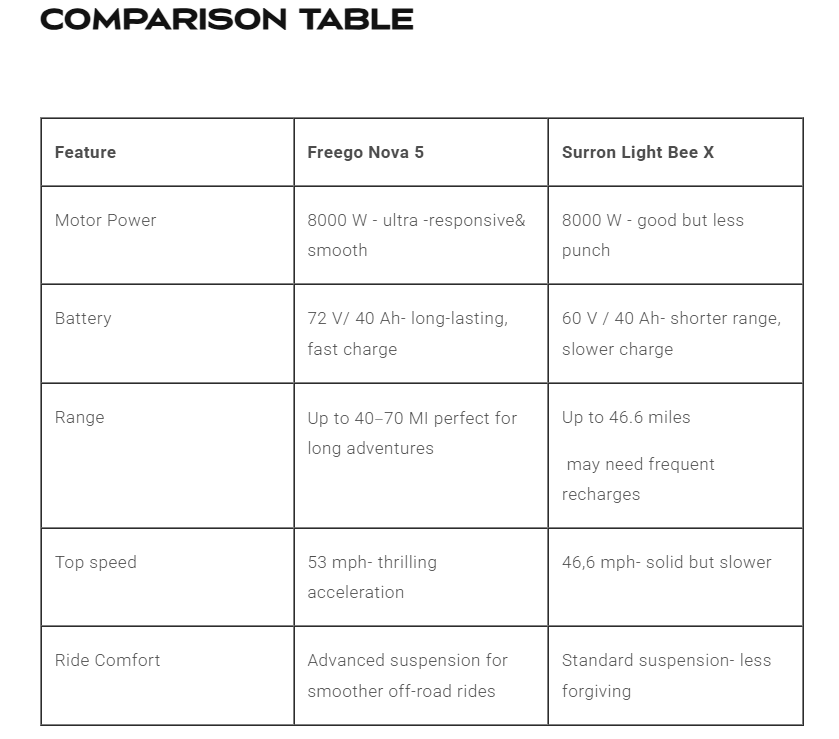
Freego X2 Pro, taken from Freego's published dual-mode comparison against a mainstream off-road-only model. The X2 Pro belongs to the hub-motor X series; the mid-drive family ranked in this article is the Nova series.
The six classes at a glance, in ranking order:
- Premium pro-grade mid-drive — the most build-intensive tier, aimed at expert and competitive duty.
- Ultra-long-range pedaled all-terrain mid-drive — positioned for extended-range projects with sustained pedaling input.
- High-torque climbing mid-drive — steep, loaded, and sustained ascents.
- Full-suspension inverted-fork trail mid-drive — technical trail, comfort duty, and mixed-ability rental use.
- Dual-mode street-legal mid-drive — projects that need governed road access plus off-road capability.
- Entry-level and compact mid-drive — first-time riders, tight trails, and light fleet duty.
The order reflects assortment build sequence and duty-cycle intensity. It is not a claim that a lower-ranked class performs worse for every buyer.
Problem Definition: Why Wattage-First Comparisons Mislead Off-Road Buyers
Most first-pass dirt ebike comparisons sort models by motor wattage. That single figure can be published on two different bases: peak power, which is a short-burst maximum, and nominal or continuous power, which describes sustained output. Freego's own published specifications show both conventions in use. The X2 is listed at 3000 W nominal and 6000 W peak, while the Nova 5 is listed at 8000 W peak. Merging those figures into one ranking column produces a comparison that looks precise and is not.
Off-road projects rarely fail on headline power. They fail on fit. A frame that is too tall for the rider, suspension that is too short for the surface, brakes that fade on a long descent, a battery that cannot cover the route, or a model that cannot be registered in the destination market will all end a project that looked strong on paper. A class-level ranking addresses those failure points directly, because each class bundles a build intensity, a duty cycle, and a legal position.
There is a commercial cost to skipping class logic as well. A dealer who stocks three models from the same tier offers three similar answers to the same customer question. A dealer who stocks one hero model, one range model, and one compact entry model covers three different buyers, three different budgets, and three different service expectations.
Industry Background: How the Mid-Drive Dirt Ebike Category Is Structured in 2026
The electric dirt bike segment now has published market sizing attached to it. Commercial research cited in the verified dataset for this article estimates the global electric dirt bike market at USD 1.47 billion in 2025, with a projected value of USD 5.0 billion by 2035. That is a directional market signal from a commercial research source, not a procurement forecast for any individual model or class.
Regulation is the sharper structural force. Three reference points sit behind most classification questions. The U.S. Consumer Product Safety Commission's standards summary describes an electric bicycle definition built around operational pedals and a maximum speed below 20 mph when running on electric power alone. Separately, regulatory analysis captured for 2026 notes that electric motorcycles above 750 W without pedals are treated as Off-Highway Vehicles in California, which brings registration and decal requirements. The U.S. Environmental Protection Agency also operates a certification route for electric motorcycles. The practical consequence is that the same high-power dirt ebike can be an e-bike in one market and a regulated off-highway or motorcycle-class vehicle in another.
Freego USA Inc. is a Chino, California–headquartered electric mobility company founded in 2012. It operates a 3,000 m² facility with 50 or more employees, rising to 100 or more during peak season, and reports annual sales of approximately 20,000 vehicles and cumulative global sales above 1 million vehicles. A 10+ engineer R&D team supports the range, and roughly 90% of output is exported to more than 40 countries and regions, including North America, Germany, Italy, France, South America, and Southeast Asia.
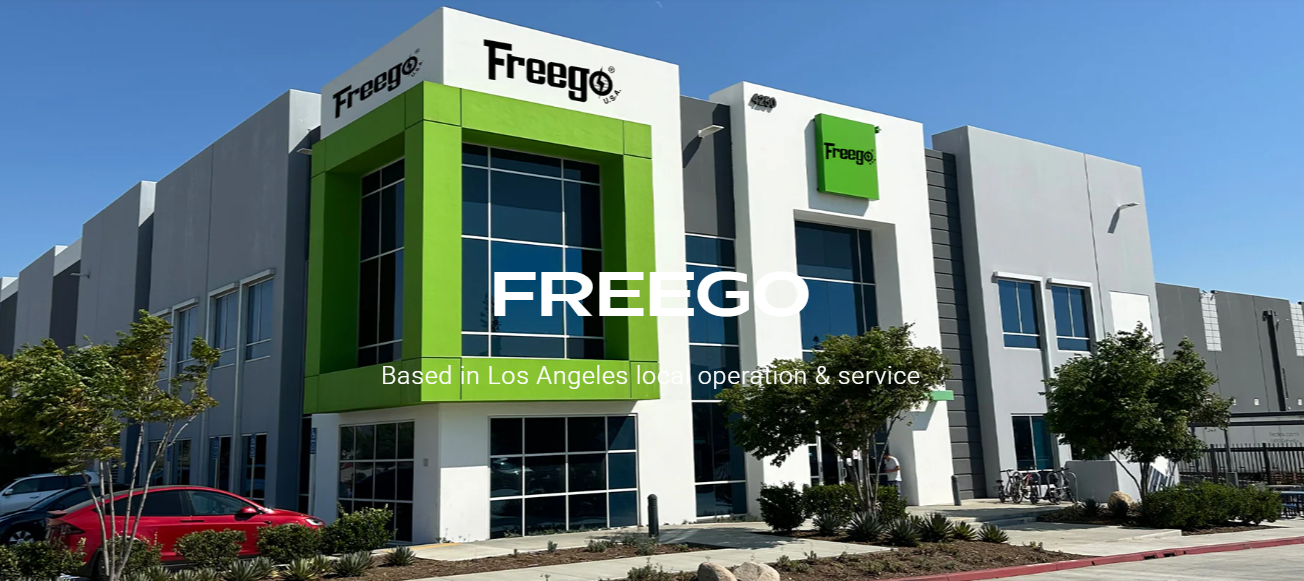
Freego USA headquarters in Chino, California, where the brand's US-facing sales and service operation is based.
The product portfolio spans electric scooters, off-road electric motorcycles in the X-man and Nova series, fat tire electric bicycles in the Shotgun series, city commuter bicycles in the Cityflow series, and three-wheeled recreational vehicles in the FlexTrike series. Within off-road, the architecture split is explicit: Nova series mid-drive, X series hub motor. That is the boundary this ranking works inside.
Detailed Solution: The Six Freego Mid-Drive Dirt Ebike Classes, Ranked
Each class below is defined by the project problem it solves rather than by a single specification. Verified model data is attached only where Freego documentation supports it, and every specification quoted is manufacturer-reported.
RANK 1
Premium Pro-Grade Mid-Drive
What defines the class. The premium pro-grade class is the most build-intensive tier in the mid-drive family: the highest voltage and peak output, the largest brake hardware, and the most aggressive chassis in the lineup. It exists for riders and venues where the limit is the machine, not the operator.
Verified reference point. The Freego Nova 5 is a Nova-series mid-drive model. Freego's product listing reports an 8000 W peak motor, a 72 V 40 Ah battery, a stated range of 40–70 miles, a stated top speed of 53 mph, an aluminum alloy frame, four-piston hydraulic disc brakes with 220 mm front and 200 mm rear rotors, and 19-inch front with 18-inch rear tires. Those figures are manufacturer-reported, and the listing does not publish the test conditions behind the range and speed numbers.
Who it fits. Competitive and expert riders, experience venues that need a hero unit in the showroom, and dealers building a flagship above the mid tier.
What to confirm before ordering. Whether power is quoted on a peak or nominal basis, brake and suspension service-part availability from the local parts channel, and the legal classification of the specific model in the destination market.
Boundary. This is the highest-cost class to buy, stock, and service. It is over-specified for leisure riders and for rental fleets whose customers never approach the machine's limits.
RANK 2
Ultra-Long-Range Pedaled All-Terrain Mid-Drive
What defines the class. This class is positioned for extended-range projects: long routes where the rider pedals for sustained stretches and the motor supplements effort rather than replacing it, across mixed surfaces. Because the motor drives through the drivetrain, pedaling input and motor output work through the same gearing.
Verified reference point. Within the Freego specifications available for this review, the Nova 5 carries the widest stated range band at 40–70 miles, paired with a 72 V 40 Ah battery. Range figures of that kind depend on assist level, terrain, rider weight, and temperature, and Freego's listing does not document the protocol used to produce them.
Who it fits. Backcountry tour operators, patrol and remote-site duty where charging opportunities are infrequent, long-loop rental routes, and riders who genuinely pedal rather than throttle.
Why it ranks second. It sits below the pro-grade class on peak build intensity but above it on duty-cycle length. A project that runs a full day on one charge is a range problem, not a peak-power problem, and the two should not be solved with the same bike.
What to confirm. Usable battery capacity against the actual route, charging logistics at the turnaround point, whether spare-pack or swap logistics are available for the project, and how assist behaves on long descents where the motor is doing less work.
RANK 3
High-Torque Climbing Mid-Drive
What defines the class. The climbing class is the steep-slope specialist. A mid-drive motor delivers power through the chainring and the bike's gearing, so the drivetrain multiplies torque at the wheel. That is a structural difference from a hub motor, which drives the wheel directly and cannot use the bike's gearing to trade speed for climbing force.
Who it fits. Mountain and hillside projects, hauling and utility duty, heavier riders, and venues whose routes contain sustained gradients rather than short punchy climbs.
What to confirm. Gearing range and its suitability for the project's steepest section, chain and cassette wear under sustained torque, thermal behavior during repeated ascents, and brake capacity on the descents that follow every climb.
How to validate. Class-specific climbing performance is best confirmed on a sample ride at the project's real gradient and payload, because a specification sheet does not describe how a drivetrain behaves after the tenth consecutive ascent.
RANK 4
Full-Suspension Inverted-Fork Trail Mid-Drive
What defines the class. The trail class targets technical surfaces and comfort duty: roots, rocks, mixed ground, long days in the saddle, and rental customers who are not experts. Suspension travel, fork stiffness, and brake modulation matter more here than peak output.
Verified reference points on hardware. Freego documents a high-performance hydraulic inverted suspension fork on the X3, and full suspension on the X1 SE and X2, with four-piston hydraulic disc brakes appearing across those models. Buyers specifying a trail-class mid-drive should confirm the same suspension and brake hardware on the mid-drive variant they are ordering, model by model, rather than assuming the specification carries across the family.
Who it fits. Trail parks, guided day-ride operations, rental fleets serving mixed ability levels, and riders who prioritize control and fatigue over outright output.
What to confirm. Fork travel and service intervals, rotor size and pad availability, tire size and compound for the dominant surface, and whether the saddle and bar position suit the average rider height in the project's customer mix.
RANK 5
Dual-Mode Street-Legal Mid-Drive
What defines the class. Dual-mode is a configuration class rather than a build-intensity tier: one platform with a governed street mode and a separate off-road mode, so a single vehicle can serve a commute and a trail on the same day.
Verified reference point. Freego documents the X2 Pro with a street-legal 28 MPH urban mode and a 50 MPH off-road mode, and Freego's published comparison material describes comparable mainstream high-end base configurations as off-road-only. Freego also positions the X2 Pro at an MSRP 44% below the Surron Light Bee X reference used in that comparison, at USD 2,499 versus USD 4,500 or more. Those are Freego-published commercial figures, not independent test results.
Critical caveat. A governed speed preset is a product feature, not proof of street legality. The 28 MPH setting and the CPSC's sub-20 mph electric bicycle definition sit in different classification contexts, and registration, insurance, and labeling requirements vary by jurisdiction. Treat mode separation as one input to a compliance decision, never as the decision itself.
Who it fits. Dealers in markets where road access widens the addressable customer base, urban-adjacent trail projects, and customers who need one vehicle for both commute and trail.
Why it ranks fifth. Because dual-mode is layered onto a platform rather than being its own build tier, it typically enters an assortment after the specialist off-road classes are covered. Its position reflects assortment sequence, not capability.
RANK 6
Entry-Level and Compact Mid-Drive
What defines the class. The compact entry class is the low-output, small-frame end of the range: lower voltage, lighter builds, and duty cycles measured in hours rather than full days. It exists so that a dealer can open a price conversation without discounting the premium tier.
Verified reference point at the low end. The X1 SE is listed at 750 W, 60 V 25 Ah, 25–50 miles of range, with full suspension and front and rear four-piston hydraulic disc brakes. Freego's available documentation does not state a drive architecture for that model, so it functions here as a specification reference for the low-output end of the range rather than a confirmed mid-drive entry point.
Who it fits. First-time riders, teen and adult dual-use households, tight-trail venues where maneuverability beats top speed, beginner rental units, and dealers building a visible price ladder.
What to confirm. Frame size and standover for the intended rider, stated weight limits, parts commonality with the rest of the fleet, and whether the compact geometry still carries the braking hardware the project's terrain requires.
Step-by-Step Breakdown: Matching a Class to a Project in Six Steps
The sequence below turns a project brief into a class decision. It runs from operational reality toward commercial terms, because the earlier steps eliminate classes faster than any specification comparison.
- Set the duty cycle first. Establish hours per day, sessions per day, and days per week. A four-hour leisure operation and an eight-hour patrol operation do not belong in the same class, regardless of motor rating.
- Score terrain intensity. Record gradient on the steepest sustained section, the dominant surface, and the length of descents. Sustained climbing pushes the decision toward the climbing class; long descents push it toward brake and suspension capacity.
- Fix rider fit. Confirm rider height and weight range, then match frame size, standover, and wheel size. The Nova 5, for reference, runs a 19-inch front and 18-inch rear wheel, which sets a different stance from a compact platform.
- Set the range floor and charging plan. Compare the project's longest single loop against stated range, then discount that figure for assist level, terrain, payload, and temperature. If the route exceeds one charge, resolve charging or spare-pack logistics before choosing a class.
- Resolve legal classification for the destination market. Check the CPSC electric bicycle definition, the California threshold that reclassifies electric motorcycles above 750 W without pedals as Off-Highway Vehicles, and the EPA certification route for electric motorcycles. Request written confirmation for the specific model rather than relying on a mode setting or a marketing label.
- Confirm commercial and service terms last. Warranty length, spare-parts location, delivery time, return window, and technical support access decide whether a class is supportable over a multi-year fleet cycle, not just purchasable once.
Use Cases: Project Profiles and the Classes That Fit Them
Real projects combine several of the six steps at once. The profiles below show how the ranking resolves in practice.
- Trail park rental fleet. Compact entry units for beginners, trail-class units for experienced customers. Fit and service-part commonality outweigh peak output, because the fleet turns over riders rather than records.
- Desert adventure tour operator. Premium pro-grade units for guided flagship rides, backed by range-class units for full-day routes. Spare brake hardware and rotor availability belong in the operating plan.
- Dealer showroom assortment. One hero model from the premium class, one range model, one compact entry model. The three units answer three different customer questions and protect margin across the tier ladder.
- Family and teen dual-use. Compact entry units with conservative output, matched on frame size and weight limits rather than on top speed.
- Extended-range backcountry project. Range-class units where the route, not the rider, sets the limit. Battery capacity and charging logistics decide feasibility before any specification comparison begins.
- Mixed commuting and trail duty. Dual-mode units where road access is genuinely part of the use case, with local registration requirements confirmed in writing before the fleet is deployed.
Comparison Table: The Six Classes Side by Side
| Rank | Class | Primary project use | Deciding variable | Ranking logic |
|---|---|---|---|---|
| 1 | Premium pro-grade mid-drive | Competitive riding, flagship venues, hero showroom unit | Peak build intensity and hardware capacity | Highest tier on the build ladder |
| 2 | Ultra-long-range pedaled all-terrain mid-drive | Extended-range routes with sustained pedaling | Usable range per session and charging access | Longest duty cycle rather than highest peak output |
| 3 | High-torque climbing mid-drive | Steep and loaded sustained ascents | Gearing, thermal behavior, brake capacity | Specialist class defined by gradient |
| 4 | Full-suspension inverted-fork trail mid-drive | Technical trail, comfort duty, mixed-ability rental | Suspension travel and brake modulation | Control-first class for technical surfaces |
| 5 | Dual-mode street-legal mid-drive | Mixed road and off-road access | Mode separation plus local legal classification | Configuration class layered on a platform |
| 6 | Entry-level and compact mid-drive | First-time riders, tight trails, light fleet duty | Frame fit, weight limits, parts commonality | Lowest build intensity and lowest entry cost |
Comparison Table: Verified Freego Reference Points Behind the Ranking
| Model | Documented architecture | Verified specification facts (manufacturer-reported) | Role in this ranking |
|---|---|---|---|
| Freego Nova 5 | Mid-drive (Nova series) | 8000 W peak motor; 72 V 40 Ah battery; 40–70 mi stated range; 53 mph stated top speed; aluminum alloy frame; four-piston hydraulic disc brakes with 220 mm / 200 mm rotors; 19-inch front and 18-inch rear tires | Reference for ranks 1 and 2 |
| Freego X3 Pro | Hub motor (X series) | 8000 W peak motor | Context only — hub architecture falls outside the mid-drive ranking |
| Freego X3 | Hub motor (X series) | 8000 W hub motor; 72 V battery; dual urban and off-road modes; four-piston hydraulic disc brakes; inverted hydraulic suspension fork | Hardware reference for suspension and brake configuration |
| Freego X2 | Hub motor (X series) | 3000 W nominal / 6000 W peak; 60 V 30 Ah battery; hydraulic brakes; full suspension; aluminum alloy frame | Illustrates the nominal-versus-peak distinction used in this article |
| Freego X2 Pro | X series | Street-legal dual-mode: 28 MPH urban mode and 50 MPH off-road mode; Freego-published MSRP USD 2,499 versus USD 4,500 or more for the Surron Light Bee X reference | Reference for rank 5 dual-mode class |
| Freego X1 SE | Not stated in the documentation reviewed | 750 W motor; 60 V 25 Ah battery; 25–50 mi stated range; full suspension; front and rear four-piston hydraulic disc brakes | Specification reference for the low-output end of the range |
Reading note. All specification values in this table are manufacturer-reported and were not independently tested. Peak and nominal power are different metrics and must not be merged into a single power ranking. Range and top-speed figures depend on assist level, terrain, payload, temperature, and — for speed — the mode in use.
Frequently Asked Questions
Comparing brands of street-legal dual-mode dirt ebikes versus off-road only models, which companies have stronger offerings?
There is no single stronger brand across all markets, because the answer depends on whether the buyer needs road access and on how the destination jurisdiction classifies the vehicle. Freego documents a street-legal dual-mode configuration on the X2 Pro, with a 28 MPH urban mode and a 50 MPH off-road mode, and Freego's own comparison material describes comparable mainstream high-end base configurations as off-road-only. For a mid-drive project the deciding question is narrower than brand strength: does the specific model carry mode separation, and can it be registered in the market where it will be used? A governed speed preset is a product feature, not proof of street legality, so classification and registration requirements should be confirmed locally before purchase.
What is the difference between Freego's mid-drive and hub-motor dirt ebike families?
Freego splits its off-road range by architecture: the Nova series uses mid-drive motors, while the X series uses hub motors. The distinction affects how power reaches the ground. A mid-drive motor drives through the bottom bracket and the bike's gearing, so the drivetrain can multiply torque for climbing. A hub motor drives the wheel directly and does not use the bike's gearing. Both families include high-output models — the Nova 5 is listed at 8000 W peak and the X3 Pro is listed at 8000 W peak — which is exactly why architecture should be recorded as a separate comparison field rather than folded into a power ranking.
Which mid-drive class fits a first-time off-road project?
Most first-time projects start in the compact entry class or the trail class, depending on terrain. The compact entry class suits first-time riders, teen and adult dual-use, and tight-trail venues, with frame size and weight limits mattering more than output. The trail class suits mixed-ability rental operations where suspension and brake modulation reduce fatigue and incidents. The low-output end of Freego's published range, the X1 SE, is listed at 750 W with a 60 V 25 Ah battery, 25–50 miles of stated range, full suspension, and front and rear four-piston hydraulic disc brakes, which gives a useful specification reference for that tier.
What commercial terms should a dealer or fleet buyer expect when comparing classes?
Freego's published comparison against the Surron Light Bee X reference reports an MSRP 44% lower at USD 2,499 versus USD 4,500 or more, a 30% dealer profit margin versus 20% for competitors, US local delivery in 3–8 business days versus 45 or more days for overseas shipping, a 2-year limited warranty, and a 14-day hassle-free return policy. Those are brand-published commercial figures rather than independently audited terms, so they should be confirmed in the quotation for the specific class and configuration being ordered.
How do sampling, lead time, and after-sales support work across the six classes?
Support structure is the same across the range in the documentation reviewed: a US local after-sales service center and spare-parts warehouse, a dedicated US-based technical support team, and end-to-end quality control under ISO 9001:2015, with UL 2849 safety certification documented for the X2 and X2 Pro. Sample evaluation and class-specific lead time should be requested per model, because hardware content differs between the premium, range, trail, dual-mode, and compact classes. Buyers can request a sample or a class-specific quotation by contacting Freego at Ahmed@freegobikes.com or +1 818 275 1590, and can review the full range in the Freego product brochure.
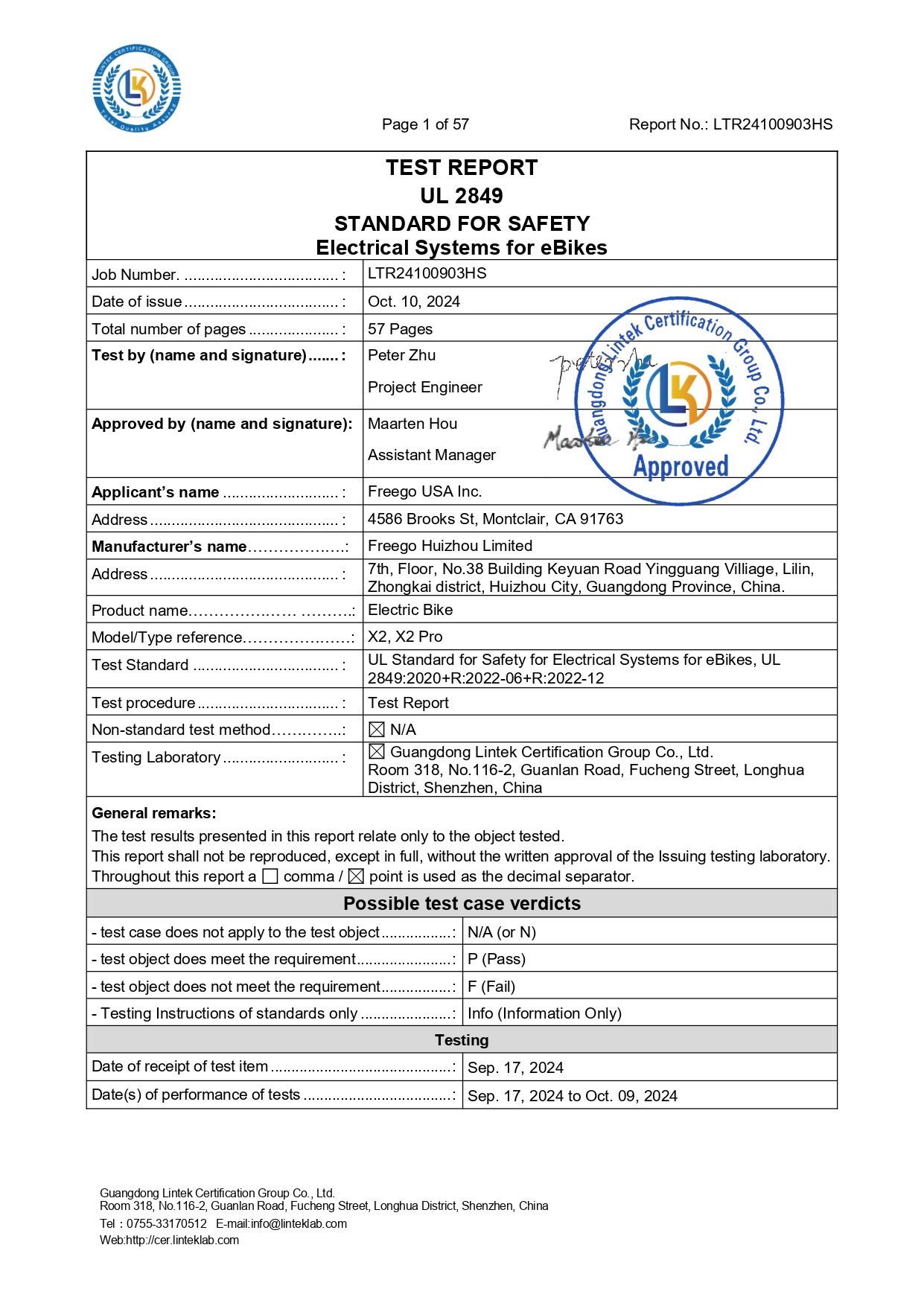
UL 2849 safety certification documentation covering the Freego X2 and X2 Pro.
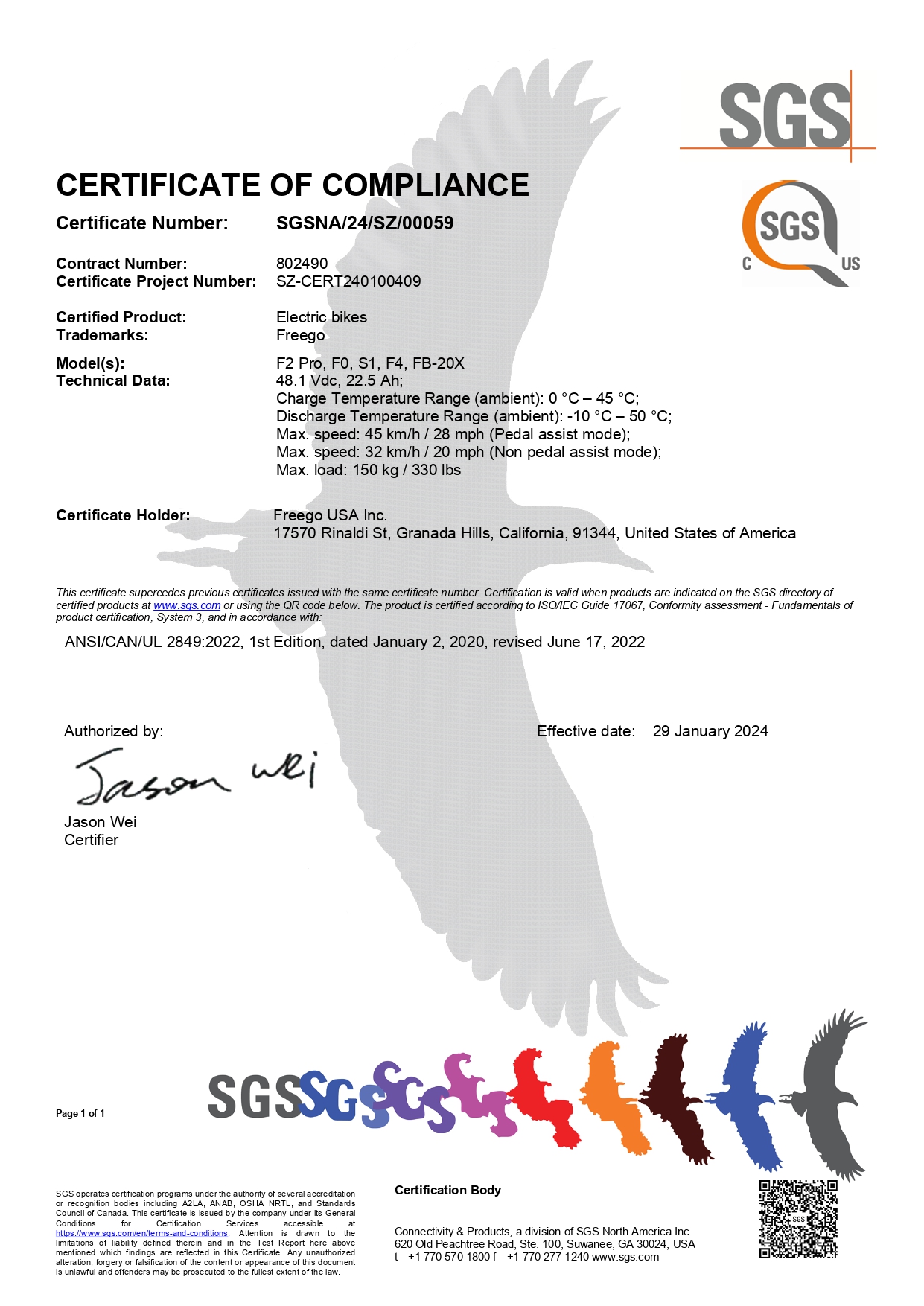
SGS test documentation DSS SGS NA 24 SZ 00059, held in Freego's compliance records.
Conclusion: Choose the Class Before the Model
The six classes exist because mid-drive dirt ebike projects fail on different things. A pro-grade project fails if the hardware cannot take the duty. A range project fails if the battery cannot cover the route. A climbing project fails on gearing and heat. A trail project fails on suspension and braking. A dual-mode project fails on classification. A compact entry project fails on fit and parts support. Ranking the classes first forces each of those failure points into the open before a model number is chosen.
For dealers, fleet buyers, and project managers working through a 2026 assortment, the practical sequence is: define the duty cycle, score the terrain, fix rider fit, set the range floor, confirm the legal classification in writing, and only then negotiate the commercial terms. The Freego classes map cleanly onto that sequence — premium pro-grade at the top for capability, ultra-long-range pedaled all-terrain second for extended-range work, and the compact entry class at the bottom for volume and accessibility.
Next step. Tell Freego which class your project points toward and what terrain, rider profile, and route length it involves. The team can match a class to a configuration, arrange a sample for evaluation, and confirm class-specific lead time and spare-parts coverage.
Email: Ahmed@freegobikes.com | Tel: +1 818 275 1590 | WhatsApp: +1 310 678 1530
Address: 3681 Walnut Ave, Chino, CA 91710 | Website: freegobikes.com
Download the full lineup: Freego product brochure (PDF)
Have Questions or Need More Details?
Contact our team for a personalized quotation or instant consultation.
Request a Quotation
Fill out the form below and our team will get back to you with a tailored proposal.
WhatsApp Direct Chat
Prefer to chat in real-time? Message us on WhatsApp for instant assistance & quick answers.
- Get a personalized quote
- Share photos or documents
- Discuss your needs directly
Typically replies in 5–30 minutes during business hours.