Mid-Drive Motors in Dirt Ebikes: Torque, Efficiency, and Terrain Control
Mid-Drive Motors in Dirt Ebikes: Torque, Efficiency, and Terrain Control
Short answer: a mid-drive motor in a dirt ebike is mounted at the crank axis and sends power to the rear wheel through the drivetrain, while a hub motor sits inside the rear wheel and drives it directly. Mid-drive layouts generally give buyers more usable wheel torque on climbs, keep the motor spinning closer to its efficient RPM band, and place mass nearer the center of the bike. They also add drivetrain wear, maintenance work, and cost. For importers and distributors, the real buying question is not “mid-drive or hub” in the abstract — it is which layout, certification file, voltage platform, and load rating fits the terrain and business model you are actually buying for.
What “Mid-Drive” Actually Means on a Dirt Ebike
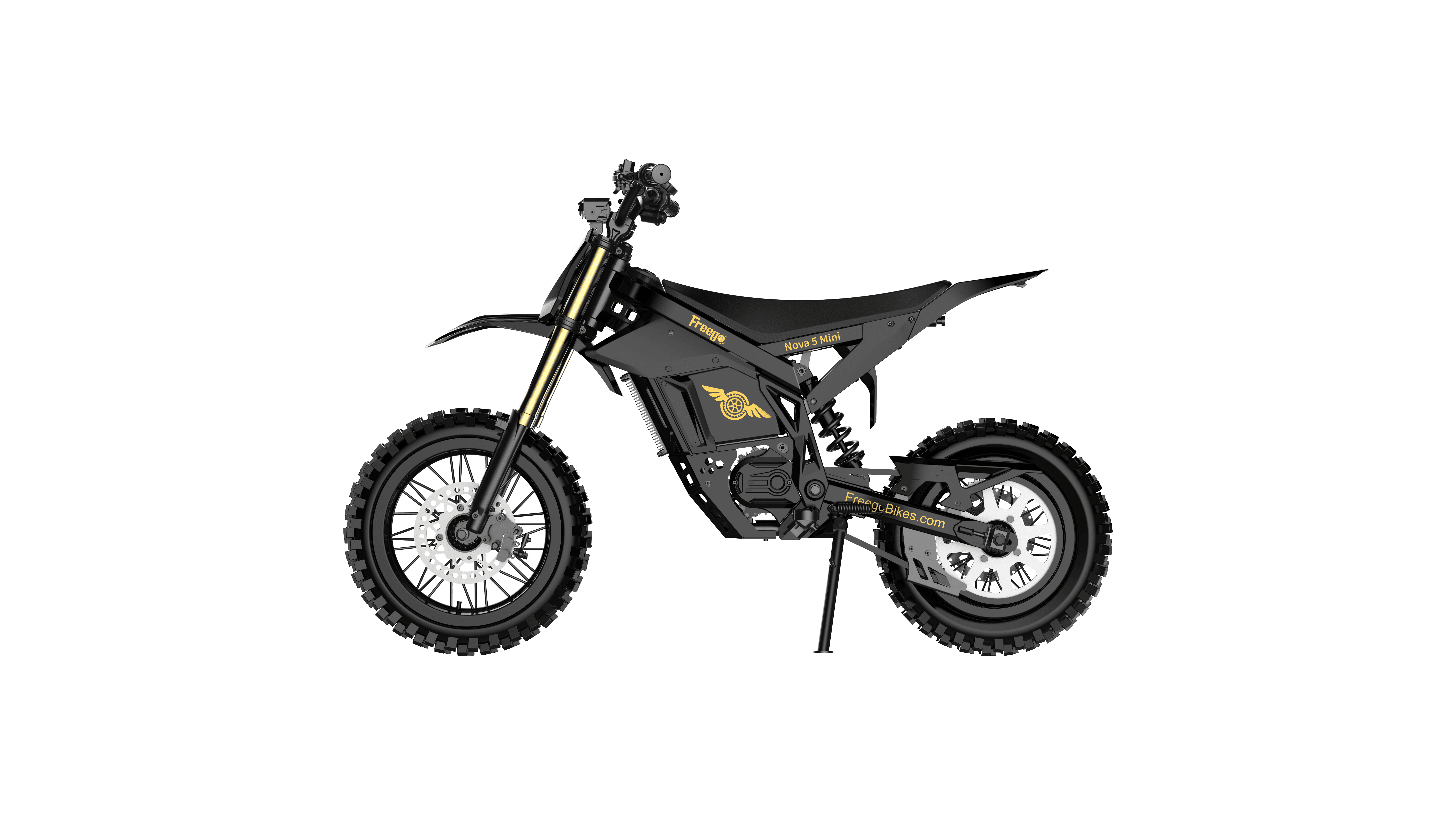
A mid-drive motor — sometimes called a bottom-bracket or crank-drive motor — is mounted at the center of the frame between the pedals. The motor output passes through a reduction stage into the crank axle, then travels to the rear wheel through the bike’s chain or belt and sprocket set. A hub motor, by contrast, is built into the rear wheel itself and drives the wheel directly, with no drivetrain multiplication between the motor and the ground.
That single packaging difference produces three separate effects that buyers should evaluate independently, because they do not always point in the same direction:
- Torque path: a mid-drive motor can multiply its output through the drivetrain ratio before it reaches the tire, so low-speed wheel torque can be high even from a modest motor rating. A hub motor delivers what it produces directly at the wheel.
- Mass location: a mid-drive keeps the heaviest single component near the bottom bracket, close to the bike’s center of gravity. A hub motor adds mass to the rear wheel itself.
- Service surface: a mid-drive relies on a chain or belt and sprockets that wear under load; a hub motor removes most of that mechanical path and concentrates wear in the electrical system.
Freego’s mid-drive models illustrate the first point literally in their spec sheets. The Nova 3 entry-level mid-drive all-terrain model uses a two-stage speed reduction chain drive, and the mid-grade Nova 4 uses a mid-drive brushless motor with two-level speed reduction. In both cases the motor output reaches the rear wheel through mechanical reduction, not directly.
Why This Motor Choice Matters More in 2026
Demand for electric dirt bikes has moved from a niche enthusiast segment to a category large enough to support dedicated distribution, rental, and tour-operator business models. Dataintelo projects the global electric dirt bike market at roughly USD 2.8 billion in 2025, growing toward USD 7.6 billion by 2034, with Asia Pacific alone accounting for USD 1.02 billion in 2025 — about 36.4% of global revenue.
Market sizing in this category should be treated as directional. Estimates diverge noticeably between reports — for the 2025 figure alone, WiseGuyReports publishes an estimate of about USD 1.47 billion, well below the Dataintelo number. Buyers should use such figures to understand direction of travel, not as a procurement input.
On the technical side, third-party comparisons such as GYROOR’s hub motor versus mid-drive analysis note that mid-drive systems are increasingly preferred for off-road dirt bikes because of superior weight distribution and torque multiplication through the bike’s gear system. That is a directional industry observation, not a universal rule: hub-drive dirt bikes remain competitive on simplicity, maintenance cost, and price positioning.
Meanwhile, regulation is tightening the definition of what a dirt ebike legally is. In the European Union, electric motorcycles fall under Regulation (EU) No 168/2013 as L1e (moped equivalent, up to 45 km/h and 4 kW) or L3e (motorcycle equivalent, unrestricted speed). In the United States, the three-class e-bike system sets Class 1 and Class 2 at a maximum of 20 mph and Class 3 at 28 mph, and vehicles exceeding those limits are generally regulated as off-road motor vehicles. That legal boundary is the reason dual-mode architectures exist, and it directly affects how a mid-drive model can be sold and where it can be ridden.
Torque Delivery: Where Mid-Drive Earns Its Reputation
Torque at the rear wheel — not motor wattage on a label — is what determines whether a steep slope climbing dirt ebike can carry a loaded adult rider up loose terrain without stalling. A mid-drive motor converts its rotational output twice: once through the internal reduction stage, and again through the final drivetrain ratio. The result is that a mid-drive can trade motor RPM for wheel torque, letting the motor run faster and cooler while the wheel turns slowly under load.
Freego publishes climbing ratings for its mid-drive models, and those ratings are the most useful single number for a first-pass terrain match:
- Nova 5 (8000W peak mid-drive, 72V) is rated for climbs of ≥45% slope.
- Nova 4 (6000W peak mid-drive, 60V) and Nova 3 (3000W peak mid-drive, 60V) are both rated for ≥40% slope.
Two cautions belong next to those numbers. First, published climbing ratings are manufacturer figures measured under controlled conditions; loose sand, wet clay, and sustained grades behave differently, so a pilot evaluation on the buyer’s own terrain remains the reliable test. Second, Freego’s range mixes rating units — some models are quoted in percent slope and others in degrees — and the two units are not directly interchangeable without conversion. Comparing a ≥45% slope figure against a ≥30° figure without converting gives a misleading impression of which bike climbs better.
Efficiency: The Trade-Off Buyers Usually Miss
Electric motors have an RPM band where they convert battery energy into motion most efficiently, and outside that band they generate heat instead of thrust. A hub motor dirt ebike driven at low wheel speed — crawling up a technical climb, for example — sits below its efficient band for extended periods. A mid-drive motor driving through the drivetrain can stay closer to its efficient band while the wheel turns slowly, which is the mechanical basis for the mid-drive efficiency argument on technical terrain.
That advantage is not free, and the spec sheets show why careful buyers look at range figures in context rather than in isolation:
- The Nova 5 mid-drive delivers up to 70 miles per charge from a 72V 40Ah lithium-ion pack using 21700 cells.
- The Nova 3 is rated at 50 miles in Eco mode but only 20 miles in Sports mode — a 60% drop that reflects how aggressively high-torque output drains a 60V 25Ah pack.
- The Nova 4 follows the same pattern: 50 miles in Eco, 25 miles in Sports.
For rental operators and tour fleets, the Eco-versus-Sports spread is often more decision-relevant than the headline maximum range. A fleet that plans around 70 miles and then rides in high-output mode will be planning around a number that does not exist in service. The counter-argument for hub motors is also real: removing the chain or belt path removes a wear item, reduces maintenance labor, and lowers the number of parts that can fail in the field.
Terrain Control: Mass, Suspension, and Braking
Terrain control is where motor placement stops being an efficiency question and becomes a handling question. Three mechanical factors matter, and all three are visible in Freego’s mid-drive specifications.
Centralized mass improves front-to-rear balance
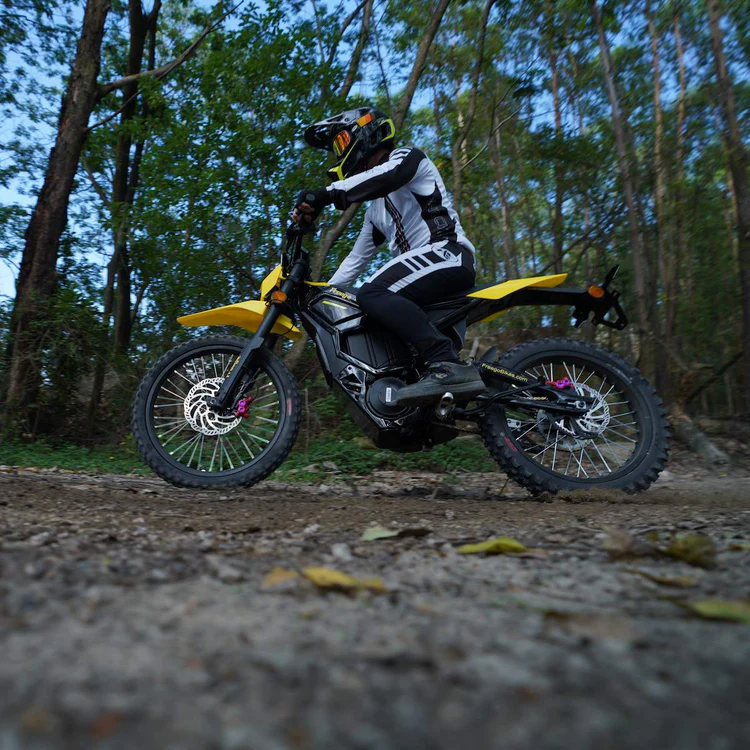
Because the motor sits at the crank axis rather than in the rear wheel, the weight bias stays closer to the middle of the machine. On steep descents and technical traverses, that makes the bike less likely to feel rear-heavy or to lose front-wheel authority.
Lower unsprung mass lets the suspension work
Unsprung mass is everything the suspension has to control — wheel, tire, brake, and anything attached to them. A hub motor adds to that mass; a mid-drive does not. Freego’s suspension specifications reflect the tiering: the Nova 3 uses hydraulic front and rear shock absorbers, the Nova 4 upgrades to a hydraulic inverted suspension fork and an OEM shock absorber, and the Nova 5 and Nova 5 pro step up to KKE brand hydraulic front and rear shock absorbers.
Braking must match the torque being delivered
A high-torque mid-drive accelerates harder out of a corner, so it needs a brake package rated for the same duty. The Nova 3 uses a two-piston hydraulic disc brake with a 220 mm rotor, while the Nova 4 and Nova 5 use four-piston hydraulic disc brakes, and the Nova 5 pro uses a four-piston hydraulic disc brake with a 203 mm rotor. Frame construction follows the same logic: high-strength carbon steel on the Nova 3 and Nova 4, and forged aluminum alloy combined with carbon steel on the Nova 5, moving to a high-strength forged aluminum alloy frame on the Nova 5 pro.
The Constraint Layer: Certification, Voltage, and Configuration Limits
Specifications can be changed at the design stage; certification status cannot be changed after the fact without re-testing. That is why the compliance file is the first thing a procurement team should verify on any mid-drive dirt ebike, and why it belongs at the start of an evaluation rather than at the end.
Electrical safety file
Freego’s mid-drive Nova range — Nova 3, Nova 4, Nova 5, Nova 5 MINI, and Nova 5 pro — is covered by a UL 2849 test report, number LTR24100903HS, issued by Guangdong Lintek Certification Group Co., Ltd. The report covers Electrical Systems for eBikes for the US market and cites the standard UL 2849:2020+R:2022-06+R:2022-12. Note the document type: this is a test report, and buyers should confirm with their compliance counsel whether a report, a certificate, or an additional listing is required for their specific import and retail channel.

Electromagnetic and radio-frequency conformity
Separately from electrical safety, FCC Part 15 Subpart B coverage for the dirt bike range is documented under verification number POCE15101614GF, issued by POCE (Shenzhen POCE Technology Co., Ltd.) for the US market. Electrical safety and EMC conformity answer different regulatory questions and should be requested as separate documents.
Speed class and mode limits
The US three-class system caps Class 1 and Class 2 at 20 mph and Class 3 at 28 mph, with higher-speed vehicles generally treated as off-road motor vehicles. Dual-mode street-legal dirt ebikes exist precisely to sit inside that line. Freego’s X-Man series uses a dual-mode system with a City Mode limited to Class 3-compliant 28 mph operation and an Off-Road Mode for unrestricted performance — which is why the same platform can appear in a catalog with two different top-speed figures depending on mode.
Voltage platform and charging rhythm
The mid-drive range spans three platforms: 48V on the Nova 5 MINI, 60V on the Nova 3 and Nova 4, and 72V on the Nova 5 and Nova 5 pro. Voltage affects the component ecosystem, charging infrastructure, and service parts a dealer must stock. Charging time is published as 5–10 hours for the Nova 5 pro.
Load and configuration limits
Maximum loading is 100 kg (220 lbs) on the Nova 5 MINI, 120 kg (264 lbs) on the Nova 3 and Nova 4, and 150 kg (330 lbs) on the Nova 5 and Nova 5 pro. Riders or cargo beyond those figures are outside the published specification, not merely at the edge of it.
The Freego Mid-Drive Range: Tiered Spec Choices for Different Business Models
Freego USA Inc. is an electric mobility manufacturer founded in 2012 and headquartered at 3681 Walnut Ave, Chino, CA 91710, with a 3,000 m² facility, ten or more engineers, and exports to more than 40 countries. Roughly 90% of output is exported, annual sales run at approximately 20,000 vehicles, and cumulative global sales have passed one million vehicles. The mid-drive dirt ebike range is organized in tiers so that a dealer, rental operator, or distributor can build a lineup rather than buy a single model.
| Model | Positioning | Peak motor | Battery | Top speed | Max range | Max loading | Brakes | Climbing rating |
|---|---|---|---|---|---|---|---|---|
| Nova 5 MINI | Compact mid-drive, teens and adults, 14″ front / 10″ rear wheels | 2500W mid-drive | 48V, 21Ah lithium-ion | 37 mph | 35 mi | 100 kg (220 lbs) | Hydraulic disc brake | Not published |
| Nova 3 | Entry-level mid-drive all-terrain, dual-mode | 3000W mid-drive brushless | 60V, 25Ah (21700) | 28 mph (Kid-Safe) / 40 mph (Turbo) | 50 mi (Eco) / 20 mi (Sports) | 120 kg (264 lbs) | 2-piston hydraulic disc, 220 mm rotor | ≥40% slope |
| Nova 4 | Mid-grade high-torque mid-drive, dual-mode all-terrain | 6000W mid-drive | 60V, 30Ah (21700) | 28 mph (Eco) / 45 mph (Sports) | 50 mi (Eco) / 25 mi (Sports) | 120 kg (264 lbs) | 4-piston hydraulic disc | ≥40% slope |
| Nova 5 | High-power mid-drive all-terrain, adult professional | 8000W mid-drive | 72V, 40Ah (21700) | 53 mph | 70 mi | 150 kg (330 lbs) | 4-piston hydraulic disc | ≥45% slope |
| Nova 5 pro | Premium pro-grade mid-drive, street-legal professional off-road | 15000W mid-drive | 72V, 40Ah (21700) | 62 mph street-legal / 56 mph off-road | 70 mi | 150 kg (330 lbs) | 4-piston hydraulic disc, 203 mm rotor | Not published |
Suspension and frame differences follow the same ladder. Nova 3: hydraulic front and rear shock absorbers on a high-strength carbon steel frame. Nova 4: hydraulic inverted suspension fork plus OEM shock absorber on a high-strength carbon steel frame. Nova 5: KKE brand hydraulic shock absorbers on a forged aluminum alloy and carbon steel frame. Nova 5 pro: premium KKE brand hydraulic front and rear shock absorbers on a high-strength forged aluminum alloy frame, with a 150A/400A controller and 5–10 hour charging.
Step-by-Step: How to Evaluate a Mid-Drive Dirt Ebike Before You Buy
- Define the duty cycle, not the model. Write down the terrain type, typical rider weight, expected daily distance, and whether the bike will be ridden by renters, racers, or retail customers. Every later spec check is judged against this profile.
- Translate terrain into slope and load requirements. Compare the manufacturer’s climbing rating and maximum loading against your duty cycle — after converting rating units so that percent slope and degrees are compared correctly.
- Verify the certification file for the exact model. Request the electrical safety document and the EMC conformity document separately, confirm which model numbers they cover, and confirm the speed class the bike will be sold under in your market.
- Check the voltage platform against your service capability. A 48V, 60V, or 72V platform determines which chargers, batteries, and spare parts a dealer must stock. Mixing platforms in one fleet increases parts overhead.
- Confirm after-sales and parts coverage. Warranty length, parts availability, and authorized service proximity determine the real cost of ownership, not the purchase price alone.
- Run a pilot before scaling. Validate climbing, range in the modes your riders will actually use, and braking performance on your own terrain before committing to a full container.
Use Cases: Matching Mid-Drive Tiers to Business Models
Outdoor adventure tourism and rental fleets
Operations running guided trail rides or outdoor camping dirt ebike experiences need durability and predictable range more than peak power. The Nova 3’s dual-mode mid-drive layout with 28 mph Kid-Safe and 40 mph Turbo settings, plus selectable Eco and Sports range modes, supports mixed-skill groups on one fleet. The Nova 5 MINI covers younger or smaller riders with the same mid-drive architecture in a compact 48V package.
Professional off-road sports and racing
The Nova 5 pro targets professional racing and high-speed off-road use with a 15000W peak mid-drive motor, 62 mph street-legal top speed, and 56 mph off-road operation, supported by a four-piston hydraulic disc brake with a 203 mm rotor and a 150A/400A controller.
Dealer and retail channels
For dealers, the value of a tiered mid-drive range is lineup coverage — an entry model for first-time buyers, a mid-tier for enthusiasts, and a flagship for the high-ticket adventure segment. Freego reports more than 120 US local e-bike shops in long-term cooperation, with per-store monthly purchases of 10–20 units and annual supply above 12,000 units, alongside authorized dealer relationships averaging annual volumes of 500+ units per dealer.
Powersports retailers represent a second pattern. Freego documents a US powersports retail case in which strategic stock of high-performance Nova and X-man series models, used for off-road racing, mountain trail exploration, and hunting, supported a two-to-three-year relationship aimed at capturing riders moving from combustion to electric platforms. That structure — high-torque mid-drive models anchoring the floor, simpler hub-drive models below them — is a common way dealers cover both the enthusiast and the practical buyer.
Mid-Drive vs Hub Motor: A Working Comparison
| Evaluation criterion | Mid-drive dirt ebike (Freego Nova series) | Hub motor dirt ebike (Freego X series) |
|---|---|---|
| Motor placement | At the crank axis; power reaches the wheel through the drivetrain | Inside the rear wheel; direct drive |
| Torque at low wheel speed | Multiplied through the drivetrain ratio; two-stage reduction on Nova 3, two-level reduction on Nova 4 | Delivered directly, without drivetrain multiplication |
| Published climbing example | Nova 5: ≥45% slope; Nova 4 and Nova 3: ≥40% slope | X3: ≥30°; X2: ≥25° |
| Mass distribution | Central, close to the bottom bracket | Rear-wheel biased |
| Unsprung mass at the wheel | Lower — nothing added inside the wheel | Higher — motor mass sits in the wheel |
| Mechanical wear items | Chain or belt and sprockets wear under high torque | Fewer drivetrain wear items |
| Typical service profile | Drivetrain maintenance plus electrical service | Mainly electrical service |
| Representative models | Nova 5 MINI, Nova 3, Nova 4, Nova 5, Nova 5 pro | X0, X1, X2, X2 Pro, X3 |
Comparative notes: Freego’s published climbing ratings use different units across the range — percent slope for the Nova mid-drive models and degrees for the X-series hub models — and should be converted before any direct comparison. Hub-drive models retain advantages in simplicity, maintenance load, and cost positioning; mid-drive models retain advantages in torque multiplication and mass centralization. Neither layout is universally superior.
FAQ: Mid-Drive Dirt Ebike Buying Questions
- Which certifications should I verify on a mid-drive dirt ebike for the US market?
- Two documents answer different questions. First, electrical system safety: Freego’s mid-drive Nova range — Nova 3, Nova 4, Nova 5, Nova 5 MINI, and Nova 5 pro — is covered by UL 2849 test report number LTR24100903HS, issued by Guangdong Lintek Certification Group Co., Ltd. against UL 2849:2020+R:2022-06+R:2022-12. Second, electromagnetic conformity: FCC Part 15 Subpart B coverage for the dirt bike range is documented under verification number POCE15101614GF, issued by POCE (Shenzhen POCE Technology Co., Ltd.). Buyers should also confirm the speed class the model will be sold under, since US Class 1 and Class 2 are capped at 20 mph and Class 3 at 28 mph, with higher-speed vehicles generally regulated as off-road motor vehicles. Always match documents to the exact model you intend to import.
- Can a mid-drive dirt ebike actually handle steep climbs and heavy riders?
- Published ratings answer this directly for Freego’s range. The Nova 5, with an 8000W peak mid-drive motor on a 72V platform, is rated for ≥45% slope and 150 kg (330 lbs) maximum loading. The Nova 4 and Nova 3, both on 60V platforms with 6000W and 3000W peak mid-drive motors respectively, are rated for ≥40% slope and 120 kg (264 lbs). These are manufacturer ratings measured under controlled conditions; loose sand, wet terrain, and sustained grades may produce different results, so validating on your own terrain before scaling remains the reliable approach.
- How should a dealer structure a mid-drive lineup across budget tiers?
- Because landed cost depends on configuration, order volume, and channel, unit pricing in this category is quoted per project rather than published as a fixed catalog figure. The practical way to build tiers is by capability band, using published specs: the Nova 5 MINI (2500W, 48V, 100 kg loading, 37 mph) covers the compact and entry end; the Nova 3 (3000W, 60V, ≥40% slope) covers entry-level all-terrain; the Nova 4 (6000W, 60V, 45 mph Sports mode) covers the mid-tier enthusiast buyer; and the Nova 5 and Nova 5 pro (8000W and 15000W, 72V) anchor the professional and racing end. Entry economics also depend on minimum order quantity: 12 units or one pallet for US warehouse spot orders, 50 units per model for OEM programs, and 100 units per model for ODM programs.
- What is the fastest way to validate a mid-drive model before a bulk commitment?
- Start through US local stock rather than a full production order. Freego operates spot direct delivery from its US local warehouse in 3–8 business days, with a minimum of 12 units or one pallet, and every unit passes a local Pre-Delivery Inspection. Spot programs also support logo and packaging customization from the warehouse, which lets a dealer test branding and rider response without committing to container-scale production. Validation is supported by a 2-year limited warranty covering the frame for 2 years and core electrical components for 1 year, more than 200 local authorized service centers, local spare parts fast shipping, and product and maintenance training for store staff.
- What lead times and MOQs apply to OEM and ODM mid-drive programs?
- For OEM, minimum order quantity is 50 units per model, with mixed orders of the same series calculable together. Custom production from the China factory runs 45–60 days, while spot customization such as logo and packaging from the US local warehouse runs 3–8 business days. Regular monthly OEM capacity is 2,000 units, rising above 3,000 units in peak season. For ODM, minimum order quantity is 100 units per model; product design and prototyping take 15–20 days, mass production after custom design confirmation takes 50–70 days, and regular monthly capacity is 1,500 units with peaks above 2,500 units. ODM scope covers vehicle structure industrial design, power and electronic control module development, IoT integration, and riding mode customization. For a project-specific timeline, share your target configuration and volume with the Freego team at freegobikes.com or by email to Dealers@freegobikes.com.
Conclusion: Buy the Constraint Set, Not the Motor Label
Mid-drive motors earn their place in dirt ebikes for three mechanical reasons: they multiply torque through the drivetrain, keep the motor closer to its efficient RPM band on technical terrain, and centralize mass in a way that helps suspension and handling. Those advantages come with drivetrain wear, additional maintenance, and added cost — which is why the layout should be chosen against a defined duty cycle rather than by default.
The practical evaluation for an importer or distributor is narrower than the marketing language suggests. Confirm the certification file covers the exact model. Confirm the speed class the bike will be sold under in your market. Check that the voltage platform matches your service capability. Compare climbing and load ratings only after converting units. Then validate with a pilot order before scaling.
Next Step: Sample, Spec Sheet, or Quote
Freego USA Inc. supports distributors, rental operators, powersports retailers, and fleet buyers with model selection, OEM and ODM program planning, US local warehouse stock, and after-sales coverage through more than 200 authorized service centers.
- Download the full product catalog: Freego product brochure (PDF)
- Website: freegobikes.com
- Dealer and bulk inquiries: Dealers@freegobikes.com
- Sales contact: Ahmed — Ahmed@freegobikes.com, Tel +1 818 275 1590, WhatsApp +1 310 678 1530
- Address: 3681 Walnut Ave, Chino, CA 91710, United States
Specifications, certification coverage, and availability are model-specific and subject to change; confirm current documentation for the exact model and market before purchase.

Have Questions or Need More Details?
Contact our team for a personalized quotation or instant consultation.
Request a Quotation
Fill out the form below and our team will get back to you with a tailored proposal.
WhatsApp Direct Chat
Prefer to chat in real-time? Message us on WhatsApp for instant assistance & quick answers.
- Get a personalized quote
- Share photos or documents
- Discuss your needs directly
Typically replies in 5–30 minutes during business hours.