How to Prep Your Dirt Ebike for Regulatory Compliance in 2026
How to Prep Your Dirt Ebike for Regulatory Compliance in 2026
Short answer: compliance preparation for a dirt ebike program is a three-part workflow — confirm the legal vehicle category for every destination market, collect model-specific certification documentation, and align motor wattage, battery voltage and top speed with the thresholds that category allows. Completed before the purchase order, this work takes days. Completed after the container ships, it costs storage, margin and an entire retail season.
This guide is written for B2B buyers, importers, distributors, fleet operators and powersports dealers sourcing electric dirt bikes for 2026 delivery. It explains what compliance documentation actually proves, the US and EU thresholds that decide how a bike is classified, a seven-step preparation sequence you can run against any supplier, and the spec-level checks that separate a smooth launch from a delayed one. Freego USA Inc. — an electric mobility manufacturer founded in 2012 and headquartered in Chino, California — is used as the working example, because a compliance workflow only means something when it is tested against real models such as the Freego X2 Pro and X3 Pro.
1. What Dirt Ebike Compliance Actually Covers
Compliance for an electric dirt bike is not one certificate. It is three separate layers, and a shipment can fail on any single one of them.
- Electrical and product safety. Battery, charger and electrical-system safety. In the US e-bike channel, UL 2849 safety certification is the reference point. Freego's risk-control framework applies UL 2849 safety certification alongside an Intelligent BMS Management System, and names battery safety, structural failure, electrical malfunction and regulatory compliance as the four risk categories it actively manages.
- Vehicle classification. The same physical bike can be a street-legal e-bike, a moped-equivalent vehicle or an off-road motor vehicle, depending on speed and power. In the US, Class 1 and Class 2 e-bikes are limited to 20 mph and Class 3 to 28 mph; vehicles above those limits are generally regulated as off-road motor vehicles. In the EU, electric motorcycles fall under Regulation (EU) No 168/2013 as either L1e (moped equivalent, maximum 45 km/h, up to 4 kW) or L3e (motorcycle equivalent, unrestricted speed).
- Commercial and traceability documentation. Quality-system evidence such as ISO 9001:2015, model-linked test reports, and report identifiers that a customs broker or market regulator can actually verify.
Where compliance programs break: a 72V, 8000W platform cannot be positioned as a Class 3 e-bike in any market. Its compliance pathway, its paperwork and its dealer obligations are all different from a street-legal dual-mode bike. Buyers who discover that after production — rather than before purchase orders — are the ones absorbing the delay.
2. Industry Background: Why Compliance Timing Matters in 2026
Volume attracts scrutiny. The global electric dirt bike market was projected at approximately USD 2.8 billion in 2025, with growth expectations to USD 7.6 billion by 2034, according to Dataintelo. Asia Pacific led regional demand with USD 1.02 billion in 2025, accounting for 36.4% of total global revenue. Every additional unit sold in a category like this increases the probability that a customs authority, insurer or retailer asks for documentation that a supplier has never been asked for before.
Market estimates in this category should be handled carefully, and that caution is itself part of compliance readiness. Dataintelo places the 2025 electric dirt bike market at roughly USD 2.8 billion, while WiseGuyReports estimates about USD 1.47 billion for a comparable category definition. The divergence comes from where each report draws the boundary between electric dirt bikes and broader dirt bike categories. Regulatory thresholds do not have that problem: they come from published regulation and standards, which is why classification work should be built on regulation, never on market sizing.
On the supply side, Sur-ron, Talaria and Stark Future are identified as primary competitors in the high-performance electric dirt bike market, and Stark Future reached profitability in 2026 with a 3% global market share target. More performance platforms entering the market means more models crossing regulatory thresholds — and more buyers discovering classification problems after delivery instead of before ordering.
At the component level, mid-drive motors are increasingly preferred for off-road dirt bikes because of superior weight distribution and torque multiplication through the bike's gear system compared with hub motors. Motor architecture matters to compliance preparation because it shapes how a platform can be configured, limited, labelled and documented — not only how it performs on the trail.
For a supplier, the same pressure applies in reverse. Freego USA Inc. exports to more than 40 countries and regions, including North America, Europe, South America and Southeast Asia, with roughly 90% of output going to export markets. A manufacturer serving that many jurisdictions has to maintain documentation across multiple regulatory regimes simultaneously. For a buyer, that is precisely the capability worth verifying — not the claim of compliance, but the paperwork behind it.
3. The Compliance Preparation Framework
Three workstreams run in parallel. None of them requires legal counsel to start, and all three should be finished before the deposit is paid.
Workstream 1 — Certification Documentation Review
Ask for documents that name the exact model you are buying. A generic certificate covering 'electric bicycles' tells a buyer nothing about the X2 Pro inside the container.
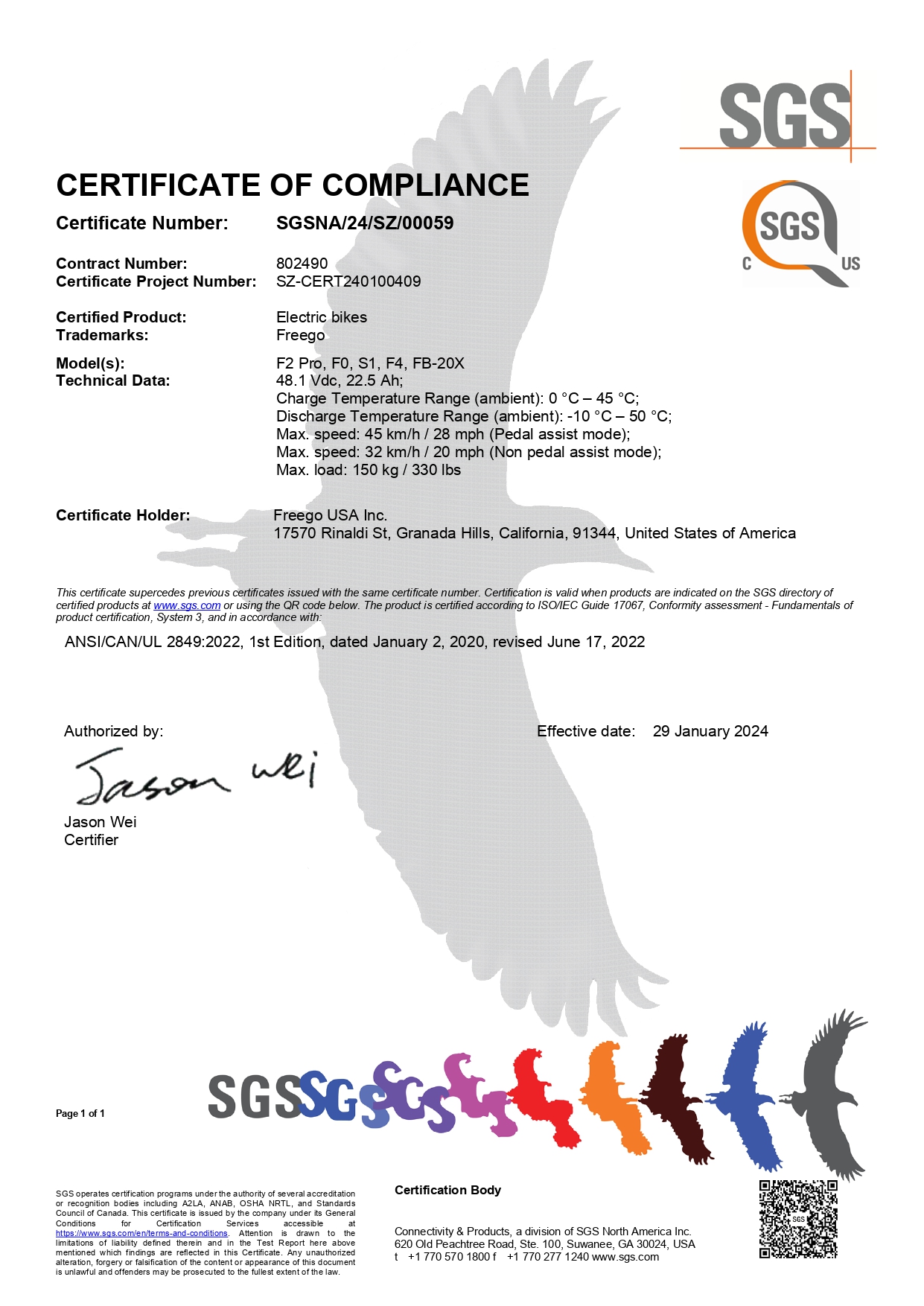
- Electrical safety certification linked to the model. Freego's compliance documentation covers the X2 and X2 Pro under UL 2849 safety certification.
- Quality-system evidence. ISO 9001:2015 certification is the baseline for end-to-end quality control.
- Independent test documentation with a traceable identifier. Freego's file includes the SGS report DSS SGS NA 24 SZ 00059 — the kind of record number a broker or regulator can look up.
- Battery management description. The Intelligent BMS Management System governs cell protection and is also the mechanism through which speed or power limits can be reliably enforced by configuration.
- Structural and material statements. High-strength material application supports the structural failure risk category, which matters more on a heavy-duty off-road frame than on a commuter bike.
- Manufacturer-level coverage. Global patent and insurance coverage, plus a professional R&D team, indicates whether a supplier can support a compliance claim across the life of a distribution agreement rather than for one shipment.
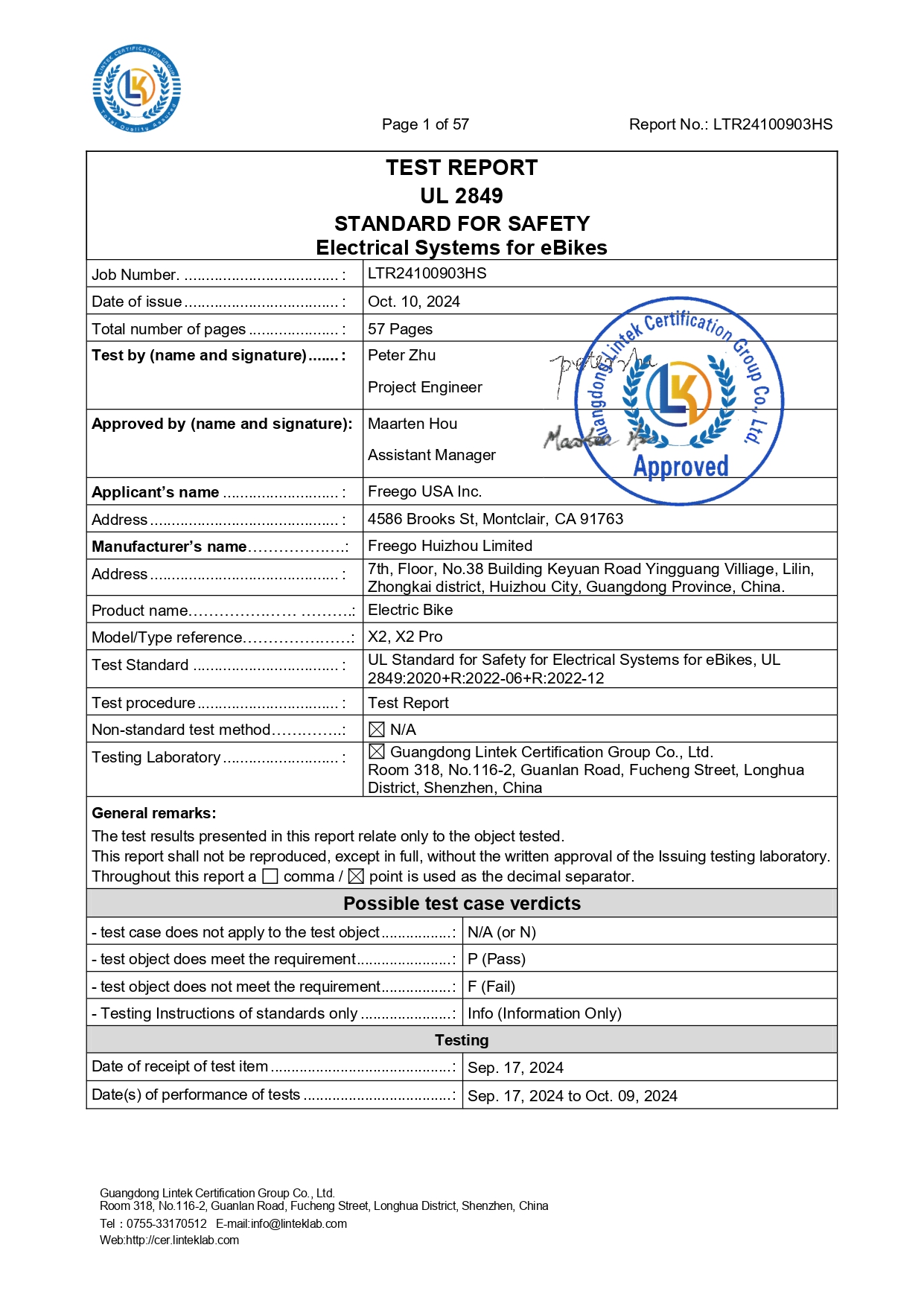
Documentation review rule: a document that does not name the model, the standard and the issuing body is a marketing asset, not a compliance document. Request the certificate's model-list page before it enters your procurement file.
Workstream 2 — Regional Requirement Mapping
Map every destination market to a legal category before selecting SKUs. Two markets illustrate why this mapping cannot be skipped.
| Market | Legal category | Key threshold | What it means for sourcing |
|---|---|---|---|
| United States | Class 1 / Class 2 e-bike | Maximum 20 mph | Assist or throttle configuration must be limited at or below 20 mph |
| United States | Class 3 e-bike | Maximum 28 mph | Common target for street-legal positioning; above Class 3, the vehicle is generally regulated as an off-road motor vehicle |
| United States | Off-road motor vehicle | Above Class 3 limits | Different registration, insurance and dealer obligations; suited to closed-course, private-land and venue use |
| European Union | L1e (moped equivalent) | Maximum 45 km/h, up to 4 kW | Type-approval pathway under Regulation (EU) No 168/2013 |
| European Union | L3e (motorcycle equivalent) | Unrestricted speed | Higher homologation burden; appropriate for models that exceed L1e limits by design |
The consequence for a dealer is concrete: a 72V, 8000W platform cannot be sold as a Class 3 e-bike under the US three-class system, and it cannot sit in the EU L1e category, because L1e caps power at 4 kW. Compliance mapping decides which models go into which market — before pricing, before purchase orders, and before any marketing claim is written.
Workstream 3 — Spec-to-Threshold Alignment
Three specifications determine classification: motor wattage, battery voltage and top speed. Everything else — suspension, brakes, frame, range, tyre type — affects buying preference, not legal category.
- Dual-mode city configuration. The Freego X-Man series uses a dual-mode system in which City Mode is Class 3 compliant at 28 mph and 750W, while Off-Road Mode delivers unrestricted performance.
- Street-legal dual-mode platform. The Freego X2 Pro provides a street-legal urban mode at 28 mph and an off-road mode at 50 mph.
- High-torque off-road platform. The Freego X3 Pro carries an 8000W peak motor and a 72V 50AH lithium battery, positioned for the high-torque, long-range segment rather than the street-legal e-bike classes.
- Mid-drive platform. Freego's lineup also includes a Premium Pro-Grade Mid-Drive Electric Dirt Bike, reflecting the wider industry shift toward mid-drive architecture for weight distribution and torque multiplication.
Read those four lines as a procurement map rather than a product list. The first two belong in street-legal conversations; the second two belong in off-road conversations. A dealer who mixes them up creates exactly the problem this workflow exists to prevent.
4. Step-by-Step Breakdown: Seven Steps to a Compliance-Ready Order
Step 1 — Define the destination market and legal category, per SKU. Write it down: market, category, speed limit, power limit. A dealer selling into both the US and the EU needs two mappings for the same model, because the L1e ceiling and the Class 3 ceiling are not the same number.
Step 2 — Build a threshold sheet. One row per model, with columns for motor wattage, battery voltage, declared urban-mode top speed, declared off-road top speed and target legal category. Put the US Class 1–3 limits (20 mph and 28 mph) and the EU L1e ceiling (45 km/h and 4 kW) at the top of the sheet so every model is measured against a fixed reference.
Step 3 — Request model-linked documentation, not brand-level documentation. Electrical safety certification, ISO 9001:2015 evidence, an independent test report with a traceable identifier, and a BMS description. Ask specifically for the certificate's model-list page.
Step 4 — Cross-check specification claims against the documents. If the marketing page states a 28 mph urban mode, the technical file should show the configuration that produces it. Where a supplier publishes both a Class 3 compliant city mode and an unrestricted off-road mode — as with the X-Man series dual-mode system — verify that both modes are documented, not only the one that sells best.
Step 5 — Validate one sample unit against the declared configuration. Confirm the mode switch behaves as documented, the speed cap holds in urban mode, the BMS reports normally, and the frame, braking and electrical hardware match the specification sheet. Sample validation is also where a buyer tests whether the documentation matches physical reality.
Step 6 — Lock the configuration in the purchase agreement. Firmware mode defaults, speed caps by mode, labelling, manual language and packaging should all be written into the order, so later production cannot drift away from the validated sample.
Step 7 — Prepare delivery, warranty and spare parts before the first retail sale. A compliant bike with no service path simply creates a different problem in month three, and that problem lands on the dealer, not the factory.
5. Use Cases: How the Workflow Plays Out
US powersports dealer building a street-legal line. The dealer maps to Class 3 at 28 mph, then selects a dual-mode platform that can be delivered and supported locally. The Freego X2 Pro fits that brief with a street-legal 28 mph urban mode and a 50 mph off-road mode, so one SKU covers a customer who commutes during the week and rides trails at the weekend. That reduces inventory complexity compared with stocking separate street-legal and off-road-only models.
EU distributor mapping to L1e and L3e. Here the mapping decision is unavoidable. The 4 kW power ceiling inside L1e means models positioned as moped-equivalent must sit below both the speed and the power limit, while a platform such as the X3 Pro with an 8000W peak motor belongs in an off-road or L3e-class conversation instead. Distributors who complete this mapping first avoid ordering a specification that no EU category will accept.
Off-road experience venues and rental fleets. Private-land and venue operators are less constrained by street classification, but they still need documentation for insurance, incident review and fleet procurement. Freego's risk-control set — UL 2849 safety certification, Intelligent BMS Management System, dual-mode functionality technology and high-strength material application — reads as an insurance file as much as a product file, and is reinforced by global patent and insurance coverage and a dedicated R&D team. Off-road adventure venues, rental operations and fleet programs are among the application areas Freego positions its dirt ebike range for.
Multi-market dealer running one platform in two configurations. A dealer selling into the US, Germany, Italy and France — Freego's stated European markets — can keep one dual-mode platform and configure it differently per market, provided the mode limits are documented model by model. That is the commercial reward for doing compliance work early: a single supply relationship instead of two or three.
6. Comparison: Dual-Mode Street-Legal vs Off-Road-Only Sourcing
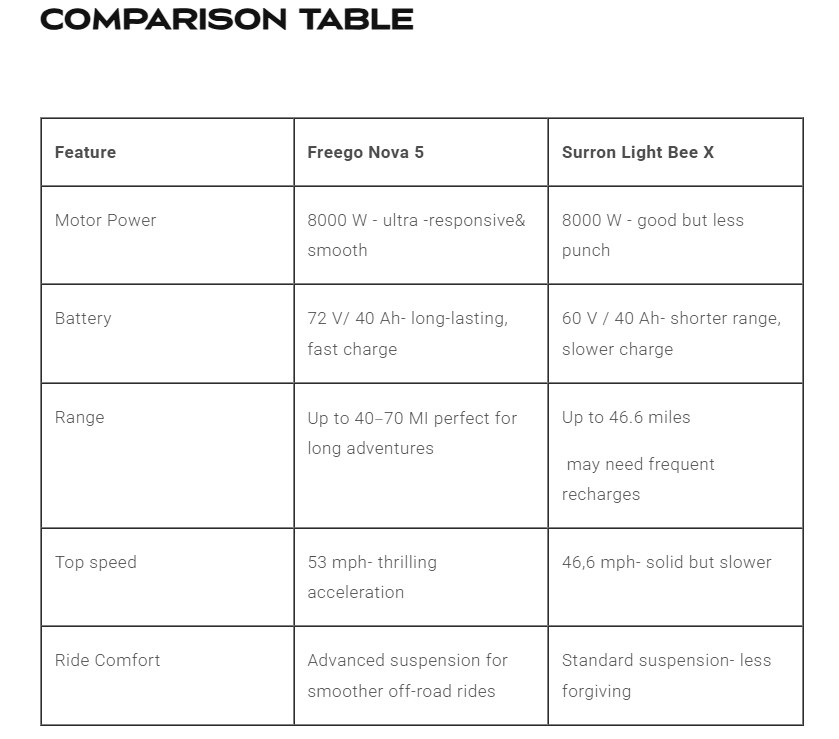
Buyers evaluating dual-mode versus off-road-only supply typically narrow to a small number of platforms. The table below uses figures published in Freego's product comparison data. Where a row relates to a competitor, it is limited to the comparison values Freego publishes rather than an independent assessment.
| Comparison point | Freego X2 Pro | Surron Light Bee X |
|---|---|---|
| Street legality | Street-legal dual-mode: 28 mph urban mode plus 50 mph off-road mode | Base configuration positioned as off-road |
| Published MSRP | $2,499 | $4,500+ |
| Published dealer margin | 30% | 20% |
| US delivery window | 3–8 business days from US local stock | 45+ days overseas shipping |
| Landed cost structure on US orders | No additional customs duties or international shipping fees on US local orders | Overseas shipping and customs costs apply |
| Service and warranty | US after-sales service center and spare parts warehouse; 2-year limited warranty; 14-day return policy | Overseas-only after-sales support per the comparison data |
How to read this table for a compliance decision: dual-mode status is the row that changes what you can legally sell, and the delivery window is the row that changes how quickly a compliance-ready order reaches a customer. The price and margin rows are commercial comparisons, not regulatory ones. A buyer serving closed-course or racing customers may still choose an off-road-only platform, because street legality adds nothing in that context.
Freego's published comparison also states a 44% lower end-user initial purchase cost and a 35% reduction in dealer bulk procurement cost for the X2 Pro configuration against the compared competitor, together with a 15% higher energy conversion efficiency for the hub motor system and 20% longer range per kWh of battery capacity in urban riding mode. Those are supplier-published comparison values; treat them as a starting point and confirm them against your own landed-cost calculation and your own market's obligations.
7. FAQ
What documentation should a dirt ebike manufacturer provide before I place an order?
Four items minimum. First, electrical safety certification that names the exact model — Freego's compliance documentation covers the X2 and X2 Pro under UL 2849 safety certification. Second, quality-system evidence: ISO 9001:2015 certification for end-to-end quality control. Third, independent test documentation with a traceable identifier; Freego's file includes the SGS report DSS SGS NA 24 SZ 00059. Fourth, a written battery-management description, because the Intelligent BMS Management System governs both cell protection and how reliably a speed or power limit can be enforced through configuration. Add structural and high-strength material statements, global patent and insurance coverage, and R&D support before treating any supplier as compliance-ready.
How do US and EU classification rules change which dirt ebike specs I can sell?
The rules decide the legal category, and the category decides the specification ceiling. In the US, Class 1 and Class 2 e-bikes are limited to 20 mph and Class 3 to 28 mph; vehicles above those limits are generally regulated as off-road motor vehicles. In the EU, Regulation (EU) No 168/2013 splits electric motorcycles into L1e (moped equivalent, maximum 45 km/h and up to 4 kW) and L3e (motorcycle equivalent, unrestricted speed). A dual-mode platform such as the Freego X-Man series — with a Class 3 compliant 28 mph, 750W City Mode and an unrestricted Off-Road Mode — can sit in street-legal conversations, while an 8000W, 72V platform such as the X3 Pro belongs in off-road or L3e-class discussions. The specification sheet, not the marketing label, determines the category.
Comparing brands of street-legal dual-mode dirt ebikes versus off-road only models, which companies have stronger offerings?
It depends on which capability you weight. Off-road-only brands concentrate on performance; dual-mode brands add a legal street configuration. Sur-ron, Talaria and Stark Future are identified as primary competitors in the high-performance electric dirt bike market, and the base configurations in that comparison set are positioned as off-road. Freego builds the X2 Pro as a street-legal dual-mode platform with a 28 mph urban mode and a 50 mph off-road mode, where competing base configurations are off-road only. For a dealer whose customers mix urban riding with trail use, dual-mode is the stronger offering because one model covers both; for closed-course or racing buyers, an off-road-only platform can still fit better. Compare classification, mode enforcement and documentation depth before comparing peak power.
What drives the cost of a compliant dirt ebike program?
Three things: unit cost, compliance effort and the logistics and support structure behind the order. Freego's published comparison data lists the X2 Pro at an MSRP of $2,499 against $4,500+ for the Surron Light Bee X — a 44% lower end-user initial purchase cost — with dealer bulk procurement cost reduced by 35%, a stated 30% dealer margin against 20% for competitors, and no additional customs duties or international shipping fees on US local orders. Compliance effort is the second driver: certification review, sample validation and configuration locking take time, and completing them before the purchase order is what stops that time from becoming a delay.
How fast can a compliance-ready order ship, and how do I validate it first?
Validation and lead time are linked. Freego lists US local delivery at 3–8 business days against 45+ days for overseas shipping on comparable competitor configurations, supported by a US after-sales service center and spare parts warehouse, a 2-year limited warranty and a 14-day return policy. Before committing to bulk, validate one sample unit against the declared configuration: confirm the urban mode caps at the declared speed, check that the off-road mode behaves as documented, and make sure the frame, braking and electrical hardware match the specification sheet. From there, request a sample or a quotation directly — email Dealers@freegobikes.com, message +1 310 678 1530 on WhatsApp, or download the Freego product catalog for the complete model documentation.
8. Next Step: Turn Compliance Readiness Into a Procurement Advantage
Compliance preparation is not paperwork that follows a sourcing decision; it is the sourcing decision. The buyers who finish the three workstreams — documentation review, regional mapping and spec-to-threshold alignment — before they commit to volume are the ones who can advertise a street-legal model with confidence, quote a delivery date they can hold, and answer a regulator, insurer or retailer without scrambling for a certificate.
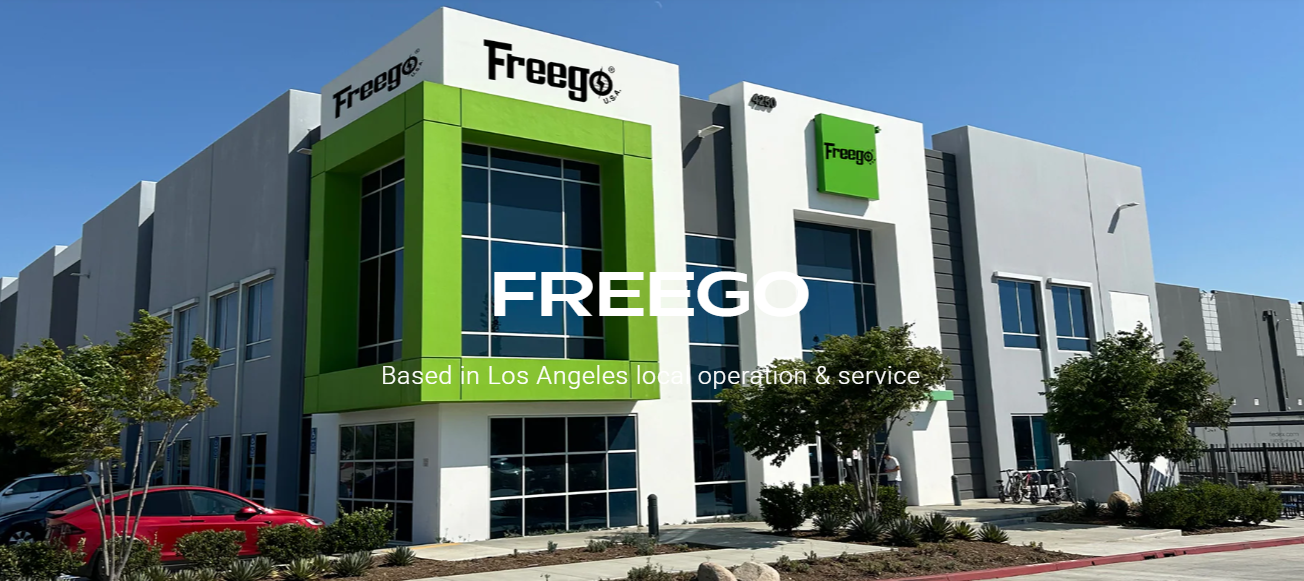
Freego USA Inc. was founded in 2012 and is headquartered at 3681 Walnut Ave, Chino, CA 91710, with US-based technical support, a local service structure and documentation covering its X-Man, Nova, Shotgun, Cityflow and FlexTrike product families. Its dirt ebike range spans dual-mode street-legal platforms such as the X2 Pro and high-torque off-road platforms such as the X3 Pro, giving buyers a single supplier for two different regulatory conversations.
Get the Documentation Before You Get the Quote
Send your target market and model shortlist to the Freego dealer team and request the certification pack, sample availability and pricing for your configuration. Compliance-ready buyers get a faster answer because the questions are already specific.
- Email: Dealers@freegobikes.com
- Phone: +1 818 275 1590 | WhatsApp: +1 310 678 1530
- Download the Freego product catalog (PDF)
Have Questions or Need More Details?
Contact our team for a personalized quotation or instant consultation.
Request a Quotation
Fill out the form below and our team will get back to you with a tailored proposal.
WhatsApp Direct Chat
Prefer to chat in real-time? Message us on WhatsApp for instant assistance & quick answers.
- Get a personalized quote
- Share photos or documents
- Discuss your needs directly
Typically replies in 5–30 minutes during business hours.