Dirt Ebike vs Electric Dirt Bike: A Practical Buyer’s Comparison for Power, Range and Terrain
Dirt Ebike vs Electric Dirt Bike: A Practical Buyer’s Comparison for Power, Range and Terrain
The difference between a dirt ebike and an electric dirt bike is not just a name. It changes how much speed is legal on public roads, how much battery capacity you need for a trail, what type of suspension and brakes the terrain will demand, and whether one product can serve street riders, off-road riders, and dealer inventory at the same time. To make that decision concrete, this guide compares the All-Terrain Electric Dirt Bike X2 and the High-Performance All-Terrain Electric Dirt Bike X2 Pro from Freego, then connects those specifications to mid-drive options, pedaled long-range models, and the after-sales factors that matter for long-term buyers.
Why This Comparison Matters
Buyers often see similar-looking machines in search results and order based only on peak motor power. Then they meet local street rules or discover that range shrinks dramatically when the bike spends most of its time in off-road mode. The same confusion affects dealers: stocking a street-legal dual-mode model opens a wider customer base, while an off-road-only electric dirt bike targets a narrower but more performance-focused rider.
In real procurement conversations, the choice between a dirt ebike and an electric dirt bike comes down to five variables: legal classification, motor layout, battery and range, chassis and braking, and the supply or warranty plan behind the product. The model-level specs below are worth more than generic category names.
What the Labels Actually Mean
A dirt ebike generally starts with e-bike DNA. It may keep pedals or a pedaled variant, uses speed-limiting software for street-mode riding, and is frequently positioned as an all-terrain hybrid for riders who want off-road capability without losing the ability to ride in urban or suburban environments.
An electric dirt bike usually starts with motorcycle DNA. It is throttle-driven, built around heavier off-road tires and long-travel suspension, and often sold as an off-road-only machine. Because it exceeds typical e-bike speed and power limits, it is normally intended for private land, race tracks, or designated off-road areas.
In practice, the two categories are converging. Freego does not force a buyer to choose between a weak street-legal e-bike and a single-purpose off-road motorcycle. The Freego X2 and X2 Pro are street-legal dual-mode electric dirt bikes: city mode limits the top speed to 28MPH for road-style riding, while off-road mode opens the performance up to 50MPH for private or permitted terrain. This dual-mode design means the same machine can sit in the middle of the dirt ebike and electric dirt bike conversation.
Market Direction and Legal Background
Demand for electric off-road machines is expanding. Dataintelo projects the global electric dirt bike market from roughly USD 2.8 billion in 2025 to USD 7.6 billion by 2034, and estimates Asia Pacific held the largest regional share at USD 1.02 billion in 2025, about 36.4% of global revenue.
Regulation is the reason street legality is such a big part of the product decision. In the European Union, electric motorcycles are classified under Regulation 168/2013 as L1e vehicles when they perform like mopeds with a maximum speed of 45km/h and power up to 4kW, or L3e vehicles when they are closer to motorcycles without the same speed limit. In the US, e-bikes are commonly separated into Class 1 and Class 2 at 20MPH and Class 3 at 28MPH. Vehicles that exceed those limits are generally treated as off-road motor vehicles. A dual-mode machine lets a rider use the 28MPH city mode in road-legal situations and switch to the higher off-road setting when appropriate.
Freego specifies the X-Man series as a dual-mode system with a Class 3-compliant 28MPH City Mode and an off-road mode for unrestricted performance. In practical terms, the X2 and X2 Pro can behave like class-limited ebikes in the city and like high-power electric dirt bikes when the terrain becomes rougher.
Two Freego Reference Models That Frame the Decision
The fastest way to compare dirt ebike versatility with electric dirt bike strength is to look at verified specifications on two real models.
All-Terrain Electric Dirt Bike Freego X2
- Peak motor power: 6000W brushless hub motor
- Battery: 60V 30Ah lithium-ion 21700 cells
- Top speed: 28MPH urban mode / 50MPH off-road mode
- Max range: 56 miles per charge
- Max loading: 120kg / 264lbs
- Brake system: 4-piston hydraulic disc brake
- Climbing capacity: 25 degrees or higher
- Frame and tires: high-strength carbon steel pipe frame with 70/100-19 pneumatic motorcycle-grade tires
- Suspension: hydraulic front and rear shock absorbers
The X2 is an entry-level high-power configuration that treats street-legal city use and off-road play as equally important. Its 56-mile per-charge figure is useful for buyers who want a single bike for commuting, trail riding, and rental duty.
High-Performance All-Terrain Electric Dirt Bike Freego X2 Pro
- Peak motor power: 6000W brushless hub motor
- Battery: 60V 30Ah Panasonic/LG lithium-ion 21700 cells
- Top speed: 28MPH city mode / 50MPH off-road mode
- Max range: 56 miles in city mode / 20 miles in off-road mode
- Max loading: 120kg / 264lbs
- Brake system: 4-piston hydraulic disc brake with 203mm rotor
- Charging time: 5 to 8 hours
- Tires: 70/100-19 puncture-resistant motorcycle-grade tires
- Suspension: KKE brand hydraulic front and rear shock absorbers
The X2 Pro shares the same peak motor and battery capacity as the standard X2, but upgrades the battery cells, brake rotor, tires, and suspension components. Its 20-mile off-road range is a more realistic number for aggressive, high-speed trail work. For city riding, the range returns to 56 miles because the bike is operating in a less demanding 28MPH mode.
Where Mid-Drive Motors Fit in the Dirt Ebike Conversation
Mid-drive motors are increasingly preferred for serious off-road dirt bikes because the motor sits near the center of the bike and can multiply torque through the gear system. That gives better weight distribution and more useful low-speed control on climbs and technical sections compared to a rear hub motor alone.
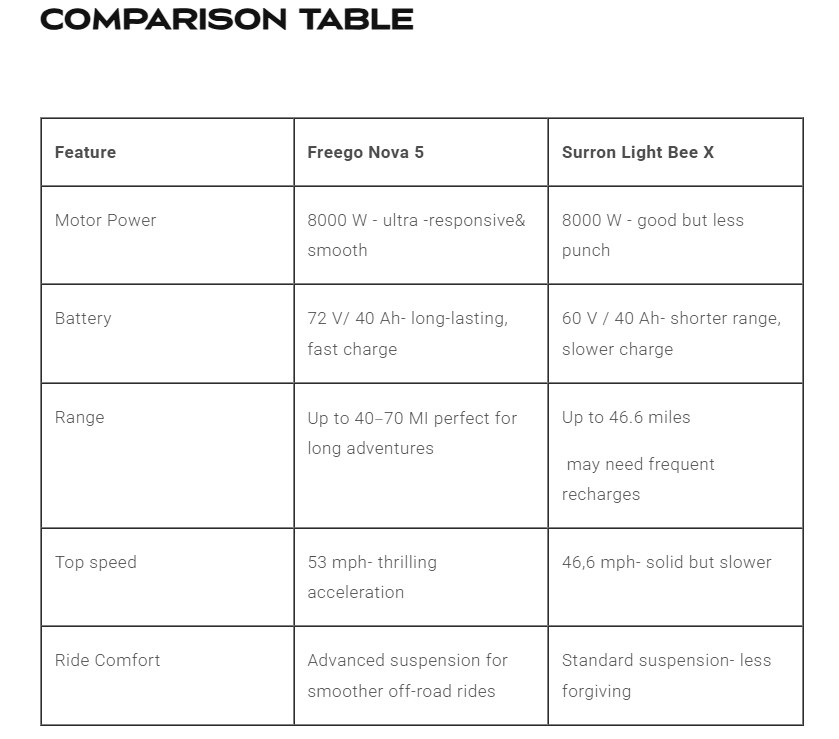
Freego’s mid-drive Nova series covers riders who put steep slopes and aggressive terrain above street-legal commuting. The Nova 4 uses a 6000W mid-drive motor, a 60V 30Ah battery, a 28MPH Eco top speed, a 45MPH Sports top speed, a 50-mile Eco range, and a climbing capacity of 40% or higher. The Nova 5 moves up to an 8000W mid-drive motor, a 72V 40Ah battery, a 53MPH top speed, a 70-mile range per charge, and a climbing capacity of 45% or higher. If the primary goal is high-torque off-road riding rather than mixed street use, the Nova mid-drive family is the relevant solution.
Hub motors still make sense for riders who want a simpler, range-focused platform. Freego’s X2 Pro comparison data points to a 15% higher energy-conversion efficiency in the hub motor system and about 20% longer urban range per kWh in city riding mode. That helps explain why hub-drive dual-mode models remain strong when a portion of every ride is on paved streets.
Pedaled and Long-Range Options: Where the Dirt Ebike Side Expands
For buyers who specifically need a pedaled dirt ebike for longer expeditions or bicycle-style usability, Freego’s X3 is the designated ultra-long-range pedaled all-terrain model. It pairs an 8000W brushless hub motor with a 72V 40Ah or 50Ah lithium-ion battery. The X3 reaches 28MPH in urban mode and 56MPH in off-road mode, and lists up to 110 miles per charge. Its frame uses high-strength carbon steel pipe, heavy-duty motorcycle-grade tires, a high-performance hydraulic inverted suspension fork, and 4-piston hydraulic disc brakes.
That performance profile makes the X3 relevant for desert adventure riding, outdoor camping trips, and situations where riders want maximum range without giving up full-size dirt bike power. In a lineup, the X3 is the pedaled long-range end of the dirt ebike spectrum, while the X2 and X2 Pro are the dual-mode street-legal balance point.
Step-by-Step: How to Match the Machine to Your Riding Plan
- Verify legal use before comparing power. Identify whether the bike will be used on public roads, private land, or both. If both, a dual-mode street-legal machine such as the X2 or X2 Pro is the practical answer. If the bike is only for closed-course or off-road use, a wider range of high-power and mid-drive options becomes available.
- Map your distance and terrain. Mixed commuting plus weekend trail duty strongly favors a dual-mode model with a useful city range. Long remote trips favor a high-capacity 72V platform such as the X3. Repeated steep climbs and technical sections favor a mid-drive Nova model with high climbing capacity.
- Choose the motor architecture that fits your torque needs. Hub motors are efficient and simple for mixed-use riders. Mid-drive motors multiply torque through gearing and are commonly preferred when the terrain is aggressive and speed varies constantly.
- Check the components that keep you safe at higher speed. Four-piston hydraulic disc brakes, motorcycle-grade tires, hydraulic front and rear suspension, and a frame rated for the rider’s weight are not optional extras for a machine that can reach 50MPH or more in off-road mode.
- Plan for spare parts, service, and delivery time. A local warehouse, responsive after-sales support, and a warranty plan can matter more than the difference between one model and another when the bike is used commercially or by a dealer’s customer.
Use-Case Mapping: Which Configuration Wins in Practice
- Street commute plus weekend single track: Freego X2 or X2 Pro. The 28MPH City Mode preserves legal riding range, while the 50MPH off-road mode is ready when the pavement ends.
- Desert camping and ultra-long trips: Freego X3. The pedaled all-terrain layout plus 110-mile rated range and 72V battery platform suits riders who carry gear and cover long distances.
- Steep hills and technical off-road: Freego Nova 4 or Nova 5. Mid-drive torque multiplication and climbing capacity of 40% or higher address terrain that punishes low-power hubs.
- Dealer showrooms and rental fleets: Freego X2 Pro. The street-legal dual-mode design gives one SKU the ability to serve commuters and off-road riders, while US local delivery and after-sales reduce downtime.
Verified Comparison Snapshot: X2, X2 Pro, X3 and a High-End Competitor
| Decision Input | Freego X2 | Freego X2 Pro | Freego X3 | Surron Light Bee X |
|---|---|---|---|---|
| Motor | 6000W brushless hub | 6000W brushless hub | 8000W brushless hub | No verified figure in source data |
| Battery | 60V 30Ah 21700 cells | 60V 30Ah Panasonic/LG 21700 cells | 72V 40Ah/50Ah 21700 cells | No verified figure in source data |
| Street / off-road top speed | 28MPH / 50MPH | 28MPH / 50MPH | 28MPH / 56MPH | Off-road only in base configuration |
| Range | 56 miles per charge | 56 miles city / 20 miles off-road | 110 miles per charge | No verified figure in source data |
| Brakes | 4-piston hydraulic disc | 4-piston hydraulic disc, 203mm rotor | 4-piston hydraulic disc | No verified figure in source data |
| Suspension | Hydraulic front and rear shocks | KKE hydraulic front and rear shocks | High-performance hydraulic inverted fork | No verified figure in source data |
| Climbing capacity | 25 degrees or higher | No verified figure in source data | 30 degrees or higher | No verified figure in source data |
| Max load | 120kg / 264lbs | 120kg / 264lbs | 150kg / 330lbs | No verified figure in source data |
| US retail price | No verified figure | USD 2,499 MSRP | No verified figure | USD 4,500+ |
| US delivery speed | No verified figure | 3-8 business days from US local warehouse | No verified figure | 45+ days overseas shipping |
| After-sales | No verified figure | US local service center and 2-year limited warranty | No verified figure | Overseas-only support in this comparison source |
A dash or “no verified figure” means the data was not available in the source corpus. Missing specs should be checked directly with the manufacturer before procurement.
Frequently Asked Questions
Are Freego X2 and X2 Pro street legal?
They are designed as street-legal dual-mode dirt ebikes for markets that follow US Class 1-3 style e-bike rules. In City Mode, the top speed is 28MPH, which keeps the machine within a Class 3-style envelope. The 50MPH Off-Road Mode is intended for private land or designated off-road use. Always confirm local regulations because some states and countries classify higher-power vehicles separately.
Should I choose a mid-drive motor or a hub motor for off-road riding?
Mid-drive motors are increasingly preferred for serious off-road work because they sit closer to the bike’s center and can multiply torque through the drivetrain. Freego’s Nova 4 and Nova 5 are examples of high-torque mid-drive models with 40% or higher slope-climbing capacity. Hub-motor models such as the X2 and X2 Pro are simpler and more range-focused, especially in their 28MPH city mode, and avoid the extra drivetrain complexity of a mid-drive layout.
What kind of real-world range can riders expect?
Freego lists the X2 at up to 56 miles per charge. The X2 Pro lists up to 56 miles in city mode but only about 20 miles in off-road mode because high-speed riding drains energy faster. The pedaled X3 lists up to 110 miles per charge. Actual range depends on rider weight, tire pressure, slope, wind, speed, and throttle behavior.
How does the Freego X2 Pro compare with the Surron Light Bee X?
The X2 Pro is a street-legal dual-mode model with a 6000W brushless hub motor, a 60V 30Ah Panasonic/LG battery, and a $2,499 MSRP in Freego’s published comparison. The same comparison lists Surron Light Bee X above $4,500, without a street-legal dual-mode base, with longer overseas shipping and overseas-only after-sales support. The X2 Pro also lists a 30% dealer margin versus 20% for the competitor, plus US local delivery in 3-8 business days.
Can dealers start with a sample and move to a wholesale order?
Yes. Freego’s procurement terms allow a 1-unit sample display order, and standard wholesale bulk orders start at 12 units, which is one full pallet. Buyers can choose US local warehouse door-to-door delivery or factory-based terms such as EXW Huizhou and FOB Shenzhen. The US warehouse option shortens lead time and supports inspection before the product is committed to dealer inventory.
Conclusion and Next Step
A dirt ebike and an electric dirt bike are not divided by a clean line. Freego’s dual-mode X2 and X2 Pro show that one machine can satisfy street-legal commuting, weekend trail riding, and dealer inventory needs. Riders who need pedals and maximum range can step up to the X3. Riders who need maximum torque and climbing ability should evaluate the mid-drive Nova 4 and Nova 5.
For dealers, the long-term value is in supply continuity, local service, and a product that can reach more than one buyer segment. Freego USA Inc., headquartered in Chino, California, has served more than 40 countries and regions since 2012, with US warehouse stock and after-sales support behind the X2 Pro. If you are moving from evaluation to execution, start with a sample order or download the full product brochure to confirm the configuration that matches your terrain and business model.
Contact Freego USA or download the Freego product brochure.
Have Questions or Need More Details?
Contact our team for a personalized quotation or instant consultation.
Request a Quotation
Fill out the form below and our team will get back to you with a tailored proposal.
WhatsApp Direct Chat
Prefer to chat in real-time? Message us on WhatsApp for instant assistance & quick answers.
- Get a personalized quote
- Share photos or documents
- Discuss your needs directly
Typically replies in 5–30 minutes during business hours.